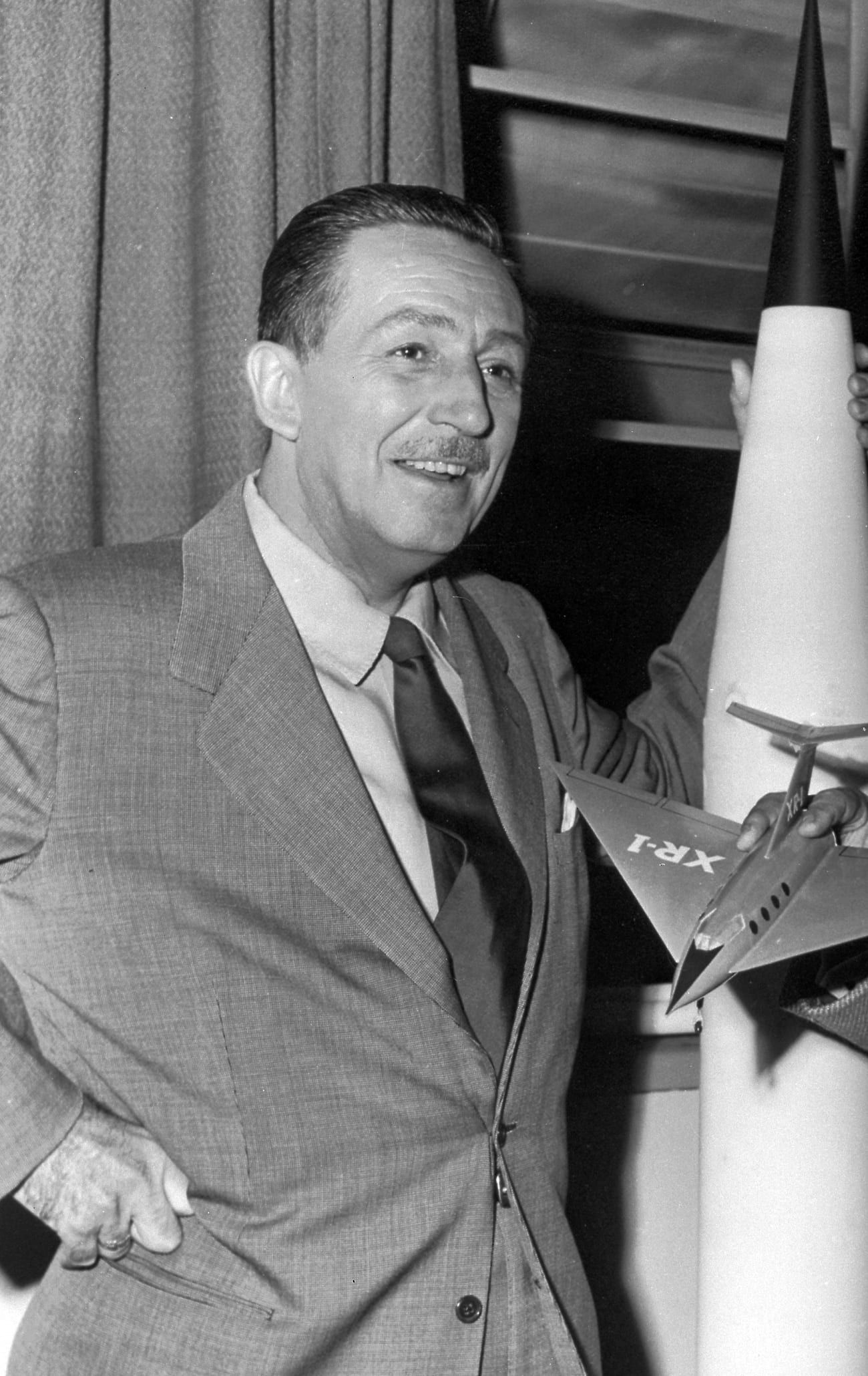
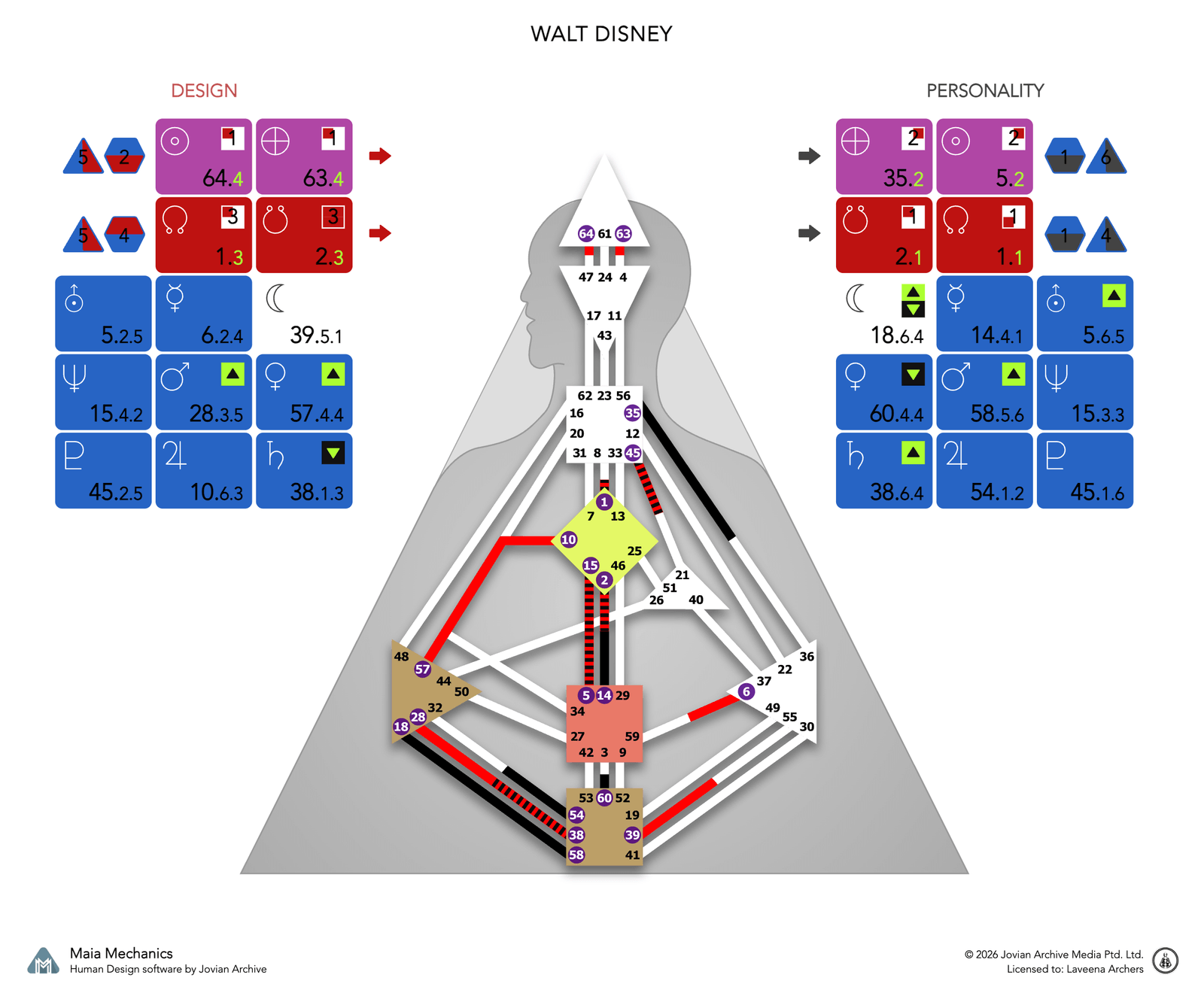
Chart calculated with Maia Mechanics, from an A-rated birth record
Quick look: Walt Disney was a Generator with Sacral Authority, Single Definition, and a Heart center carrying no activation at all, the open mechanic this system ties to willpower, self-worth, and the pressure to promise and prove. His own circuitry never needed a partner to complete it. What it lacked was any fixed, reliable engine for the material side of running a company, which is a specific and checkable gap, not a personality trait. For four decades that gap had a name: his older brother Roy O. Disney, who ran the studio’s finances while Walt ran everything else. The one time that arrangement broke down, in 1952, Walt did not wait for Roy to come around. He mortgaged his own life insurance policy and sold his second home to fund Disneyland himself. Reading his chart’s open center against that decision is a more precise account of the partnership than “creative genius, business-minded brother” ever was.
The chart: a Single Definition Generator with an open center at its core
Disney was born December 5, 1901, at 12:35 a.m. Central Standard Time in Chicago, birth data quoted by astrologer Marion March from Disney studio records, an A-rated source, one of the more solid ratings this field uses. A full sweep of the birth day confirms his Type, Authority, and Definition hold constant from midnight straight through, and his 2/4 Profile is stable well past the recorded minute, so every layer of what follows is stated as settled, not estimated.
He carries Sacral Authority: a body that answers yes or no to what shows up in front of it, correctly, in the moment, without needing to think its way there first. His Definition is Single, one continuous circuit running G Center to Sacral to Spleen to Root through five channels: 15-5 (Rhythm), 2-14 (The Beat), 10-57 (Perfected Form), 28-38 (Struggle), and 18-58 (Judgment). A Single Definition chart is self-contained. It does not need another person’s design to complete its own sense of things the way a Split Definition chart does, and Buffett’s chart, covered elsewhere on this site, is the clearer example of that need. Disney’s core engine ran on its own.
What it did not carry was any activation at all in five of the body graph’s nine centers: Head, Ajna, Throat, Heart (Will), and Solar Plexus. Two of those, Ajna and the Heart center, carry no gate activation whatsoever, the cleanest kind of open a center gets. The other three carry hanging, unconnected gates: gate 6 (Friction) in Solar Plexus, and gates 35 (Change) and 45 (The Gatherer) in Throat. Those last two matter for a specific reason: his Incarnation Cross runs through all four of Personality Sun, Personality Earth, Design Sun, and Design Earth, and three of those four land in open territory. The Personality Sun sits at gate 5, Fixed Rhythms, the one anchor of the cross that falls inside his defined Sacral. The Personality Earth sits at gate 35, Change, hanging in the open Throat. The Design Sun sits at gate 64, Confusion, and the Design Earth at gate 63, Doubt, both hanging in a completely open Head. Half his own life’s-work cross runs through a center with no fixed way of resolving pressure, which fits a man whose story process was, by every account, relentlessly external: pitched, argued over, and pressure-tested in story meetings rather than settled alone at a desk.
His 2/4 Profile is what I teach as the Hermit-Opportunist combination. The second-line half needs real, private groundwork before stepping forward; the fourth-line half runs almost entirely on a network of familiars, the specific people who already know, like, and trust him, and it is that network, not the open market, that keeps bringing him opportunity. Disney’s own working life tracked the second half closely: the people who mattered to his business across five decades were an unusually small, fixed circle, his brother, Ub Iwerks, the animators who stayed for thirty years, and later the “Nine Old Men” who became the core of the studio’s whole animation department. A 2/4 does not build a wide public network. It builds a narrow, deep one, and then works that one for the rest of its life.
Sacral authority and the bet that nearly broke the studio
Sacral Authority does not deliberate. It responds, correctly, to what is directly in front of it, and then it follows through on that response with a consistency that looks, from the outside, like stubbornness. Snow White and the Seven Dwarfs is the clearest documented test of that mechanic in Disney’s career. The original budget was roughly $250,000. Costs climbed to $1,488,422.74, close to six times over, at a moment when no studio had ever released a feature-length animated film and Hollywood was calling the project “Disney’s Folly” before it had even opened. Partway through production Disney needed an additional $250,000 loan to finish it. He screened a rough cut for Bank of America’s Joseph Rosenberg, who watched in silence and then told him, “Walt, that thing is going to make a hatful of money,” and approved the loan. The film premiered at the Carthay Circle Theatre on December 21, 1937.
What is notable mechanically is not that Disney took a risk. Founders take risks constantly. It is that a Generator with Sacral Authority, once it has said yes to something, does not re-litigate that yes as the cost climbs. Disney did not scale the ambition down as the budget blew past its original mark; he kept adding the multiplane camera work, the Technicolor process, the full orchestral score that made the picture as expensive as it became. That is what a correct Sacral response looks like under real pressure: not caution, not a hedge, but a body that already said yes and stayed said. The mockery and the budget overrun were real. So was the fact that the film, once it opened, became the highest-grossing film of its era. Sacral Authority does not promise that outcome. It only explains why Disney never seriously entertained the alternative of stopping.
The Fighter in the Root, and the brother who filled what he left open
Disney’s natal Saturn sits at gate 38, line 6, The Fighter, one of the two Root center gates that anchor his Struggle channel. I teach gate 38 as the fuel to struggle for a meaningful existence, an adrenalized drive that is not really about combat for its own sake. It is about finding “an individual alliance, to fight by your side,” and about needing, specifically, someone in your corner when business itself is a risk. That mechanic has an origin story in Disney’s own career that predates everything else covered here. In February 1928, Charles Mintz revealed that he had quietly signed nearly all of Disney’s own animators to new contracts and would produce the Oswald the Lucky Rabbit series without him unless Disney accepted a 20 percent budget cut. Disney refused, walked away from the character he had built, and lost most of his staff to Mintz in the process. What came out of that loss, with Ub Iwerks as the one animator who stayed, was Mickey Mouse, debuting in Steamboat Willie on November 18, 1928. The fight Disney is on record describing, the fight the gate names directly, produced the character the entire company would be built on.
The brother who fought beside him longest was Roy O. Disney, older by eight years, who had put up early capital for the Disney Brothers Cartoon Studio in 1923, the entity the company’s own history record traces from a rented office in Hollywood through to the corporation that exists today, and functioned as its chief financial and administrative officer in substance from the start, formally sharing the chairman’s title with Walt from 1945 on. For over four decades, while Walt built characters, films, and eventually a theme park, Roy raised capital, negotiated distribution deals, and kept the company solvent, including personally overseeing the studio during Walt’s 1931 breakdown and directly mediating the 1941 animators’ strike alongside a federal mediator. That division of labor is usually told as a story about temperament: the creative brother and the business brother. The chart makes it more specific than that.
What the open Heart center explains about Roy O. Disney
Single Definition, as covered above, does not need an outside bridge the way Split Definition does. Disney’s core circuit ran complete on its own, which means the Roy partnership cannot be explained by his chart needing another person’s design to close a gap in his own information processing. What the chart does show is a Heart center, also called the Will center, carrying no gate activation of any kind, the cleanest form of open that center gets. I teach the Heart center as the seat of the material way, the place in the body graph where willpower, self-worth, and the pressure to promise and prove all sit. It is, in a very literal sense, the center at the center of the stream of capitalism. When it is open, there is no fixed, dependable relationship to any of that. A person with this configuration can go either way on the same question in two different years, not from inconsistency of character but because the function genuinely has no built-in setting.
For most of Disney’s working life, that gap ran through Roy. Roy negotiated the loans, signed the deals, and made the promises the studio needed to keep. That is a documented, decades-long arrangement, not a one-time favor. But the mechanic also predicts what happens when the usual channel is unavailable, and Disney’s career supplies exactly that test. In the early 1950s, Disney wanted to build a theme park. Roy, along with the rest of the Walt Disney Productions board, opposed it outright; by Disney’s own account Roy thought he had “taken leave of his senses.” With the partnership’s normal willpower channel closed to him, Disney did not simply give up the idea, nor did he produce some fixed, confident counter-argument the way a defined Heart center might. He went outside the company structure entirely. He formed WED Enterprises as his own private company, financed with money borrowed against his own life insurance policy and the sale of his newly bought second home, putting his family’s own financial security on the line to do it. That is not the behavior of a stable, built-in willpower engine overriding a partner’s caution. It is the behavior of an open center with nothing fixed to fall back on, reaching for the largest personal lever available once the reliable one had stopped answering.
Four returns, checked against the record
A natal chart is a starting point. Certain planets return to the exact degree they held at birth on a fixed, calculable schedule, and Disney lived long enough, sixty-five years, to pass through every one of the major ones: two Saturn Returns, a Uranus Opposition, and a Chiron Return. Each date and its cycle chart below are Maia Mechanics’ own output, not an independent estimate. Dates are given in UT.
Saturn Return (30’s): January 9, 1931
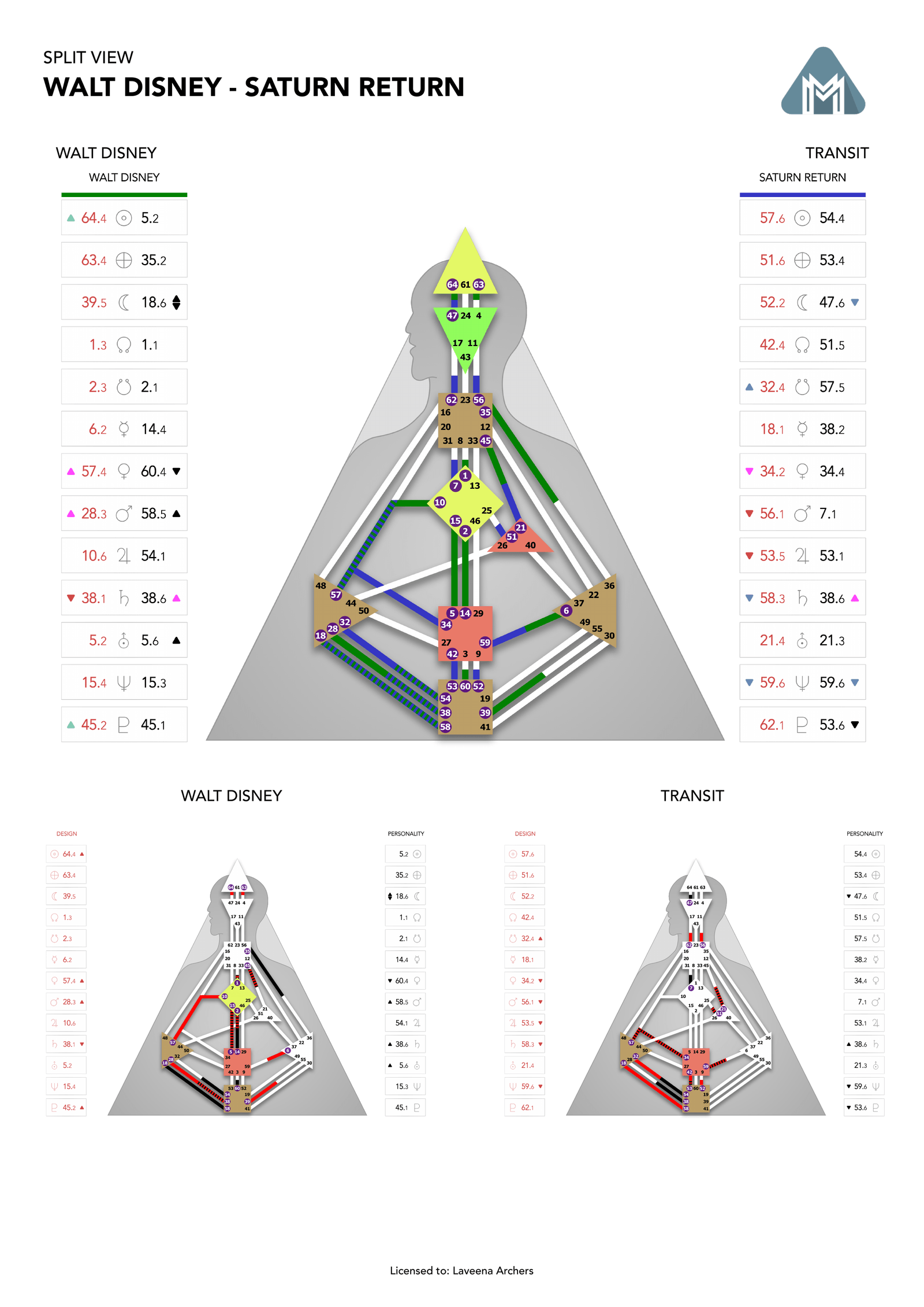 Design and Personality on the left, the 9 January 1931 Saturn Return transit overlaid on the right.
Transiting Saturn returned to Disney’s natal gate 38.6 on January 9, 1931, three weeks after his 29th birthday. The chart for that date newly completes seven channels against his natal design — the cycle’s own Design and Personality sides both feed the comparison, the same way a birth chart does — and the two most legible are 45-21, Money, running between his open Throat and his open Heart center, and 34-57, Power, running between his own defined Sacral and Spleen. A Saturn Return is a structural accounting, the point where whatever has been built gets tested against reality. What was being tested in Disney’s business that winter was success itself. Walt Disney Enterprises, the merchandising arm formed in December 1929, had spent 1930 signing the George Borgfeldt & Company licensing deal and its first international license for Mickey Mouse handkerchiefs, and demand for the character was outrunning the studio’s capacity to produce cartoons fast enough to keep it fed. By Disney’s own account, later that year, the strain broke him. “Each picture we made cost more than we figured it would earn,” he wrote. “First we began to panic. Then I cracked up. I couldn’t sleep. I reached the point when I couldn’t even talk over the telephone without crying.” His doctor ordered a complete rest. Disney and his wife Lillian took a months-long recovery trip, down the Mississippi, through Washington, to Key West and Cuba, back through the Panama Canal, and the studio Disney returned to had been run the entire time by Roy.
Uranus Opposition (40’s): August 1945 – May 1946
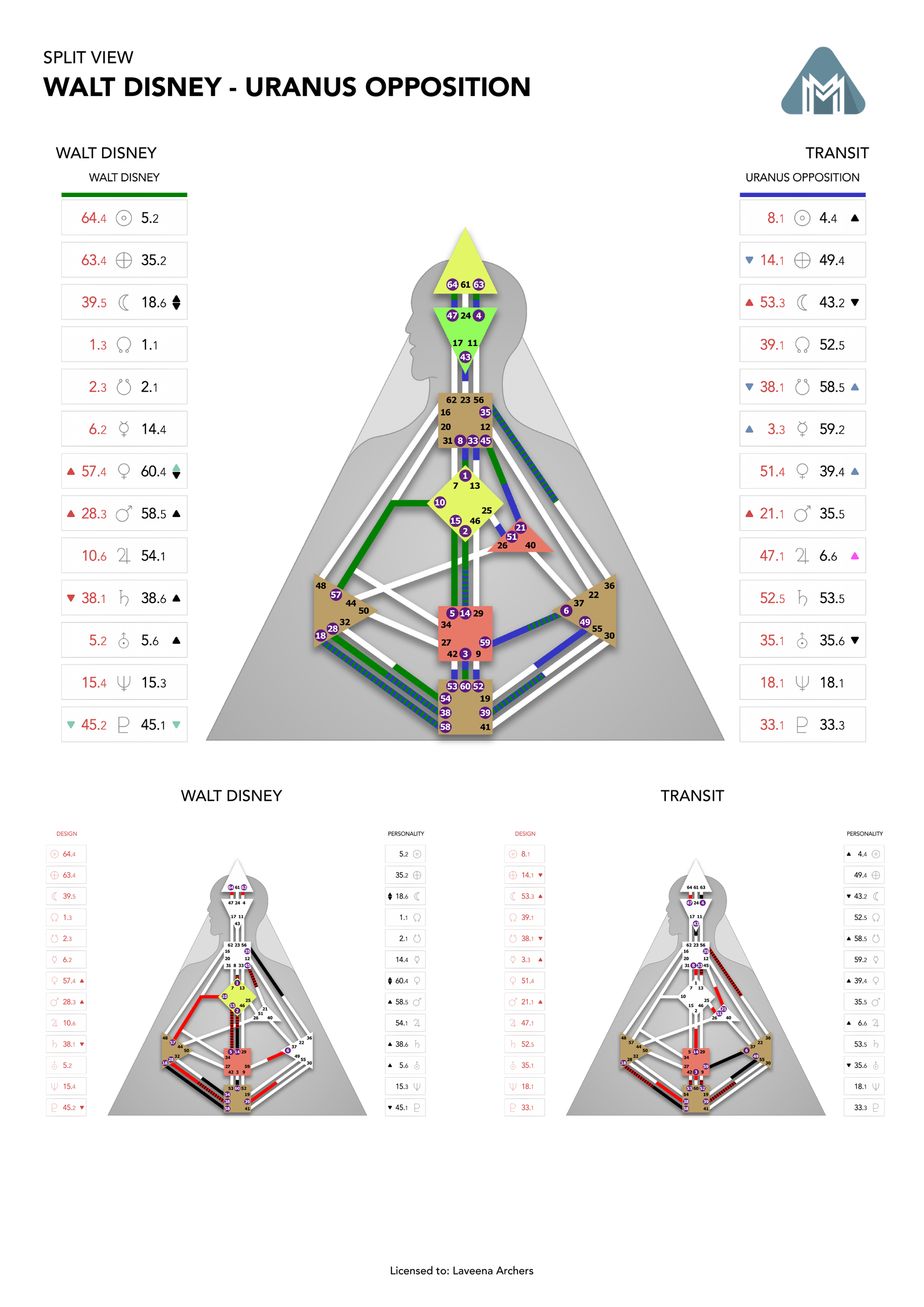 Design and Personality on the left, the 15 August 1945 Uranus Opposition transit overlaid on the right.
Transiting Uranus first opposed Disney’s natal Uranus on August 15, 1945, at his own gate 35.6, Change, the same hanging Throat gate that carries half his Incarnation Cross. That date is V-J Day: Japan’s surrender was announced in Washington on August 14, 1945, which by time zone was already August 15 in Japan and in Universal Time. A Uranus Opposition is a break from an established pattern, the moment a structure gets pushed toward something it was never built to hold, and the pattern breaking that week was as literal as it gets in this piece. Since 1942, over 90 percent of Disney’s staff had been producing training and propaganda films under contract to the U.S. government, including 32 shorts commissioned by the Treasury Department and animation work for Frank Capra’s Army film series. That relationship, and the revenue and structure that came with it, ended with the war itself in August 1945. Uranus crossed the same opposition point twice more, on November 1, 1945, and May 27, 1946, the retrograde passes typical of an outer planet’s return, and the studio spent that entire window rebuilding a commercial release slate almost from scratch after years of government work. Make Mine Music, assembled from unrelated musical segments because the studio had no finished feature story ready to go, became the first Disney film released after the war, in April 1946, right inside that same window.
Chiron Return (50’s): December 27, 1951
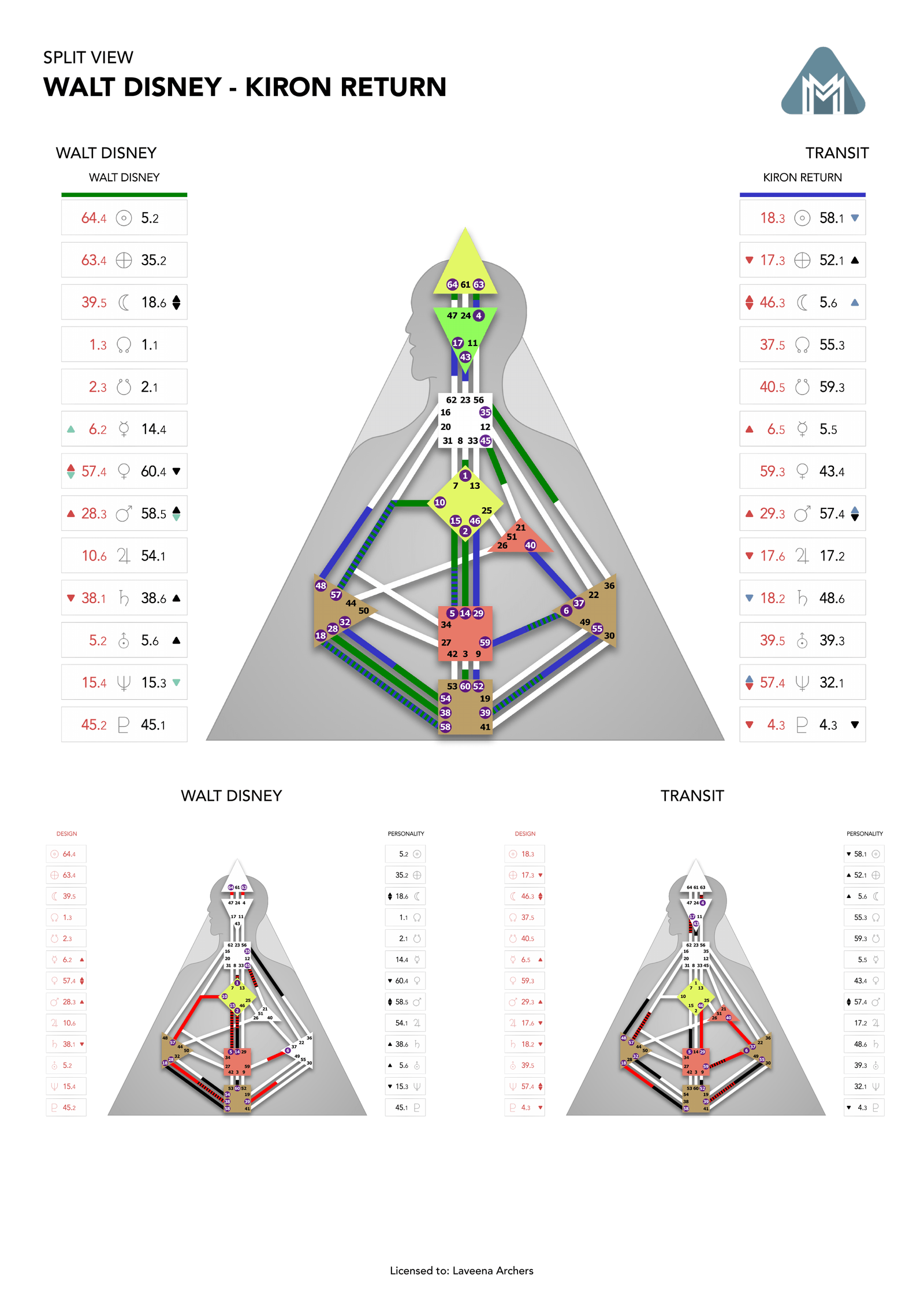 Design and Personality on the left, the 27 December 1951 Chiron Return transit overlaid on the right.
Transiting Chiron returned to Disney’s natal gate 58.1, Vitality, in the defined Root center, on December 27, 1951, six days after his 50th birthday. The chart for that date newly completes 32-54, Transformation, a channel running between his own defined Spleen and Root, built entirely out of centers already native to his own circuitry rather than borrowed from anywhere else. A Chiron Return is the wound turned into medicine, and Disney’s own record supplies a specific one. Roy and the rest of the Walt Disney Productions board had already made clear they would not finance a theme park. Eleven and a half months after this exact date, on December 16, 1952, Disney formed WED Enterprises as his own private company, funded with money borrowed against his life insurance policy and the proceeds of selling his second home, to develop what would become Disneyland outside the studio’s normal financing structure entirely. The wound was a defined Root and Spleen with a genuine drive to build something new, sitting next to an open Heart center with no partner willing to co-sign it. What Chiron’s return produced was Disney converting that exact gap into the company that would eventually design and build the park, financed on his own signature because no one else’s would do.
Second Saturn Return (60’s): 1960
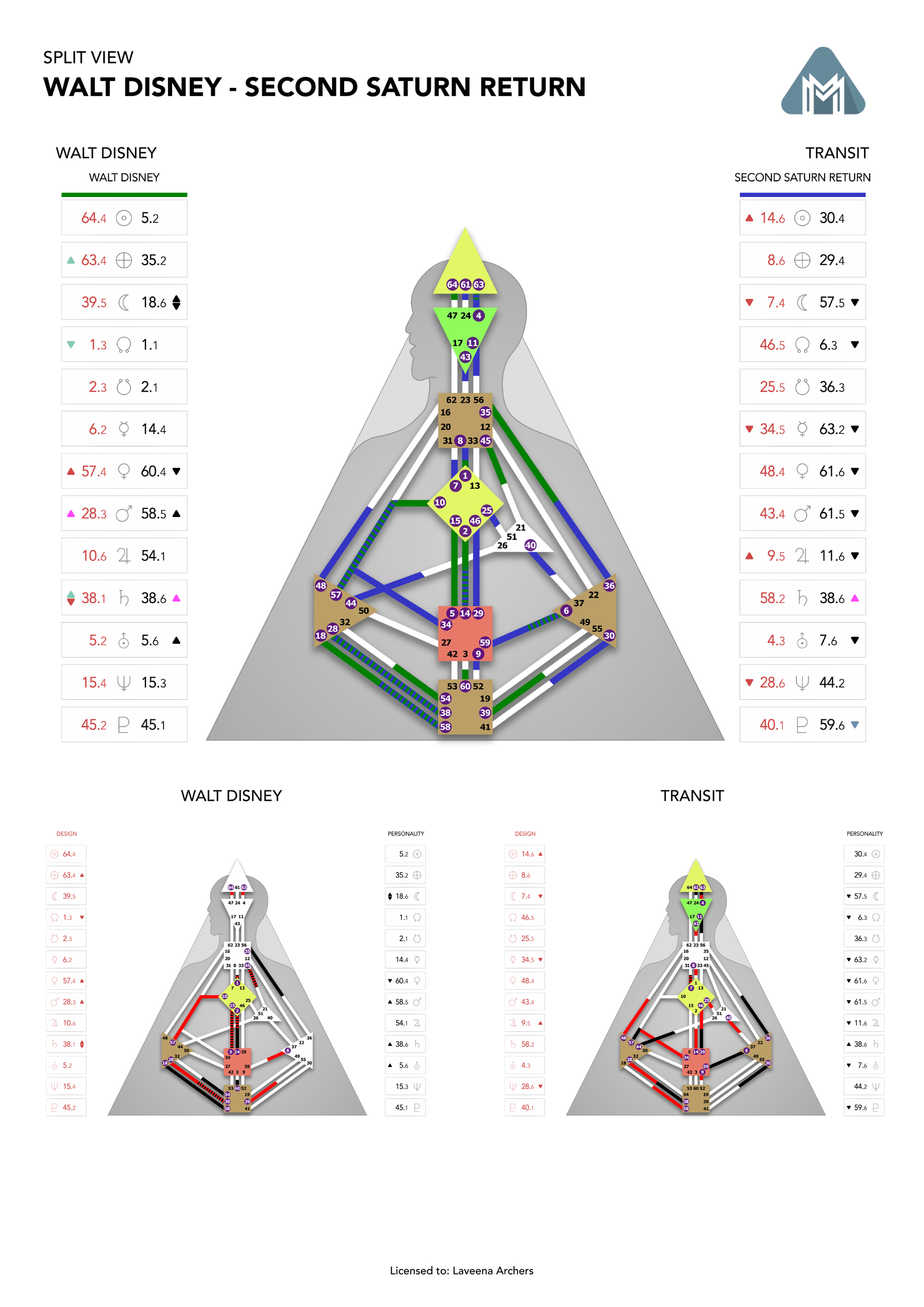 Design and Personality on the left, the 17 February 1960 Saturn Return transit overlaid on the right.
Saturn’s orbit runs roughly twenty-nine and a half years, so it returns to its natal degree a second time late in a long life. Disney’s fell across three passes in 1960, at age 58: February 17, July 13, and November 15, each landing back on his own gate 38.6. The first of those, February 17, newly completes 35-36, Transitoriness, running between his open Throat and open Solar Plexus. The following day, February 18, 1960, the Winter Olympics opened at Squaw Valley, California, with Disney serving as chairman of the Games’ Pageantry Committee, a role the organizing committee had asked him to take in 1958 and that put him in charge of the opening and closing ceremonies, the torch relay, and the venue’s presentation from the ground up. Transitoriness is the correct word for it mechanically as well as literally: this was a single, non-recurring commitment to a production Disney did not own and would never repeat, staged the day after his second structural reckoning and never folded into the studio’s ongoing slate at all.
The department he anchored, and the one he never tried to run
Group size is its own mechanic in Human Design for Business, and at OC16 scale, ten to sixteen people or more working physically together on a regular basis, I teach six organizing channels, each anchoring a department: Management (45-21), Competitiveness (51-25), Direction (2-14), Logical Enforcement (50-27), Interaction (59-6), and Innovation (anchored at gate 60). A full anchor pair is a field of potential to be recognized as that department’s head, never a guarantee, and it only activates inside a group that size, in person, which a studio with hundreds of animators working shoulder to shoulder for decades genuinely was.
Disney fully defines exactly one of those six: Direction, gate 2 paired with gate 14, the same channel that also runs through his own core Sacral-to-G-Center circuit. He carries no full anchor for the other five, but the distribution of what he does carry is not random. He holds the single anchor gate for Innovation, gate 60, along with four of its power-base feeder gates (28, 38, 39, 57), the heaviest concentration in his chart outside Direction itself. He feeds Logical Enforcement with four power-base gates (15, 18, 58, 63) without the anchor pair itself, and feeds Interaction and Management with smaller clusters (64 and 35; 54, respectively). Management, the department whose own name is the closest thing this framework has to a Money department at group scale, is where the split becomes exact. Its anchor pair is 45-21, and Disney carries precisely one half of it: gate 45, the Gatherer, the Throat voice that says I have, activated twice over by both his Personality and his Design Pluto. Gate 21, the Hunter, the Heart-center half that actually controls a domain, is nowhere in his chart, because the Heart it would sit in carries nothing at all.
Read against the record, that is a precise match rather than a coincidence. A studio built around one man’s singular creative direction, feeding innovation constantly and enforcing exacting technical standards on everyone under him, while holding the announcing half of the money department and none of the controlling half, describes exactly the company Disney and Roy built together, and describes why the division of labor between them was never really in question.
Where the actual profit was: his open centers
Disney has four defined centers and five open ones. This site’s own model of profit potential argues that the real commercial edge tends to sit in the open centers rather than the defined ones, because an open center has no fixed way of operating. It takes in whatever is around it, runs every version of that pressure across a lifetime, and turns the exposure into a read nobody with a defined center in the same position ever develops.
Two of the five are covered above and need no repeating: the empty Heart that Roy filled for forty years, and the Head carrying gates 63 and 64 that half his Incarnation Cross runs through. The other three are worth reading commercially, because between them they describe the product.
Ajna, and it is completely empty. Not one Ajna gate is activated anywhere in his chart, which pairs with the Head above to leave his entire mental apparatus, pressure and conceptualization both, without a single fixed setting. There is no built-in way for this design to arrive at a settled view on its own. Set against the Head gates of Doubt and Confusion carrying half his life’s-work cross, it is the mechanical description of a man whose ideas had to be argued into existence in a room. The studio’s story-meeting culture, the storyboard itself as a Disney-associated working method, and the thirty-year animators who could push back on him are not incidental to the business. They are the missing center, staffed.
Throat, carrying gates 35 and 45. Gate 35, Change, sits without its partner 36; gate 45, the Gatherer, without 21. Both hang. An open Throat has no fixed register of its own and takes its voice from the setting, which is a strange thing to find in the most recognizable brand voice of the twentieth century until you notice that Disney’s public voice was never really his. It was a mouse, then a studio, then a television host persona, then a park. Gate 35 is the gate of change and of appetite for the next experience, and it carries his Personality Earth. Gate 45 is the voice that gathers and announces what it has, doubly activated and permanently unattached to any means of control. A man who could announce a domain compellingly and could not, mechanically, hold one is a man who needed a Roy, and who in 1952 went out and mortgaged his own life insurance the moment Roy stopped answering.
Solar Plexus, carrying gate 6 alone. Its partner 59 is absent, so Mating never closes. An open Solar Plexus generates no emotional wave of its own; it takes in whatever is in the room and amplifies it. Gate 6, Friction, is the mechanic of emotional distance and intimacy regulated, the gate that decides what gets let in. An entertainment business is, in the end, an apparatus for producing a specific emotional state in an audience on schedule, and the center doing that reading in Disney’s chart is the one with no fixed answer of its own. The 1931 collapse belongs in the same paragraph, told exactly as he told it and not diagnosed further: an open Solar Plexus running a company whose demand had outrun its capacity is a center absorbing an entire organization’s pressure with nothing internal to buffer it.
Four defined centers gave him the yes and the stamina to hold it. The five open ones gave him the studio’s working method, its voice, and its product.
Where this reading stops
None of this says Human Design explains why Snow White succeeded, or that Disney’s chart made Disneyland inevitable, or that Roy O. Disney’s own design worked as a mirror-image complement to Walt’s, which would require Roy’s own chart calculated and compared, a step this piece has not taken. What the chart offers is a mechanic: a Single Definition circuit that never needed a partner to complete it, next to a Heart center with nothing fixed in it at all. An unusually well-documented forty-year partnership, and an unusually well-documented moment when that partnership’s usual channel closed and Disney mortgaged his own name to keep going anyway, both sit inside one businessman’s public record, close enough to the predicted shape to lay out plainly rather than fold into the usual story about a creative genius and his practical brother.
Related
Curious what your own chart looks like? Get your own natal chart, Saturn Return, Uranus Opposition, and Chiron Return, rendered the same way, plus the full keynote PDF, for $37.
- Bill Gates, Human Design, and the Deal He Didn’t Have to Sell — another founder’s chart read against one specific, dated business decision
- Steve Jobs, Steve Wozniak, and the Human Design Behind Apple’s Founding Partnership — a different circuitry answer to the same question this piece asks about Disney and his brother
- Dolly Parton, Human Design, and the Business Built on a Single No — another Sacral Generator’s authority read against one documented, dated decision
Chart calculated with Maia Mechanics software, cross-checked against birth data on myBodyGraph.com. Birth data (5 December 1901, 12:35 a.m. Central Standard Time, Chicago, Illinois) and an “A” reliability rating, quoted by astrologer Marion March from Disney studio records, are recorded on Astro-Databank via Astrotheme. The Oswald the Lucky Rabbit and Mickey Mouse origin story, the Snow White production and Bank of America loan, the 1931 breakdown, the 1941 animators’ strike, the studio’s World War II government contract work, the 1960 Winter Olympics pageantry chairmanship, the WED Enterprises financing, and Roy O. Disney’s decades of financial leadership are all part of the extensively documented public record of Disney’s career, drawn from Disney company history, contemporary press, and Roy O. Disney’s own biographical record; exact dollar figures vary slightly by account and are presented here in general terms rather than as settled ledger entries.
I’ve spent more than thirty years as an entrepreneur and teach the career and business application of the Human Design System. I help business owners and entrepreneurs market themselves in a way that fits their design, lead their teams to greater efficiency and profitability, and find the work their chart was actually built for.