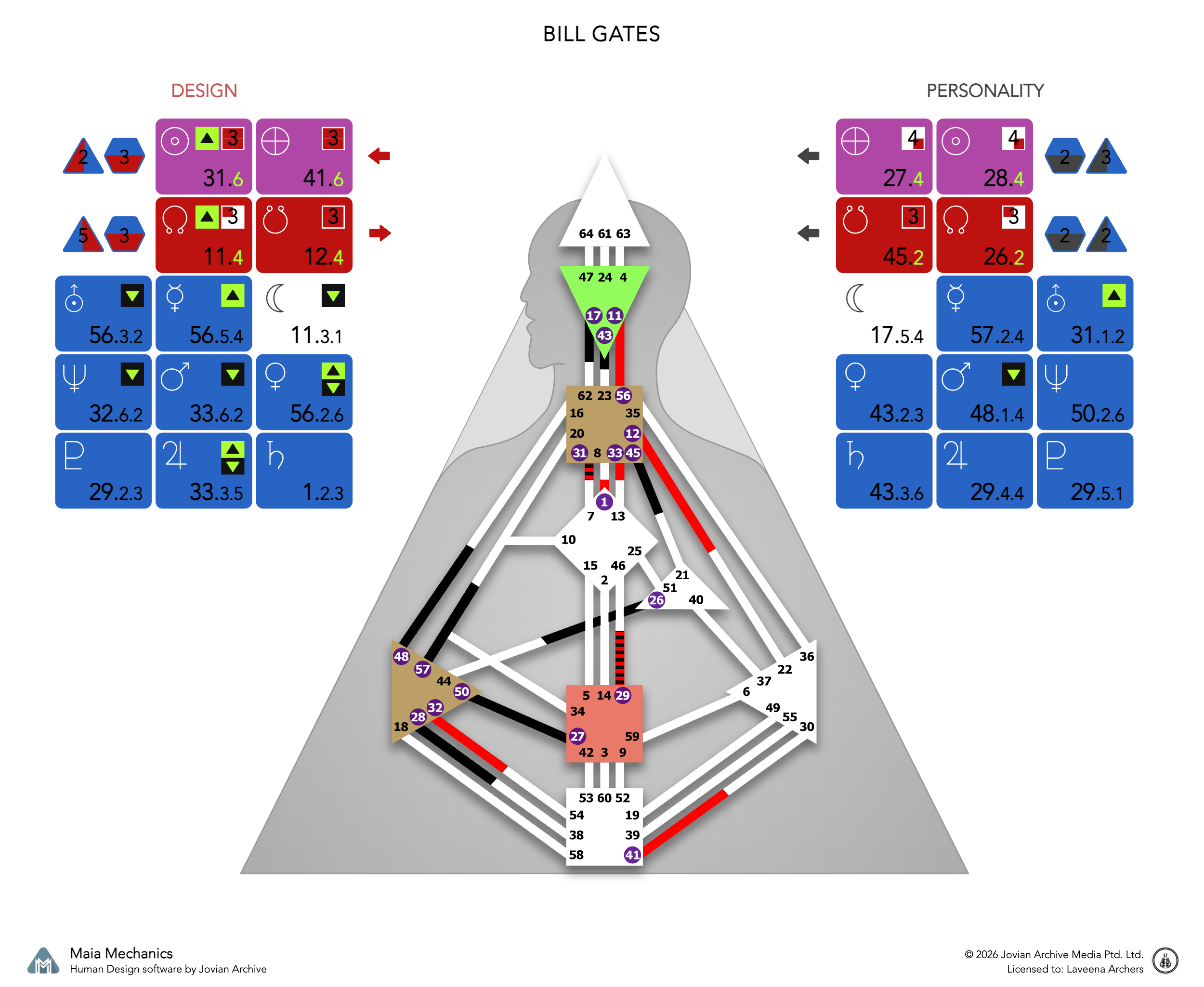
Chart calculated with Maia Mechanics, from an A-rated birth record
Quick look: Bill Gates is a Sacral-defined Generator with Sacral Authority, which means the correct decisions in his life were never going to arrive as a plan he initiated from a whiteboard. They arrive as a body-level yes or no to something already sitting in front of him. In the summer of 1980, IBM came to a 24-year-old Gates with a request, and what he did with it, license an operating system to them rather than sell it outright, is one of the most consequential business decisions of the twentieth century. Read against his design, it looks less like a masterstroke of foresight and more like a correct response, made in the room, to an offer somebody else brought him.
The offer IBM brought him
By 1980, IBM had decided to enter the personal computer market and needed an operating system fast. IBM representatives approached Gates and Microsoft, then a small software company, about supplying one. Microsoft didn’t have a finished operating system to offer at that first meeting; what it had was a working relationship with IBM already, from a BASIC programming language license, and Gates’s willingness to say yes to the broader ask. Microsoft went on to acquire the rights to an existing operating system, adapt it, and deliver what became PC-DOS for IBM’s machines and MS-DOS for everyone else.
The detail that made the decision durable wasn’t the acquisition itself. It was the licensing structure. Gates didn’t sell IBM the operating system outright. He licensed it, non-exclusively, which meant Microsoft kept the right to license MS-DOS to every other computer maker that wanted to compete with IBM’s PC. When the rest of the industry built IBM-compatible machines through the 1980s, nearly all of them needed MS-DOS too, and Microsoft was already positioned to supply it to every one of them.
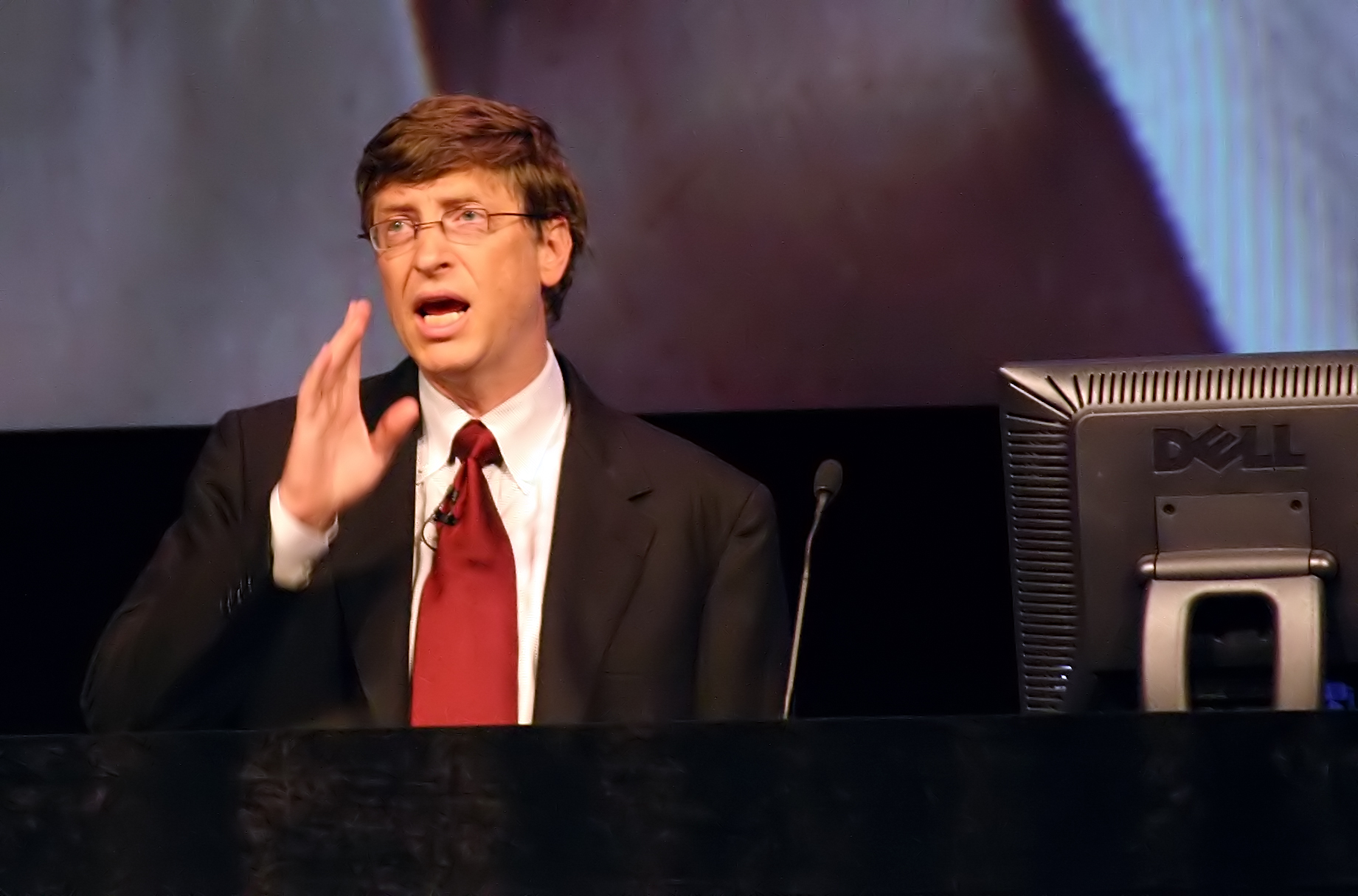 Bill Gates delivering a keynote at IT-Forum, Copenhagen, 16 November 2004, near the height of Windows’s market dominance. Photo by Kees de Vos, licensed CC BY-SA 2.0.
A response, not an initiation
A Generator’s strategy is to respond to what’s actually in front of it, not to originate from a strategy document. In one of my own teaching sessions on the types, I describe the not-self trap for a Generator as “waiting to respond rather than initiating and acting like pretending to be the manifestor.” The correct move, by contrast, runs through what I call the sacral’s “nonarticulate sounds,” a gut-level uh-huh or uh-uh available the instant something real is in front of you, not a decision arrived at by thinking ahead of the moment.
IBM’s approach to Microsoft in 1980 is about as clean a version of that setup as a business biography offers. Gates didn’t go looking for a chance to build an operating system for the world’s largest computer maker. IBM came to him. The Sacral, in my teaching, is where “being who you are for yourself is the most important thing,” which I frame as its own kind of “enlightened selfishness,” not a doctrine of passivity, but a refusal to manufacture motivation that isn’t actually there. What was there, by every account of that meeting, was an opportunity Microsoft could say a clean yes to. The record shows Gates moving fast once IBM was in the room: acquiring an operating system, adapting it, and delivering it on IBM’s schedule. That’s not hesitation. It’s a response, fully engaged, to something real.
The licensing term is where it gets interesting
Here’s where the decision goes beyond a simple “he said yes.” IBM wanted an operating system; what it didn’t especially care about, in 1980, was who else Microsoft was allowed to sell it to. Non-exclusive licensing wasn’t the obvious ask from IBM’s side, and it wasn’t a term IBM had to grant. It’s the piece of the deal most retellings treat as the whole story, and it’s worth being careful here: Gates was not the one who owned the underlying operating system Microsoft first licensed and adapted for IBM, and the exact sequence of who approached whom, and how much Gates foresaw the compatible-clone market that eventually made the non-exclusive term so valuable, is contested by different accounts. What’s well established is the outcome: Microsoft kept the right to license the software elsewhere, and that right became the foundation the rest of the company was built on through the 1980s and beyond.
Read through Sacral Authority, a gut response doesn’t require the person having it to have modeled every downstream consequence. It requires the response to be correct in the moment, whether or not the size of what it opens up is visible yet. Nothing about what follows from a sacral yes needs to be strategized in advance for the yes itself to be sound.
Split Definition and where Microsoft needed a bridge
Gates’s chart carries Split Definition, meaning the centers he has defined don’t all connect into one continuous shape. They form separate groups that need a bridge, either a transiting gate or another person’s chart, to connect. My teaching on split definition describes what a bridge supplies: “two islands of definition” completed by “the ideal partnership for the right partner to guide their energy.” Where the bridge is present, the gap closes and the whole system runs. Where it’s absent, I’m direct that the reflex is to misplace the disconnection onto blame, either blaming yourself or, in a wider gap, “so bitter about others… you blame them that you can’t have the experience,” when the more accurate read is that “it’s simply a mechanical truth that some people are not aligned to interact with.”
Microsoft’s early history is a business built on exactly that kind of bridging. Gates did not run the company as a solitary operation; Paul Allen co-founded it with him, and the leadership team Gates assembled through the 1980s, including longtime partner Steve Ballmer, supplied capacities Gates’s own chart doesn’t carry alone. None of that is a claim that any specific gate in Gates’s chart is bridged by any specific person’s chart; that level of comparison would need both charts calculated and compared directly, which is outside the scope of what’s established here. The more honest read is structural: a Split-definition Generator’s design is not built to run everything solo, and the well-documented fact of Microsoft as a partnership from its earliest days, rather than a one-man operation, is at least consistent with that mechanic.
A 4/6 Profile and a business built early, watched later
Gates’s 4/6 Profile carries a specific arc. My teaching on the 4/6 describes the years before roughly 30 as trial-and-error, “operating like a three, meaning trial and error,” run through close friendships and direct testing rather than settled conviction, and the years after as a shift I call moving “onto the roof phase,” with “a certain sense of stability.” The related sixth-line material describes the same turn in sharper language: a Saturn-return-era withdrawal I name directly as a hermit period, “the easiest way to be yourself is to be alone… the hermit underneath,” followed by a life spent being watched rather than tested, functioning as a “role model” who does “not initiate” but is instead observed and, eventually, called on.
Gates was 24 in 1980, squarely inside the trial-and-error window that teaching describes, testing an unproven company’s capacity through a fast, high-stakes response to a real offer rather than a settled long-range plan. The company he and Allen had started five years earlier was still small; the IBM deal was itself a test of what Microsoft could deliver, decided through relationship and immediate response rather than institutional caution. The later chapter of Gates’s public life, stepping back from Microsoft’s day-to-day operations starting in 2000 and then more fully in 2008 and 2020, and taking up a role through the Gates Foundation where he is watched and cited more than he personally executes, tracks with the same profile arc: early years spent in direct, hands-on trial-and-error, later years spent in a more distanced, observed, role-model position. That’s a loose correspondence, not a proof, but it’s the shape the profile predicts, and it’s the shape his own biography happens to follow.
Three returns, three moments already on record
A birth chart isn’t a fixed snapshot. Certain planets return to the exact degree they held at someone’s birth on a schedule that can be calculated decades in advance, and three of those returns, the Saturn Return, the Uranus Opposition, and the Chiron Return, mark the structural turning points of a life. Overlay the transit chart for that date on top of the natal chart underneath it, and Gates’s three line up with dated, documented moments in his own record closely enough to walk through one at a time.
Saturn Return: December 2, 1984
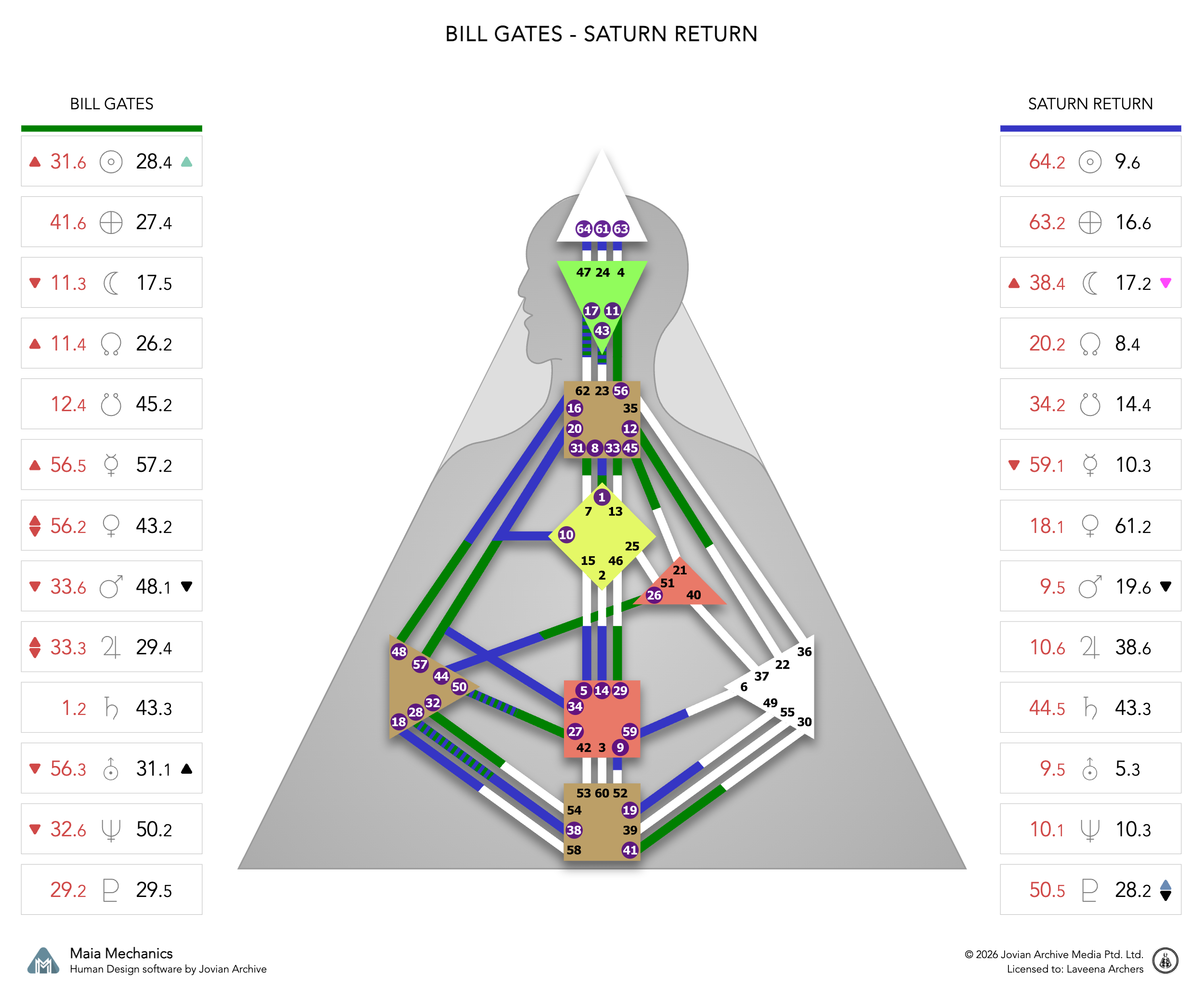 Bill Gates’s Saturn Return transit chart, age 29, via Maia Mechanics.
Gates’s Saturn Return fell on December 2, 1984, right as Microsoft’s original Windows announcement, made in November 1983 with a spring 1984 ship date, sat publicly and badly missed. By August 1984, Windows was already four months late with no release in sight, and it wouldn’t actually ship until November 1985, eighteen months behind schedule. InfoWorld’s Stewart Alsop handed Gates a mocking “Golden Vaporware” award for the delay, a designation that stuck to the product’s reputation for years. A Saturn Return is a structural accounting, the point where whatever’s been built gets tested against reality and found either solid or wanting. Gates’s fell during the exact stretch where Windows, the product that would eventually define Microsoft’s dominance, was publicly failing to be real.
Uranus Opposition: February 21, 1996
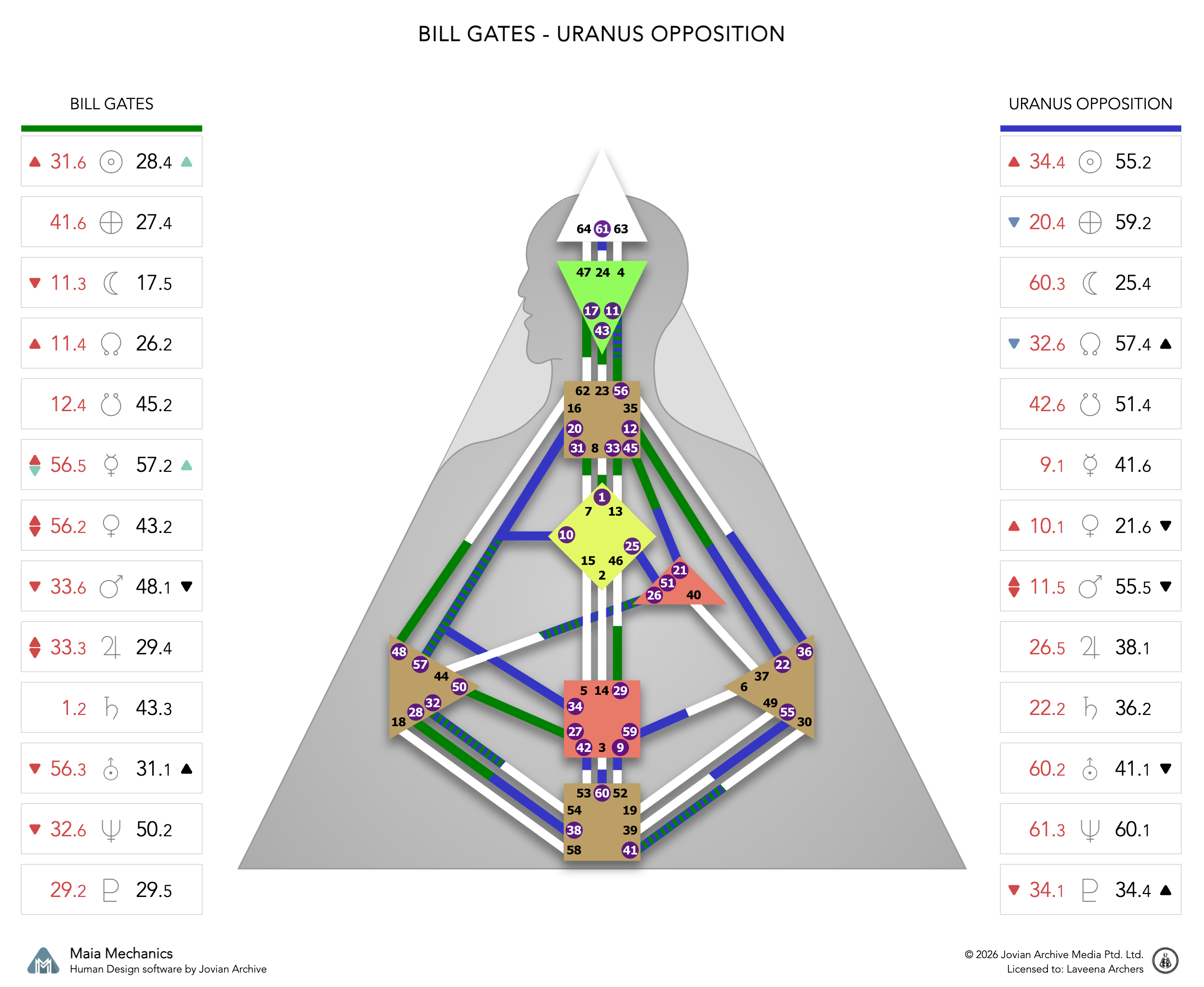 Bill Gates’s Uranus Opposition transit chart, age 40, via Maia Mechanics.
Gates’s Uranus Opposition fell on February 21, 1996, ten weeks after he and NBC’s Robert Wright announced, on December 14, 1995, that Microsoft and NBC would jointly build MSNBC, a cable news channel and an online news service, a $470 million commitment into an industry Microsoft had never operated in. A Uranus Opposition is a break from an established pattern, the point where the built structure gets pushed toward something it wasn’t previously built to hold. For Gates that period was the broader “Internet Tidal Wave” pivot he’d ordered across Microsoft the year before, and MSNBC was its most visible, least software-shaped bet: a technology company buying its way into broadcast television.
Chiron Return: February 26, 2005
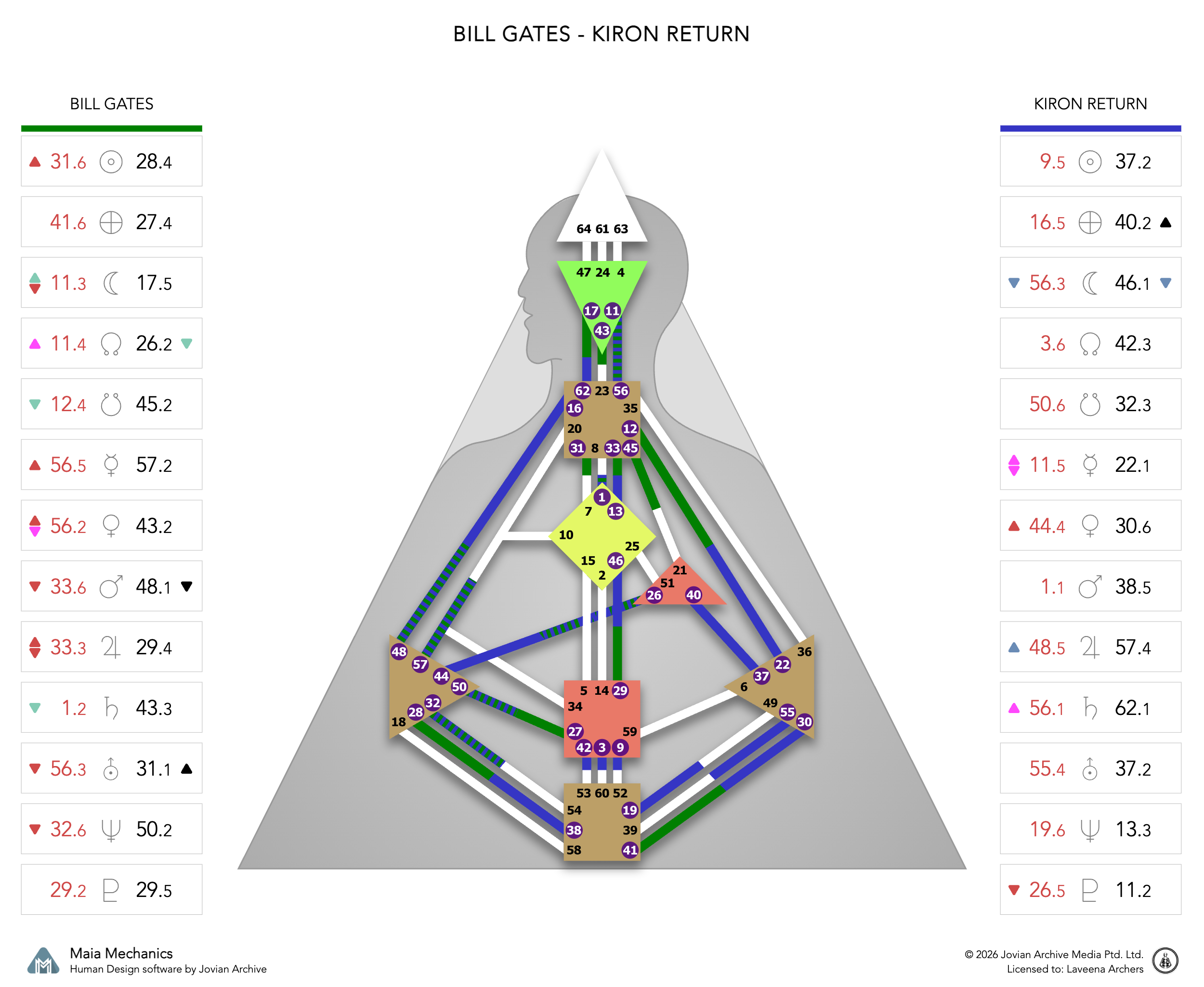 Bill Gates’s Chiron Return transit chart, age 49, via Maia Mechanics.
Gates’s Chiron Return fell on February 26, 2005, eleven days after he laid out, on February 15, 2005, a major push to make Microsoft software safer, moving the company further into the security business and giving away newly acquired anti-spyware software to consumers. Chiron’s mythology is the wound turned into medicine, and Microsoft’s security record, the target of relentless criticism through the early 2000s as viruses and exploits spread across Windows machines worldwide, was as close to an open wound as the company had. Gates using his own public platform to address it directly, days before the exact date his chart returns to its own Chiron placement, is a tight enough correspondence to lay out here rather than leave abstract.
What this doesn’t claim
None of this says Human Design explains why Microsoft succeeded, or that Gates’s chart guaranteed the outcome. Plenty of Sacral Generators turn down good offers, and plenty of 4/6 Profiles never build anything IBM wants to license. What the chart offers is a mechanic: respond rather than initiate, look for the bridge instead of expecting to run solo, treat the first three decades as trial-and-error. One specific 1980 decision happens to trace that mechanic closely enough to lay out directly, rather than folding it into a generic story about genius or timing.
Where the actual profit was: his open centers
Split Definition is about how Gates’s defined centers connect to each other. It doesn’t touch the separate question of which centers carry no definition at all, and that’s the question I’d point to first. Five of Gates’s nine centers are open: Head, G, Heart, Solar Plexus, and Root. My own model of profit centers holds that a person’s real commercial edge tends to live there rather than in what’s defined, because an open center has no fixed setting. It runs on whatever the moment brings, samples every version of that pressure over a lifetime, and eventually turns the exposure into a read on the terrain a person with a defined center in the same spot never has reason to develop, because theirs already answers the same way every time. Gates’s five open centers, read against his own record, produce a pattern that has nothing to do with the Sacral yes that got him the IBM deal.
Head. An open Head takes in a mental question and holds it open rather than settling it once. Gates’s public position on whether AI will destroy more jobs than it creates has moved substantially in real time. His 2023 year-end letter called the transition “bumpy” but manageable. By August 2026, in an interview with Semafor, his own language had shifted to alarm: “I am in a state of shock that I’m sort of the first one saying, ‘This is crazy. This is insane,’” predicting humans would be “vastly inferior” to AI at most jobs within years. That’s not a fixed forecast being defended. It’s the same open question, revisited and re-answered as the input changed.
G Center. An open G Center carries no fixed identity, and one of Gates’s most durable ones was handed to him rather than built by him. On December 18, 2005, Time magazine named Bill and Melinda Gates, alongside Bono, its Persons of the Year, under the label “The Good Samaritans,” a philanthropist identity assigned by outside media and layered over, not replacing, the technologist identity he’d already built at Microsoft. An open G takes whatever gets projected onto it and wears it as well as the one it made for itself.
Heart. An open Heart has no standing need to win or prove itself, which shows up more clearly in what a person admits than in what they defend. On the podcast Armchair Expert in August 2020, Gates told Dax Shepard he’d been “so jealous” of Steve Jobs’s charisma, describing Jobs as a “wizard at over-motivating people” whose spell Gates could see cast on a room without being able to cast it himself. A defined Heart competes for the win. An open one can just say so.
Solar Plexus. An open Solar Plexus has no fixed emotional position, only an unusually accurate read on the emotional temperature of a room it didn’t set. Gates’s videotaped 1998 antitrust deposition was famously combative and evasive. By his April 2002 remedy-hearing testimony, contemporary coverage described a visibly different Gates, offering what The Washington Post called “a human face and a modicum of deference,” a more controlled and conciliatory presence than four years earlier. Nothing about the legal facts had softened. The read on the room had.
Root. An open Root has no fixed relationship to pressure, which means it can also correctly identify pressure other people in the same building haven’t registered yet. On May 26, 1995, after years of Microsoft treating the internet as a side project, Gates wrote a 5,600-word memo to his executive staff declaring it a “five-alarm fire,” a sudden, self-generated escalation rather than a response to an external deadline anyone else at the company had already flagged as urgent.
Five open centers, five different reads, and not one of them is the Sacral gut-response that got him into the room with IBM in the first place. That’s the pattern worth naming: the places Gates has no fixed answer of his own are where the real edge keeps showing up.
Related
Curious what your own chart looks like? Get your own natal chart, Saturn Return, Uranus Opposition, and Chiron Return, rendered the same way, plus the full keynote PDF, for $37.
- Leadership Is Alignment to Your Own Authority — what it looks like to run decisions through real Authority instead of a boardroom’s preferred process
- Partnership: Why Two-Person Businesses Work or Fail — the mechanics behind choosing a structural partner well
- Jessica Alba: The Founder Who Never Took the CEO Seat — another founder’s design read against her company’s documented history
Chart calculated with Maia Mechanics software. Birth data (28 October 1955, 10:00 PM, Seattle, Washington) and an “A” reliability rating, from memory or autobiography, are recorded on Astro-Databank via Astrotheme, contributed by Lois Rodden. The 1980 IBM licensing decision is part of the widely documented public record of Microsoft’s early history; the exact sequence of who proposed the non-exclusive licensing term, and how much of the later clone-PC market Gates anticipated at the time, varies by account and is presented here in general terms rather than as a settled quote-level history.
Dr. LaVeena B. Archers has spent more than thirty years as an entrepreneur and teaches the career and business application of the Human Design System. She helps business owners and entrepreneurs market themselves in a way that fits their design, lead their teams to greater efficiency and profitability, and find the work their chart was actually built for.