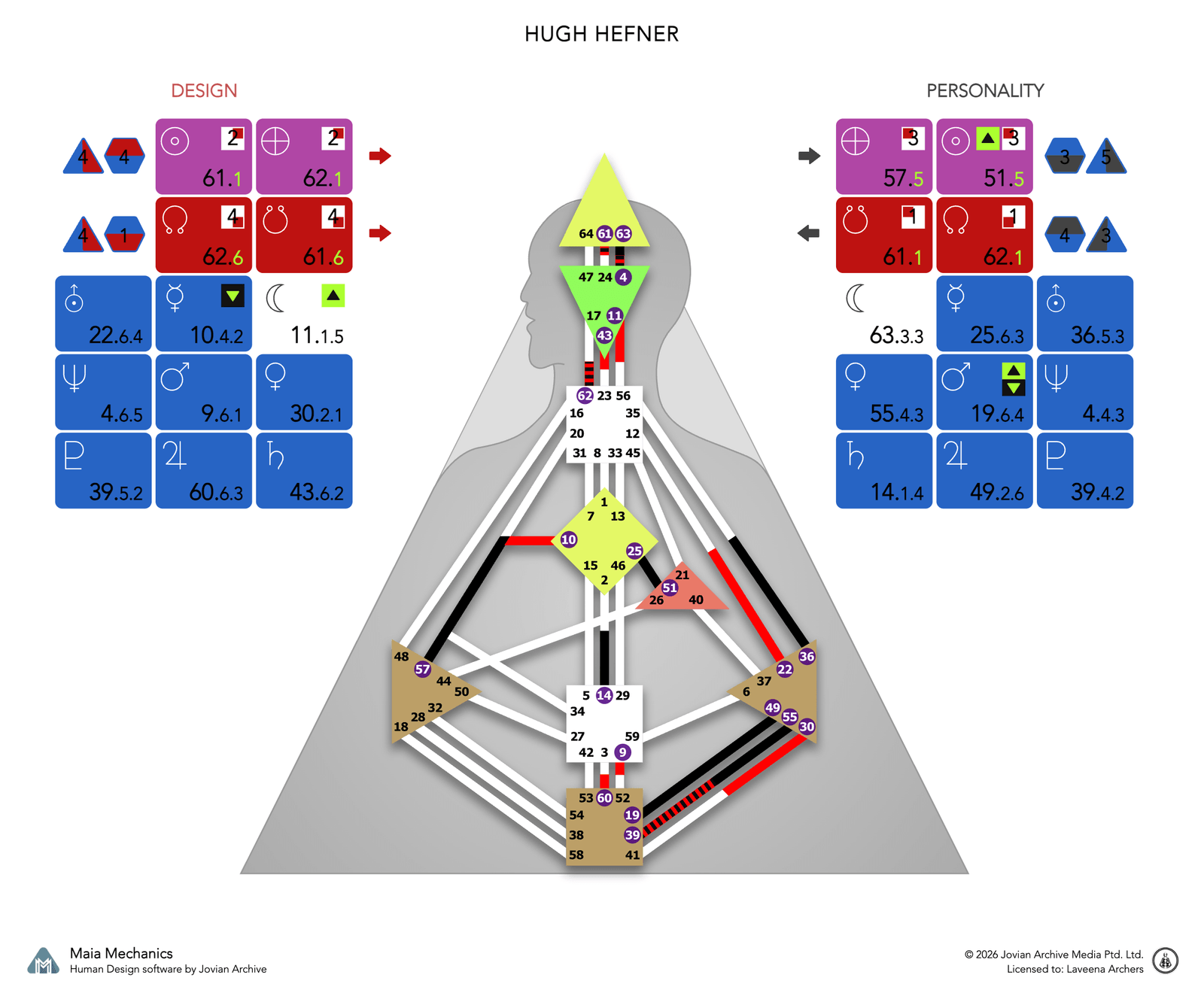
Chart calculated with Maia Mechanics, from an AA-rated birth record
Quick look: Hugh Hefner was a Projector with Emotional Authority, an open Throat, and a 5/1 profile, the profile this system reads as carrying an “initial positive projection field,” a stranger’s instant assumption of greatness before you’ve done anything to earn it. Deliver on that projection and you’re a savior. Fail, and the same mechanic that lifted you tears you down, in my own teaching, “burned at the stake.” Hefner built a business almost entirely out of waiting to be invited rather than pushing to be seen, and by the time of his death in 2017 and the documentary testimony that followed in 2022, his own public record had run that exact mechanic in both directions, at a scale few business figures ever experience.
The chart: an AA-rated Projector wired to wait
Hefner was born April 9, 1926, at 4:20 p.m. Central Standard Time in Chicago, Illinois, a Rodden AA-rated record, meaning a birth certificate is on file, the highest reliability tier this field uses and stronger than the sourcing behind most figures covered on this site. A full sweep of the birth day confirms his Type and Authority hold constant at every hour, and his Triple Split definition and 5/1 profile are stable across a nine-hour window, 1:00 p.m. to 10:00 p.m., that comfortably contains the recorded minute. Nothing that follows needed to be hedged.
He carries Projector Type with Emotional Authority, a Solar Plexus wave that means, in my own teaching, “there is no truth in the now” for how he is built to decide anything real. His definition is a Triple Split, three separate groups of channels that never physically connect: Ajna to Head through Logic (63-4), G Center to Heart through Initiation (25-51), G Center to Spleen through Perfected Form (10-57), and Root to Solar Plexus through both Synthesis (49-19) and Emoting (55-39). Seven of his nine centers are defined. Only two are open: Sacral and Throat.
His Incarnation Cross is the Left Angle Cross of the Clarion 1 (51/57 | 61/62), a Personality Sun at gate 51, Shock, line 5. This is the same cross carried by Ra Uru Hu, the founder of the Human Design System himself, whose entire life was “a sudden transmission, announced publicly, that mobilized a global community around a new body of knowledge.” Hefner built something very different with the same underlying geometry: a sudden, cheaply-financed transmission of his own, announced from a kitchen table in Chicago, that mobilized an audience most of the culture had never openly admitted to wanting addressed at all. A clarion is a trumpet call. What it is not is a solo achievement. Left Angle crosses only complete through the people who hear the call, never in isolation, which is the first mechanical fact worth holding next to everything below.
The undated first issue: waiting for an audience that hadn’t said yes yet
Projector strategy is to wait for recognition and invitation, never to initiate. I teach the Projector aura as “focused, absorbing, and penetrating,” built to work one person, or one room, at a time, never a crowd on command. Pushed uninvited, the signature result is the Projector not-self theme, bitterness, “a signpost, like the bumps on the side of the road that tell you you’re off your path.” Hefner’s own open Throat sharpens exactly what he was waiting for: no fixed, guaranteed channel to be heard through, and no way to know in advance whether an audience would actually show up for what he had to say.
He raised roughly $8,000 from about 45 investors, including $1,000 from his own mother, and took out a $600 loan against his own furniture to cover the rest. The first issue, assembled at his kitchen table and put on newsstands in December 1953, ran 44 pages and carried no cover date at all, commonly attributed to the fact that Hefner did not know whether there would be a second one. It sold out, 53,991 copies at fifty cents, built substantially on reprint rights he had bought that same fall, for $500, to nude photographs of Marilyn Monroe shot in 1949, an early, plain example of a pattern this piece returns to later: a business built on other people’s images, not always on their own terms.
An undated magazine cover is a small, oddly literal artifact of exactly what an open-Throat Projector strategy requires: you cannot promise the next invitation before it has actually arrived. His Personality Sun at gate 51, Shock, in my own teaching, is “the bastard 25,” the one individual gate sitting inside an otherwise tribal center, carrying “a hunger for being immortalized” and the plain admission “I want my name in lights.” That hunger did not wait quietly. It waited strategically, for exactly the kind of recognition a sold-out, undated first issue makes concrete.
The wave, not the room: an eighteen-year wait before the irreversible move
My central teaching image for Emotional Authority separates the size of the decision from the size of the wave it requires: small choices are pebbles dropped in a lake, ripples that settle fast; the big ones are a boulder off a dump truck, and “your chemistry creates waves on its own” regardless of how badly you want an answer immediately. High-end clarity, in my teaching, is exactly as false as low-end despair; the only trustworthy answer sits in the middle, identified by the literal absence of nervousness in the body, and it only arrives on the far side of time. “Time is the only truth with emotionally intelligent people. Time is your friend. Your mind is not.”
Hefner ran Playboy as a private company for eighteen years before taking it public. Playboy Enterprises listed on the New York Stock Exchange on November 3, 1971, at $23.50 a share, an offering that valued the company at roughly $220 million; Hefner retained about 72 percent of it, worth on paper somewhere near $168 million at age 45. Going public is the least reversible structural decision a founder can make: it permanently trades private control for outside shareholders, disclosure obligations, and a board that answers to people who were never invited into the room. For a Projector whose Solar Plexus was never going to hand him same-day certainty on a decision that size, eighteen years is not hesitation. It is what the correct wave looks like when the decision is actually irreversible.
Designing an environment to guarantee survival
Hefner’s G Center to Spleen channel, Perfected Form (10-57), belongs to a four-gate group I teach as sitting entirely outside the six standard circuits of the system, a “lone wolf” in Ra Uru Hu’s own phrase, “resolutely individual” and “dedicated entirely to its own self-absorbed survival process.” Its expression, in my own teaching, is “creating and designing environments to guarantee survival, not just architecture, but also your body.” I name it explicitly as a Projected channel: it must be recognized and invited to function correctly, “otherwise the individual will suffer from deep bitterness and melancholy.”
Hefner did not rent office space and go home at night. He bought a mansion in Chicago in 1959, the year before the first Playboy Club opened a few blocks away, and a second one in Los Angeles in 1971, the same year the company went public, and ran the business substantially out of both: photo shoots, television production, the entertaining that became the product’s own advertisement. This was not lifestyle excess bolted onto a magazine business. It was the literal, load-bearing expression of a chart mechanic that reads survival itself as an environment to be designed, not a paycheck to be earned, at a scale almost no other business figure on this site has attempted.
The profile built to be worshipped or burned at the stake
Here is where the mechanic and the record meet most directly, and where this piece will not soften either side of it.
A 5th-line Personality generates what I call an “initial positive projection field”: strangers assume greatness before you’ve done anything to earn it, “when your child is born and you look down at that little 5/1, they’re a stranger” to the people already projecting onto them. Deliver on the projection and you become the savior, “riding in on the white horse,” “our last resort, our last hope.” Fail, or simply get caught in the gap between the projection and the person, and the same energy reverses completely: “burned at the stake,” reputation “demolished.” My own instruction to any 5th line is a form of healthy paranoia, to stay “slightly suspicious of the expectation” being placed on them rather than accepting it uncritically, and a specific business warning that applies with unusual force here: “don’t make your clients your friends,” because familiarity collapses the projection field faster than almost anything else.
Hefner’s public reputation ran precisely this arc. Reporting around his 2017 death split cleanly into “oppressor or liberator” framings on outlets including CNN and Fortune: the feminist writer Susan Brownmiller called the wave of tributes “disgusting,” while Bitch Media’s Andi Zeisler argued Hefner received “disproportionate credit” for a sexual revolution that Playboy’s own pages had, separately and consistently, backed with real editorial support for abortion rights and birth control access. That is a white-horse-or-stake split playing out in the obituary pages themselves, in real time, on a real record. This is not a verdict on which side of that argument is correct. It is chart mechanics: a 5th-line Left Angle Cross does not get read moderately by the culture around it, in either direction.
The record also includes something no mechanic explains away. Holly Madison’s 2015 memoir, Down the Rabbit Hole, described a Playboy Mansion with a strict 9 p.m. curfew for live-in girlfriends, a $1,000-a-week allowance tied to implicit rules about appearance, and a psychologically controlling environment she says brought her to consider suicide. Hefner responded publicly that “a few have chosen to rewrite history” to stay in the spotlight and called his former girlfriends “dear friends”; Madison maintained she was finally telling the truth. A&E’s documentary series Secrets of Playboy, which premiered in January 2022, carried further, more serious claims from named former Mansion residents and staff, including an allegation that Bill Cosby assaulted a guest there in 1979, a separate assault allegation from a 1994 visit, and descriptions of a house physician freely dispensing drugs alongside a culture of non-disclosure agreements. Playboy’s current ownership responded that “the Hefner family is no longer associated with Playboy, and today’s Playboy is not Hugh Hefner’s Playboy.”
None of that is adjudicated by a bodygraph, and this piece will not pretend otherwise. What the chart offers is narrower and, read honestly, still real: an explanation for why the culture’s response to Hefner was never going to land as ordinary business reputation, tempered by ordinary mixed reviews. A 5/1 Left Angle Cross does not get a moderate verdict. It gets a white horse or a stake, sometimes from the same public within the same decade, and Hefner’s own record, both the philanthropy and the philosophy he was genuinely proud of and the specific, named, dated allegations above, ran that mechanic to its full extent.
The department he fully anchored, in a market that kept getting more crowded
At OC16 scale, ten to sixteen or more people working physically together on a regular basis, I teach six organizing channels, each anchoring a large-group department. Hefner fully anchors exactly one: Competitiveness, gate 51 paired with gate 25, the same channel that also runs through his own core G Center to Heart definition. He carries no other department’s full anchor pair, but the gates he does carry are not scattered randomly. He feeds Management, gate 45 paired with gate 21, through his own natal Synthesis channel (49-19) without the anchor pair itself, and he carries the single anchor gate for Innovation, gate 60, alongside four of its power-base feeder gates (22, 39, 55, 57), the heaviest concentration in his chart outside Competitiveness itself.
A person who fully anchors Competitiveness is a field of potential to be recognized as the department that keeps an organization relevant in a changing market, never a guarantee, and Hefner’s own business record supplies a direct, dated test of it. Playboy launched Oui in 1972 specifically to answer Penthouse, which had entered the American market in 1969 and had already begun cutting into Playboy’s circulation with more explicit content Playboy’s own house style wouldn’t run. Hustler followed in 1974, tightening the competitive field further. Innovation’s own gate concentration explains where the newer, harder-edged product came from. Competitiveness explains why he felt the pressure to launch it in the first place, rather than simply defending the position Playboy had already won a decade earlier.
Six returns, checked against the record
Hefner lived 91 years, long enough to pass through every planetary return this system tracks, including two that almost no subject on this site reaches. Ra Uru Hu himself was skeptical of leaning on the ones past midlife: he called the second Saturn return, before it was ever added to the software, a realignment to “a fading influence,” said he had never once offered it to a client, and taught it as layered underneath the Chiron return rather than standing on its own. He also thought there might be a third Saturn return, a possibility my own class notes record him raising while watching his own mother age into it, though he died at 62, decades short of reaching it himself. That third return, and a full Uranus return, land squarely inside Hefner’s own lifespan and outside what Maia Mechanics’ own cycle menu offers by default. Every date below is computed the same validated way: cross-checked against Maia’s own output wherever it offers the cycle as a named option, and computed independently, with the same Swiss Ephemeris methodology, where it does not. Dates are given in UT.
Saturn Return (30’s): November 27, 1955
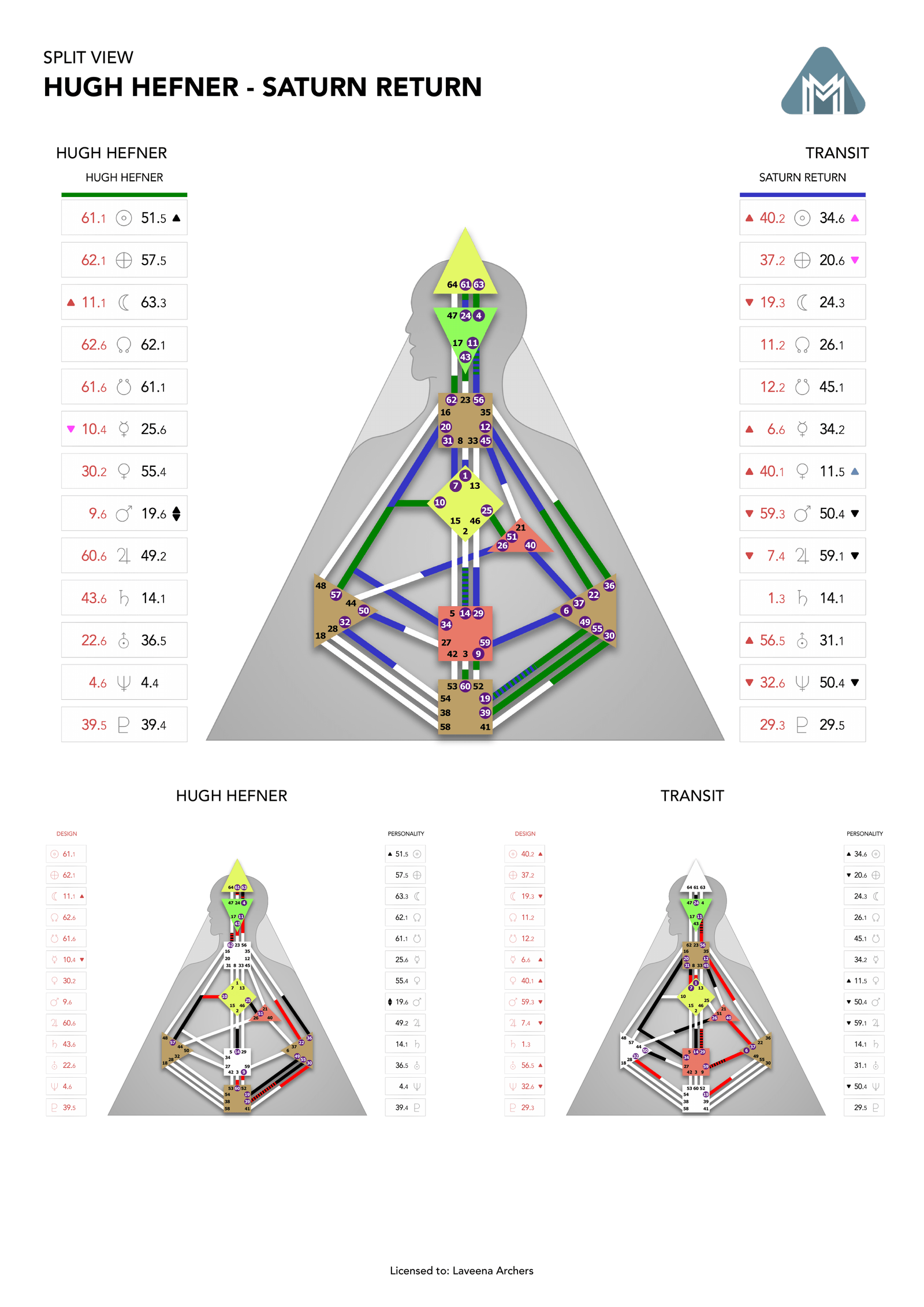 Design and Personality on the left, the 27 November 1955 Saturn Return transit overlaid on the right.
Transiting Saturn returned to Hefner’s own natal Saturn, gate 14.1, on November 27, 1955, two years into the magazine’s life. That same moment’s transiting Sun and Earth, at gates 34 and 20, complete two new channels against his chart on their own, Charisma (20-34) and Awakening (20-10), both landing in his own open Throat, the exact center a Projector strategy exists to fill through outside recognition rather than self-generated effort. A Saturn Return is a structural accounting of what has actually been built so far, and by this date the magazine that had opened with no confidence there would even be a second issue was two full years and dozens of issues into a run that had never come close to folding. The Throat that carried nothing fixed at birth was, by this exact date, carrying real, external, structural voice, built entirely out of an audience that had shown up and stayed.
Uranus Opposition (40’s): October 20, 1967
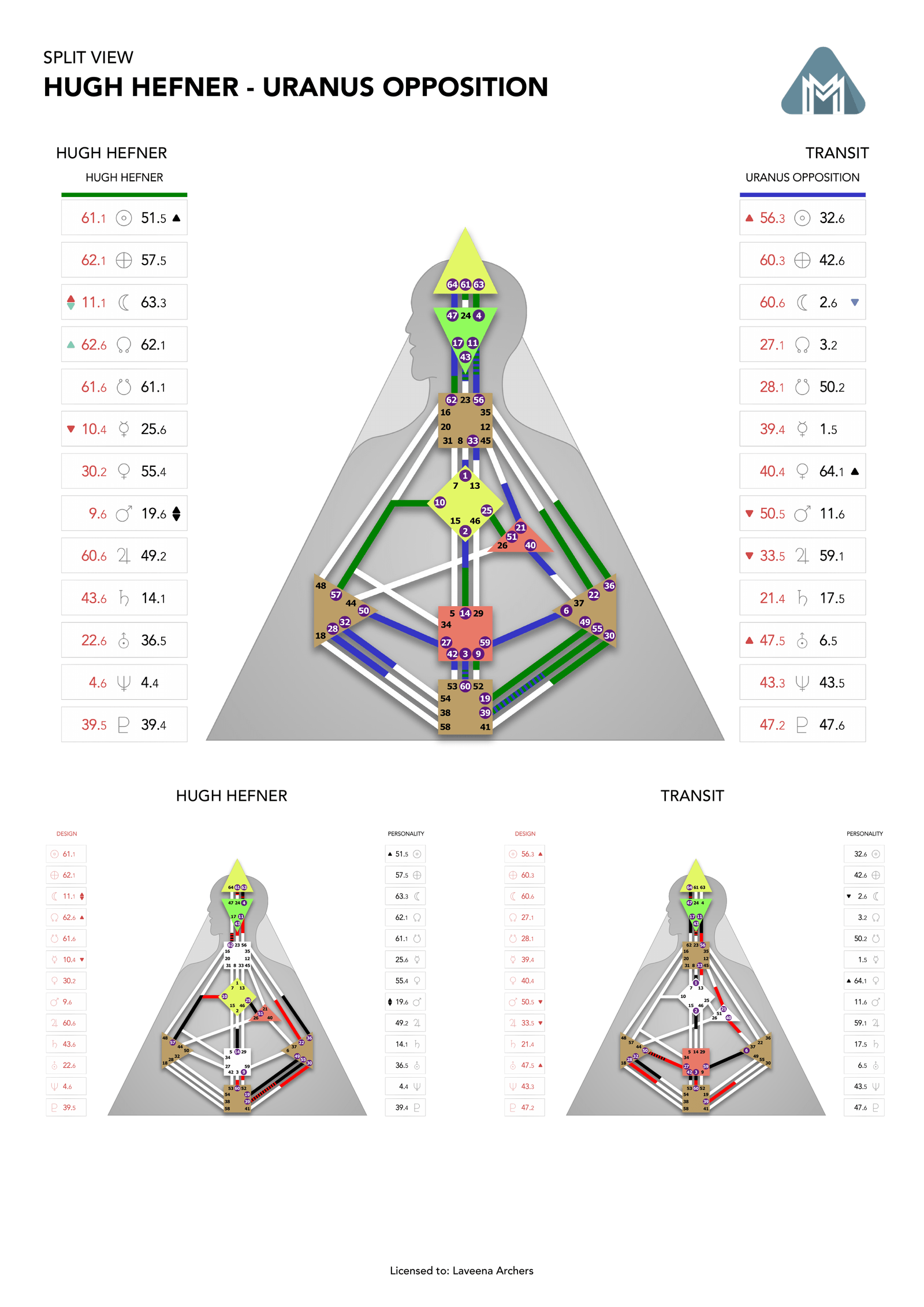 Design and Personality on the left, the 20 October 1967 Uranus Opposition transit overlaid on the right.
Transiting Uranus first opposed Hefner’s natal Uranus on October 20, 1967, at age 41. The cycle completes Acceptance (17-62) and Mating (59-6) against his chart, again reaching into his own open Throat through gate 62. A Uranus Opposition is a break from an established pattern, pushing a structure toward something it was never built to hold, and by this point in the 1960s Playboy Enterprises had expanded from a single Chicago magazine into a network of Clubs stretching across multiple countries, television production, and a public persona built almost entirely around Hefner’s own image rather than the printed page alone. The pattern that broke was containment itself: a business that had started as one man’s undated bet on an audience had, by 41, become something closer to a media franchise operating largely outside his ability to personally oversee any single piece of it.
Chiron Return (50’s): June 18, 1975
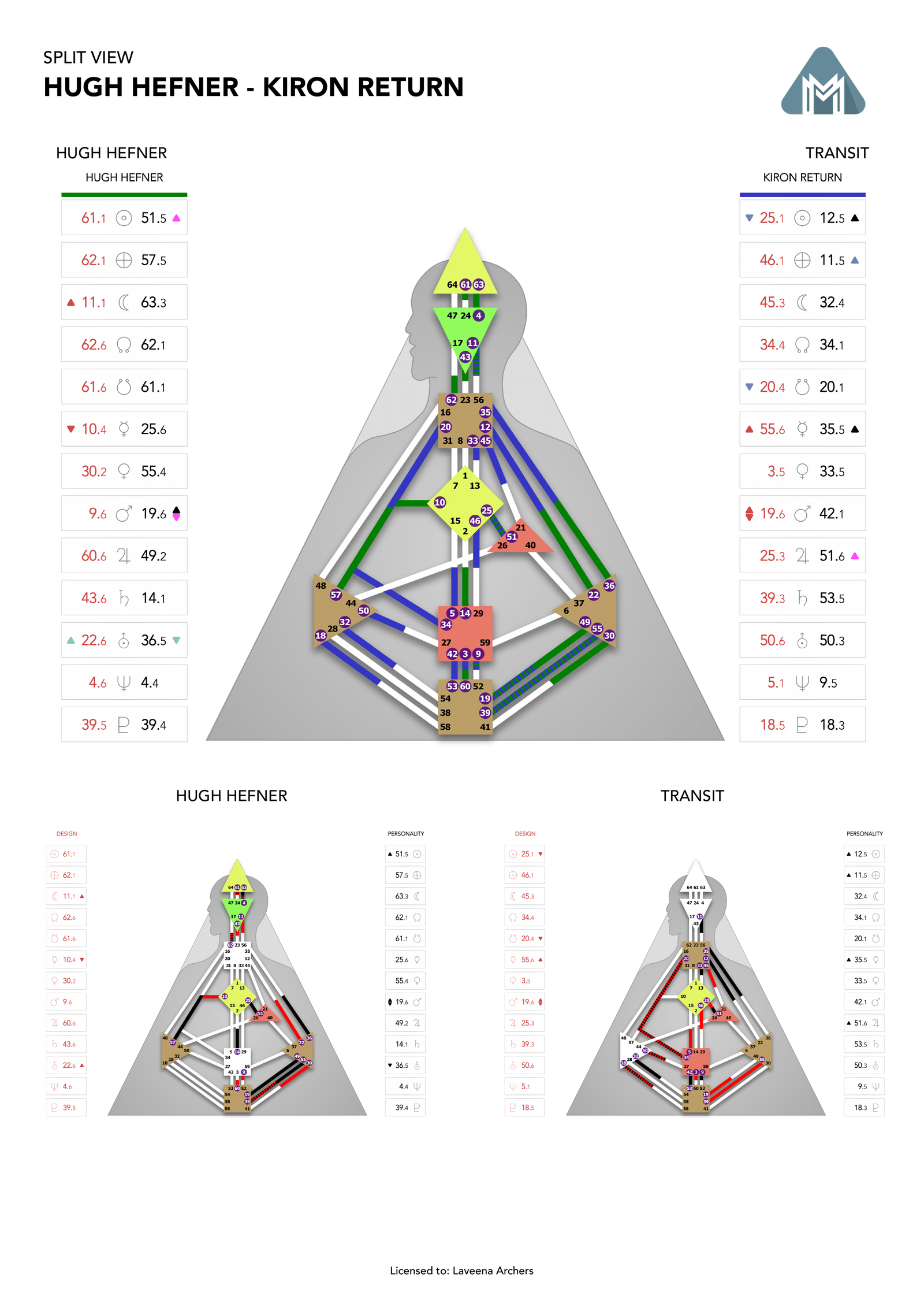 Design and Personality on the left, the 18 June 1975 Chiron Return transit overlaid on the right.
Transiting Chiron returned to Hefner’s own natal Chiron, gate 3.2, on June 18, 1975, six days after his 49th birthday, a gate that itself sits in his open Sacral alongside natal Saturn’s gate 14, the one center in his whole chart that never carried a fixed answer. The cycle completes seven new channels, an unusually heavy single-cycle count, including Power (34-57) and The Brain Wave (57-20) built directly against his own natal Spleen gate. A Chiron Return is the wound turned into medicine, and by 1975 the wound was competitive rather than personal: Penthouse had been cutting into circulation since 1969, and Hustler had launched the year before, the most direct, explicit competition Playboy had ever faced. The same year, per the reading above, Hefner’s chart fully anchors Competitiveness against exactly this kind of market pressure. What the return produced was not retreat. It was Oui, the harder-edged answer to Penthouse launched three years earlier, now the established second product line absorbing the newest wave of competition so the original magazine did not have to change what it was.
Second Saturn Return (60’s): January 5, 1985
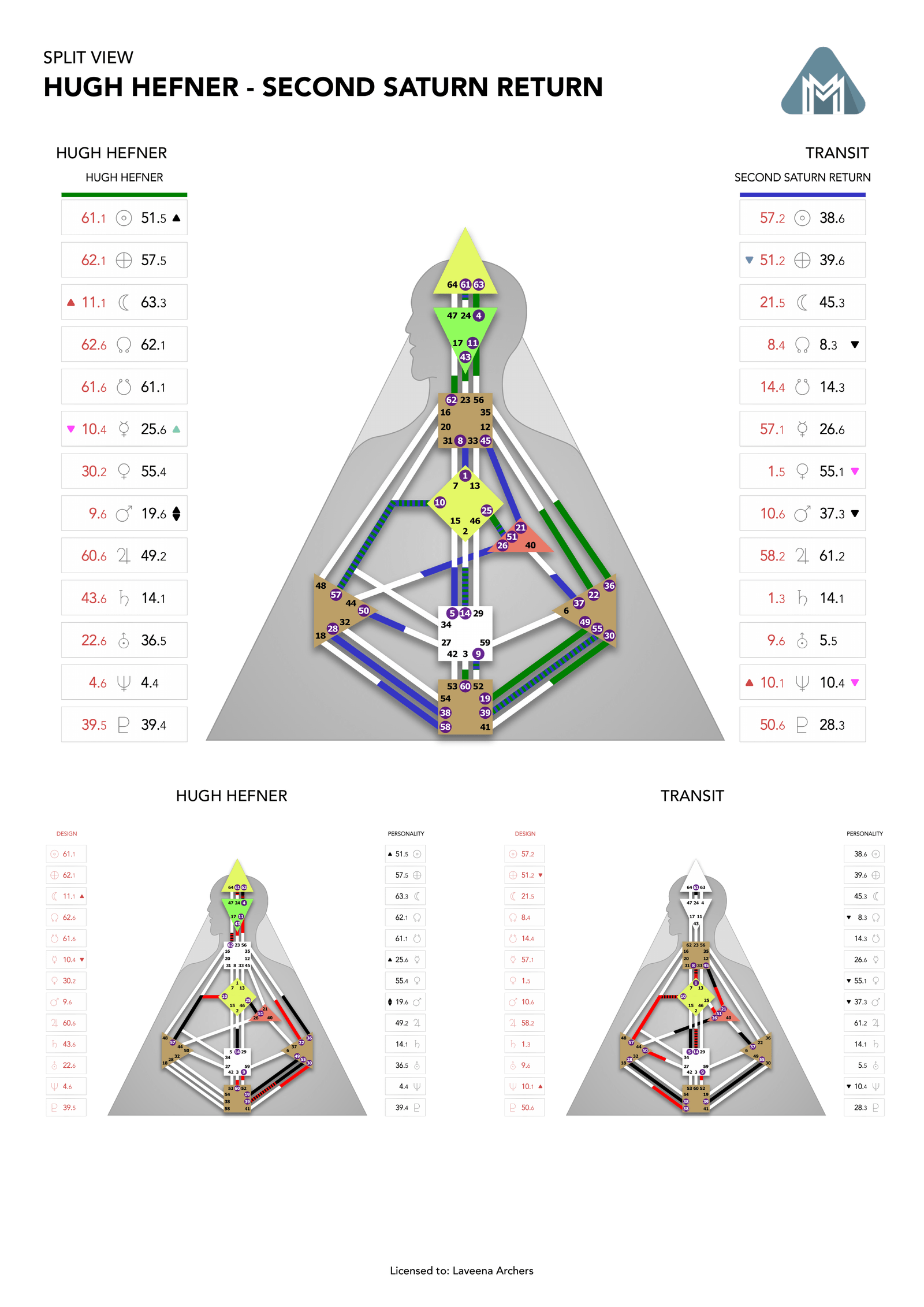 Design and Personality on the left, the 5 January 1985 Saturn Return transit overlaid on the right.
Saturn’s roughly twenty-nine-and-a-half-year orbit brought it back to Hefner’s own natal Saturn, gate 14.1, a second time on January 5, 1985, at age 58. The cycle’s own Incarnation Cross, the Left Angle Cross of Individualism (38/39 | 57/51), draws three of its four defining gates directly from Hefner’s own natal activations, an unusually tight resonance between a returning cycle and the chart it is returning to. This exact stretch was the hardest structural test of his life. Nine months earlier, in April 1984, Playboy completed the forced sale of its Atlantic City casino-hotel, a $135 million property that New Jersey gaming regulators had refused to grant a permanent license over the company’s earlier London casino ties, at a reported loss of tens of millions of dollars. Five weeks after this exact date, on February 7, 1985, Hefner suffered a stroke that put him in bed for two weeks and led him to hand day-to-day control of the company to his daughter Christie. A second Saturn Return is a life’s second structural accounting, and this one landed between a forced sale he had fought and lost and a health collapse that forced the handoff his first Saturn Return, thirty years earlier, had never required. Ra Uru Hu taught this specific return in starker terms than any other cycle in this piece, calling it, in the teaching I relay, something close to “a Terminator” for anyone who had not fully lived as themselves by the time it arrived. Hefner’s own second Saturn return produced exactly the harder of the two outcomes Ra described: not a business decision he made, but a stroke that made the decision for him.
Uranus Return (80’s): 2010
Uranus takes roughly eighty-four years to complete one full orbit, so an actual Uranus return, the planet arriving back at the exact degree it held at birth rather than the midlife opposition covered above, only happens to people who live deep into their eighties. Transiting Uranus crossed Hefner’s own natal Uranus, gate 36.5, Crisis, three times in 2010 as it turned retrograde and back across the same degree: March 20, November 20, and December 21, at age 84. Maia Mechanics’ own cycle menu does not offer a Uranus return as a named option, only the midlife opposition, so no chart image accompanies this section; the dates and completions below are computed independently, the same validated methodology used everywhere else in this piece, and each pass lands on its own named cross: the Right Angle Cross of the Vessel of Love, the Right Angle Cross of Contagion, and the Vessel of Love again on the third pass. Across the three, the transit newly completes Acceptance (17-62), Curiosity (11-56), Judgment (18-58), Awareness (61-24), Rhythm (15-5), Discovery (46-29), Concentration (9-52), and Struggle (28-38) against his own chart.
Ra Uru Hu taught that we are, in his own phrase, “Uranian creatures”: born, reaching a midlife opposition, and dying somewhere at the Uranus cycle’s own return, a full orbit treated as roughly the outer edge of a human life rather than an arbitrary astronomical fact. What actually crossed Hefner’s desk at 84 was a genuine crisis returning to the gate named for one. On July 8, 2010, he formally proposed to buy out the rest of Playboy Enterprises at $5.50 a share, valuing the company at roughly $185 million; the board’s special committee opened the bid to competitors, and FriendFinder Networks, the then-owner of Penthouse, the same rival whose 1969 debut had forced Oui into existence in the first place, entered a competing bid that dragged the deal into a five-month fight before Hefner’s own group finally reached agreement at $6.15 a share, roughly $207 million, on January 10, 2011. That December, as his gate of Crisis completed its third and final pass, he also proposed marriage to Crystal Harris. Uranus does not distinguish between a structural return and a personal one. Both arrived the same year.
Third Saturn Return (late 80’s): November 11, 2014
A third Saturn return, Saturn lapping its own roughly twenty-nine-and-a-half-year orbit a third time, requires living to nearly ninety, and it is the one cycle in this piece that was never fully built into the standard teaching. Ra Uru Hu raised the possibility that a third return might matter, according to my own class notes, while watching his own mother age into that territory; he died at 62, decades short of testing it against his own chart, and it has never been formalized into a standalone offering the way the second Saturn return eventually was. What follows is computed with the same rigor as every other cycle in this piece and offered with the same honesty about where it sits in the tradition: real, Ra-acknowledged, and still informal.
Transiting Saturn returned to Hefner’s own natal Saturn, gate 14.1, for a third time on November 11, 2014, at age 88, on the Right Angle Cross of Explanation (43/23 | 4/49), newly completing Structuring (43-23), Curiosity (11-56), and Struggle (28-38) against his chart. As with the Uranus return, this cycle sits outside Maia’s own menu, so no rendered chart accompanies it. The gate returning is his own natal Saturn, sitting in his open Sacral, the one center in his chart that was never fixed at birth. Three months before this date, in August 2014, Playboy.com relaunched stripped of nudity so its content could run on Facebook, Twitter, and Instagram, and its traffic reportedly quadrupled within months. Eleven months after it, on October 12, 2015, the print magazine announced it would drop full nudity from its pages entirely, beginning with the March 2016 issue; contemporary reporting has Hefner agreeing to the change himself, with the sharper resistance from inside his own family arriving later, after his son Cooper’s formal role began in 2016. What returned to his one never-fixed center at 88 was, on the record, the moment the company built on a single fixed answer, nudity as the product itself, gave that answer up for good.
The final sequence: the moon’s death cycle
There is one more layer in this teaching, distinct from the planetary returns above and normally reserved for advanced Rave Cosmology coursework: a monthly transiting sequence, the Moon passing through five specific gates in a fixed order, gate 10 (Behavior of the Self), gate 3 (Ordering), gate 2 (Direction of the Self), gate 29 (Perseverance), and gate 14 (Power Skills), that I teach as the mechanism every human body is initiated into the potential of its own death through, every lunar month, for everyone, independent of their own natal chart. Only one specific monthly pass of it, identified after the fact, turns out to be the one a given death actually falls inside. I have taught this exact sequence once in recorded material, using Ra Uru Hu’s own final weeks as the worked example. Checked independently here against the transiting Moon’s actual ephemeris rather than taken on authority, the computed dates for Ra’s own sequence, gate 10 on January 30, 2011, gate 3 on February 9, gate 2 on February 10, gate 29 on February 18, and gate 14 on February 24, match my taught dates exactly.
Applied the same way to Hefner’s own record, the Moon completed this same sequence in the weeks before his death: gate 10 on August 31, 2017, gate 3 on September 9, gate 2 on September 10, gate 29 on September 17, and gate 14 on September 24. From the moment the Moon fully exits gate 14, per the teaching, until it cycles back into gate 14 again roughly twenty-seven days later, death becomes a live possibility rather than a scheduled event. Hefner died September 27, 2017, three days after his own window opened, of cardiac arrest and respiratory failure with sepsis from an E. coli infection as contributing causes, at his home at the Playboy Mansion.
The teaching goes one layer deeper than this for a fully documented subject: the exact degree the transiting Earth holds at the moment of death sets a specific sequence of “guardian” planets and line-keynotes, the Bardo stages proper, which is how I read the final eleven days of Ra Uru Hu’s own life, hour by hour, against his own confirmed time of death. That precision depends on knowing the death to the hour, which I had for Ra through my own direct relationship with Jovian Archive, and which is not part of Hefner’s public record; no source consulted for this piece states one. Rather than assign him a guardian planet and a Bardo sequence this piece cannot actually verify, this is where that particular reading stops. The five-gate sequence above is real, computed, and correct. The deeper layer would require data nobody outside his own family and physicians has.
Where the actual profit was: his two open centers
Seven of Hefner’s nine centers are defined, which leaves only two open: the Throat and the Sacral. This site’s own model of profit potential holds that the commercial edge tends to sit in the open centers rather than the defined ones, because an open center has no fixed way of operating. It takes in whatever is around it, runs every version of that pressure across a lifetime, and turns the exposure into a read nobody with a defined center in the same position develops.
With only two open, there is no ambiguity about where to look, and both of them turn out to be the business.
Throat, carrying gate 62 alone. Its partner gate 17 is absent, so Acceptance never closes, and he had no fixed, self-generated channel to be heard through. The Throat is where a design becomes speech and action. Open, the register is taken from the setting rather than run on a current of its own. The whole of the first section of this piece is that mechanic: the undated cover of a magazine whose publisher could not promise himself a second issue, because an open Throat cannot guarantee in advance that anyone will answer. What it can do, across sixty years, is develop an unusually accurate read on what an audience will respond to, which is a fair description of an editor. It is worth noting how often the transits above reached into this exact center. The 1955 Saturn Return completed Charisma and Awakening there; the 1967 Uranus Opposition completed Acceptance there. The center he was born without a fixed answer in is the one his cycles kept filling from outside.
Sacral, carrying gates 9 and 14, with neither partner. Gate 9, Focus, sits without 52; gate 14, Power Skills, without gate 2, the Direction of the Self. Every Projector has an undefined Sacral by definition, and it is the single most consequential fact about how a Projector has to build a business: there is no consistent, self-generated life force to run on, so the work has to be done through other people’s energy or not at all.
Hefner’s record is that mechanic at industrial scale, and it cuts in both directions at once. He raised roughly $8,000 from about forty-five other people and borrowed $600 against his own furniture. The first issue’s commercial engine was photographs of Marilyn Monroe taken four years earlier by someone else, for a purpose she had not chosen, bought as reprint rights for $500. The Clubs, the television production, the Mansion operation and eventually the company itself under his daughter’s management all ran on labor and images that were not his. A design with no fixed generative energy of its own built one of the century’s most recognizable businesses by organizing other people’s, and the well-documented allegations set out above are, at their core, allegations about the terms on which that energy was taken. The mechanic explains the commercial shape. It neither explains nor excuses the conduct, and the two should not be confused.
Gate 14 deserves its own line. It is the fuel gate of material resources, and without gate 2 attached there is no steering component: the capacity to generate wealth without a fixed internal sense of what direction to point it in. The same half-channel appears in Tyra Banks’s chart, and in both records the pattern is a person who produced enormous commercial energy and repeatedly needed somebody else to decide where it went. For Hefner that person was, by 1985 and after a stroke he did not choose, Christie Hefner.
Where this reading stops
None of this says Human Design explains why Playboy succeeded, or that a 5/1 profile made either the tributes or the allegations inevitable. What the chart offers is a mechanic: an open-Throat Projector who built an entire company around waiting to be invited rather than pushing to be seen, on a Left Angle Cross that only completes through the people who respond to the call, for better and, on the documented record above, sometimes for considerably worse. The undated first issue, the eighteen-year wait to go public, the mansions built as literal survival architecture, and the specific, named allegations that surfaced across 2015 and 2022 all sit inside one man’s extensively documented public life, close enough to the chart’s own predicted shape to read plainly rather than soften into either a hagiography or a takedown. That shape held up across six real planetary returns spanning sixty years, two of them so rare this site has never had occasion to compute them before, and in its final layer against the specific five gates the transiting Moon crossed in the weeks before he actually died. That is a wide field to test one framework against. This piece goes exactly as far into it as the data honestly supports, and stops there.
Related
Curious what your own chart looks like? Get your own natal chart, Saturn Return, Uranus Opposition, and Chiron Return, rendered the same way, plus the full keynote PDF, for $37.
- Martha Stewart, Human Design, and the Sale That Was Never the Crime — another business figure whose chart is read directly against the hardest, most publicly documented chapter of their record
- Bill Gates, Human Design, and the Deal He Didn’t Have to Sell — another founder’s chart read against one specific, dated business decision
- Ted Turner, Human Design, and the Deals He Answered Instead of Starting — a different Type and Authority answering the same question this piece asks about waiting versus initiating
Chart calculated with Maia Mechanics software, independently cross-checked against an in-house Swiss Ephemeris calculation built from the same reference data this site uses for every gate and channel; the Uranus return, third Saturn return, and death-cycle sequence, none of which Maia’s own cycle menu exposes, are computed the same way and validated by independently reproducing Ra Uru Hu’s own documented death-cycle dates before applying the method to Hefner. Birth data (9 April 1926, 4:20 p.m. Central Standard Time, Chicago, Illinois) and an “AA” reliability rating, the highest tier Astro-Databank uses, are recorded on Astro-Databank; Ra Uru Hu’s own birth and death data are recorded on Astro-Databank as well. Hugh Hefner died September 27, 2017, in Los Angeles, at age 91. The Playboy founding story, the 1971 IPO, the Oui and Hustler competitive timeline, the 2010 buyout fight with FriendFinder Networks, the Atlantic City casino sale, the 1985 stroke, and the 2014-15 retreat from nudity are drawn from contemporary and retrospective business press, including CNBC, the Christian Science Monitor, and the New York Times’ October 2015 report on the decision. The allegations discussed above are drawn specifically from Holly Madison’s memoir Down the Rabbit Hole (Dey Street Books, 2015) and A&E’s documentary series Secrets of Playboy (2022), each linked above, together with Playboy’s own 2022 public statement distancing the current company from Hefner. The Uranus-cycle and death-cycle teaching is drawn from my own recorded coursework, relaying Ra Uru Hu’s own statements on second and third Saturn returns and his documented death-cycle analysis; exact dollar figures on the Atlantic City sale and the 2010 buyout vary by account and are presented here in general terms rather than as settled ledger entries.
In memory of an ICONIC Human Design, LaVeena B. Archers, PhD
I’ve spent more than thirty years as an entrepreneur and teach the career and business application of the Human Design System. I help business owners and entrepreneurs market themselves in a way that fits their design, lead their teams to greater efficiency and profitability, and find the work their chart was actually built for.
Common questions
Does Hugh Hefner's Human Design chart explain or excuse the allegations against him?
No. The chart indicates a pattern of public perception, specifically why a 5/1 profile tends to get idolized when it delivers and vilified when it doesn't, which is a real, checkable mechanic behind why Hefner's reputation split so sharply into liberator and predator narratives. It says nothing about whether any specific allegation is true. The claims made in Holly Madison's memoir and A&E's Secrets of Playboy documentary stand on their own evidentiary and journalistic footing, entirely separate from anything in this chart reading.
How reliable is Hugh Hefner's birth data?
About as reliable as birth data gets. Astro-Databank rates it AA, its highest tier, meaning a birth certificate or record is on file (9 April 1926, 4:20 p.m. Central Standard Time, Chicago). A full sweep of that day confirms Type and Authority hold constant at every hour, and the Triple Split definition and 5/1 profile stated here hold across a nine-hour window comfortably containing the recorded minute, so nothing in this piece needed to be hedged.
Why does this piece analyze the exact days before Hugh Hefner's death?
Because this system teaches that a specific, universal lunar sequence precedes every death, the same tool used elsewhere to study the final weeks of the system's own founder, Ra Uru Hu. Applying it here is chart mechanics, not commentary on how Hefner lived or died. Where the public record doesn't support the deeper, hour-of-death-specific layer of that same teaching, this piece says so directly rather than guessing at it.