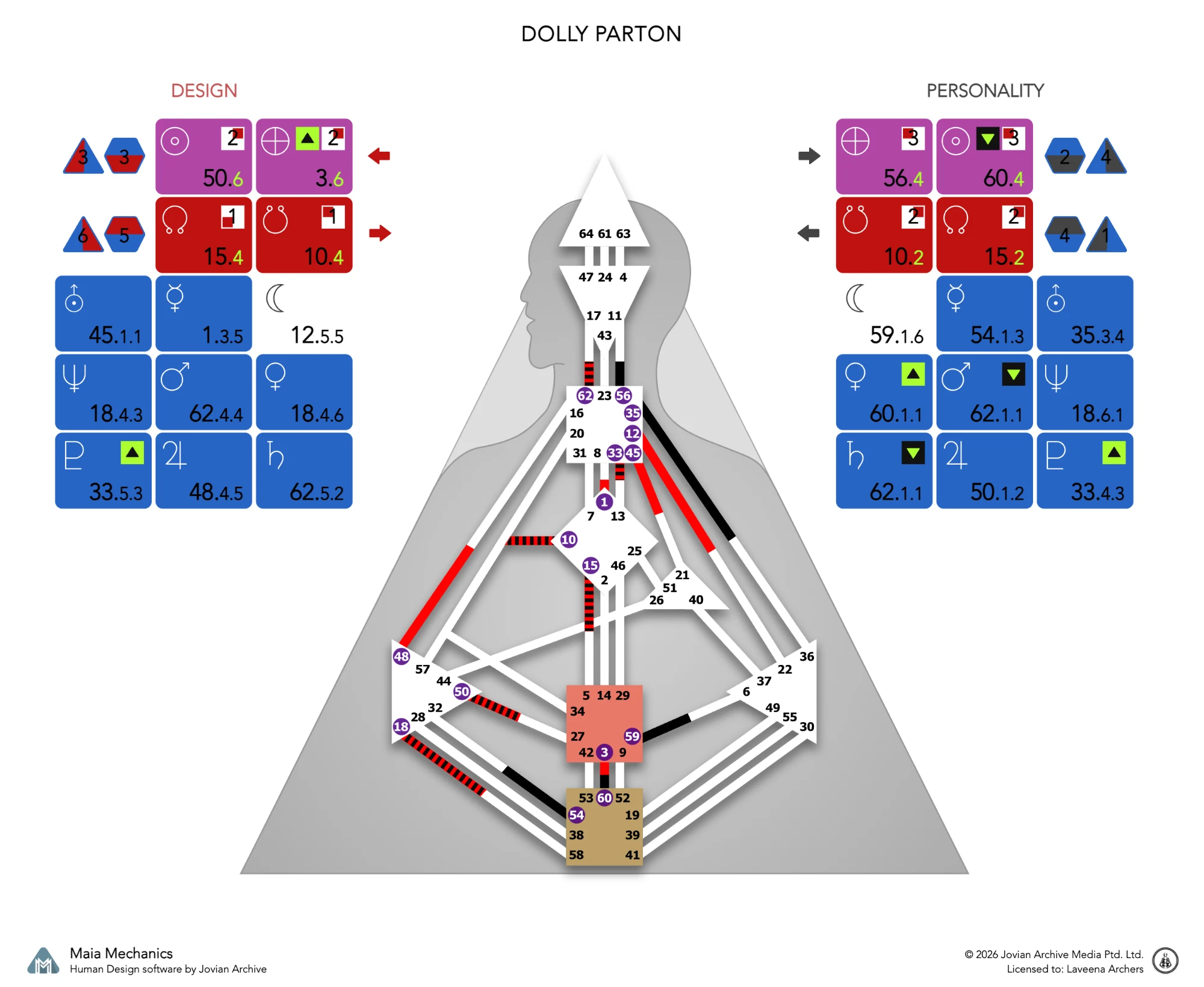
Chart calculated with Maia Mechanics, from an AA-rated birth record
Quick look: Dolly Parton was a Sacral-defined Generator, and you can watch that mechanism run her business in a single decision she made in a Nashville office in 1974. Elvis Presley’s manager called wanting half the publishing on “I Will Always Love You,” and Parton turned him down before she’d had time to think about it. That gut-level no is why she still owned the song outright eighteen years later, when Whitney Houston’s cover turned it into one of the most lucrative songs ever recorded. If you’re not a Generator yourself, that particular kind of no was never going to be available to you anyway. What follows is about what is.
Parton died on 25 August 2026, at her home in Nashville, at 80, closing out one of the fullest lives American music has produced. She wrote songs before she did anything else, by her own account, and nearly everything that came after, the theme park, the resort, the record label, the giving away of tens of millions of books to children who needed them, grew out of that same instinct: make something real, then be generous with it. She also left behind an unusually well-documented business record, specific enough dates and decisions that her design can be read against what she actually did. That feels like its own kind of tribute, closer attention rather than a highlight reel.
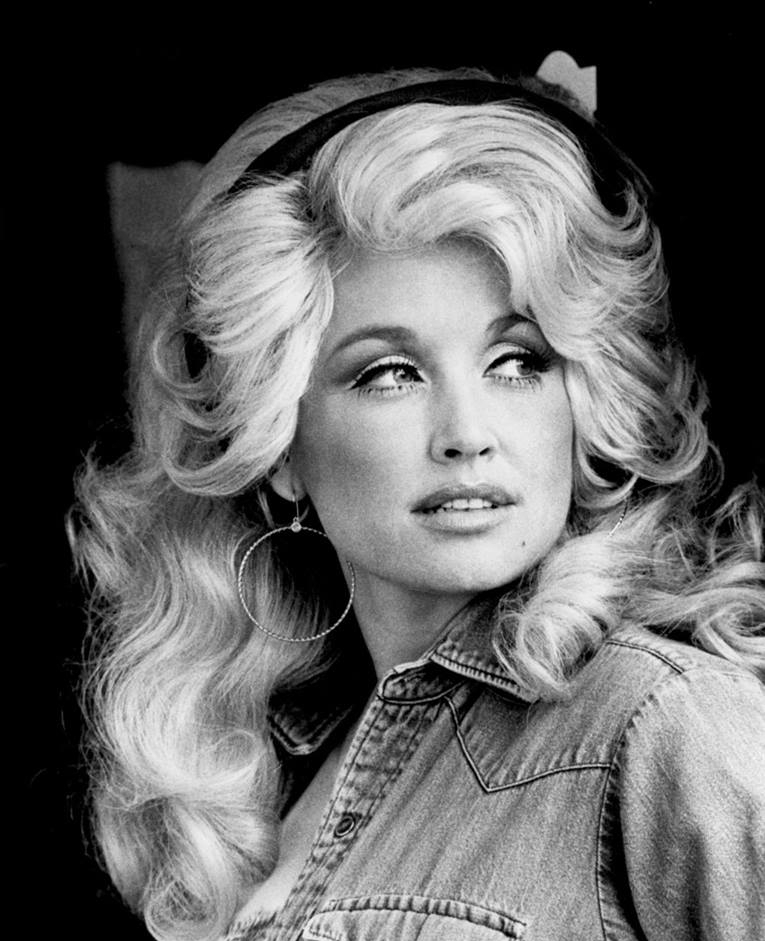 Dolly Parton in 1977, near the height of her crossover from country to pop. RCA Records publicity photo, public domain in the US.
A yes and a no, both decided in the room
In 1974, Porter Wagoner’s producer Colonel Tom Parker came to Parton with an offer: Elvis wanted to record “I Will Always Love You,” a song she’d already written and taken to number one on the country charts on her own. There was a catch. Parker told her plainly that Presley didn’t record anything unless his side took half the publishing. Parton said no on the spot. She’s told the story dozens of times since, and she’s never once described it as something she weighed or slept on, just something that broke her heart and that she still wouldn’t undo.
That’s Sacral Authority working the way it’s supposed to: a gut yes or no, available the instant something is in front of you, correct in the moment whether or not it feels good. It isn’t a faster version of thinking something through. It runs on its own clock, and the clock doesn’t care how the decision looks. Elvis never got the song. Whitney Houston did, for The Bodyguard in 1992, and because Parton still owned the publishing outright, that one cover alone earned her enough to buy Graceland several times over. None of that was visible from inside the room in 1974. What was visible was a phone call and a decision that took about a second to make.
Parton told the story of that phone call, and what Priscilla Presley later told her about it, decades afterward. Hearing her tell it in her own words makes the speed of the no easier to feel than any description of it can.
Saturn Return, 1975: the split becomes final
A Saturn Return happens once every twenty-nine and a half years, when transiting Saturn arrives back at the exact degree it held the day you were born. Astrology and BG5 both read it the same way: the end of whatever structure you have been operating inside of, a job, a family role, a partnership, either renegotiated on your own terms or broken outright. Parton’s first Saturn Return fell in early July 1975, at 29, transiting the same degree as her natal Saturn, which sits in Gate 62, Details, in the Throat.
That Return closed out a two-year process that had already started. She announced she was leaving The Porter Wagoner Show on 19 February 1974, after seven years as his duet partner and the co-star of his television program. By April she had stopped touring with him. The two of them recorded one last album together, fittingly titled Say Forever You’ll Be Mine, in 1975, as the Return itself arrived. Gate 62 is about precise, factual detail, saying exactly what is true instead of what is comfortable, and that tracks with how she actually did it: not a public feud or a slow drift, but a specific, dated announcement, followed by a plainly written goodbye song handed straight to the man it was about. The Elvis decision above landed in this same stretch of months. 1974 and 1975 were the years her Authority stopped operating inside anyone else’s structure, on more than one front at once.
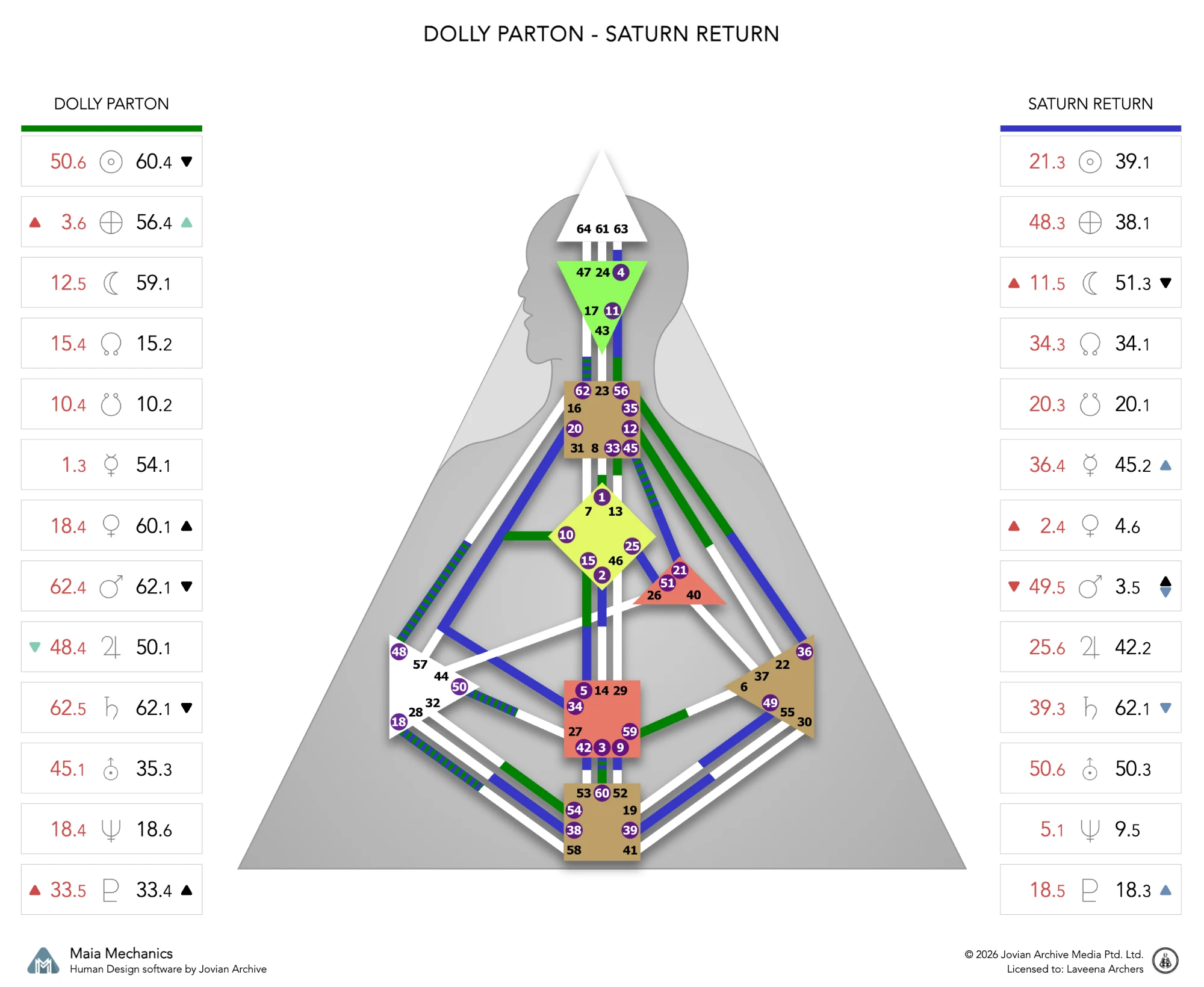 Design and Personality on the left, the July 1975 Saturn Return transit overlaid on the right.
Uranus Opposition, 1984: built as a solo act, and she partnered anyway
Parton’s chart carries Single Definition, which means the centers she has defined all link into one connected shape rather than splitting into separate pieces that need another person to bridge them. Mechanically, that makes her a solo act: nothing in her design requires another person to complete it, the way a Split or Triple Split chart does. That’s a different starting point from most people’s charts, and it’s worth being plain about it rather than dressing it up.
A Uranus Opposition arrives once, around midlife, when transiting Uranus reaches the exact opposite point of its position at birth, roughly forty-two years after a first Saturn Return. It is the cycle most associated with a sudden, uncharacteristic break from an established pattern, the moment a settled-looking life visibly stops staying settled. Parton’s fell on 7 December 1984, at 38, transiting Gate 5, Fixed Rhythms, in the Sacral, the gate of steady, repeatable practice rather than one-off inspiration.
Two years before that, in 1982, a television interview she gave caught the attention of Pete and Jack Herschend, who ran a theme park an hour from her hometown called Silver Dollar City. A chain of introductions, her bus driver knew the park’s general manager, who knew the Herschends, turned into an actual conversation, and by 1985 the two sides had a signed agreement: Parton would invest several million dollars to expand and rename the park, keeping its existing rides and attractions rather than starting over from nothing. It reopened as Dollywood on 3 May 1986. Her Uranus Opposition sits almost exactly in the middle of that three-year arc, the point where a spontaneous spark turned into the Fixed Rhythms of an actual signed deal, a park with a season and a calendar it would go on keeping for four decades. She didn’t need the Herschends to be whole, Single Definition doesn’t work that way. She brought them in for what they actually had, running a theme park, which she’d never done and never claimed to know how to do, and that’s a different kind of decision than one made out of needing another person to function.
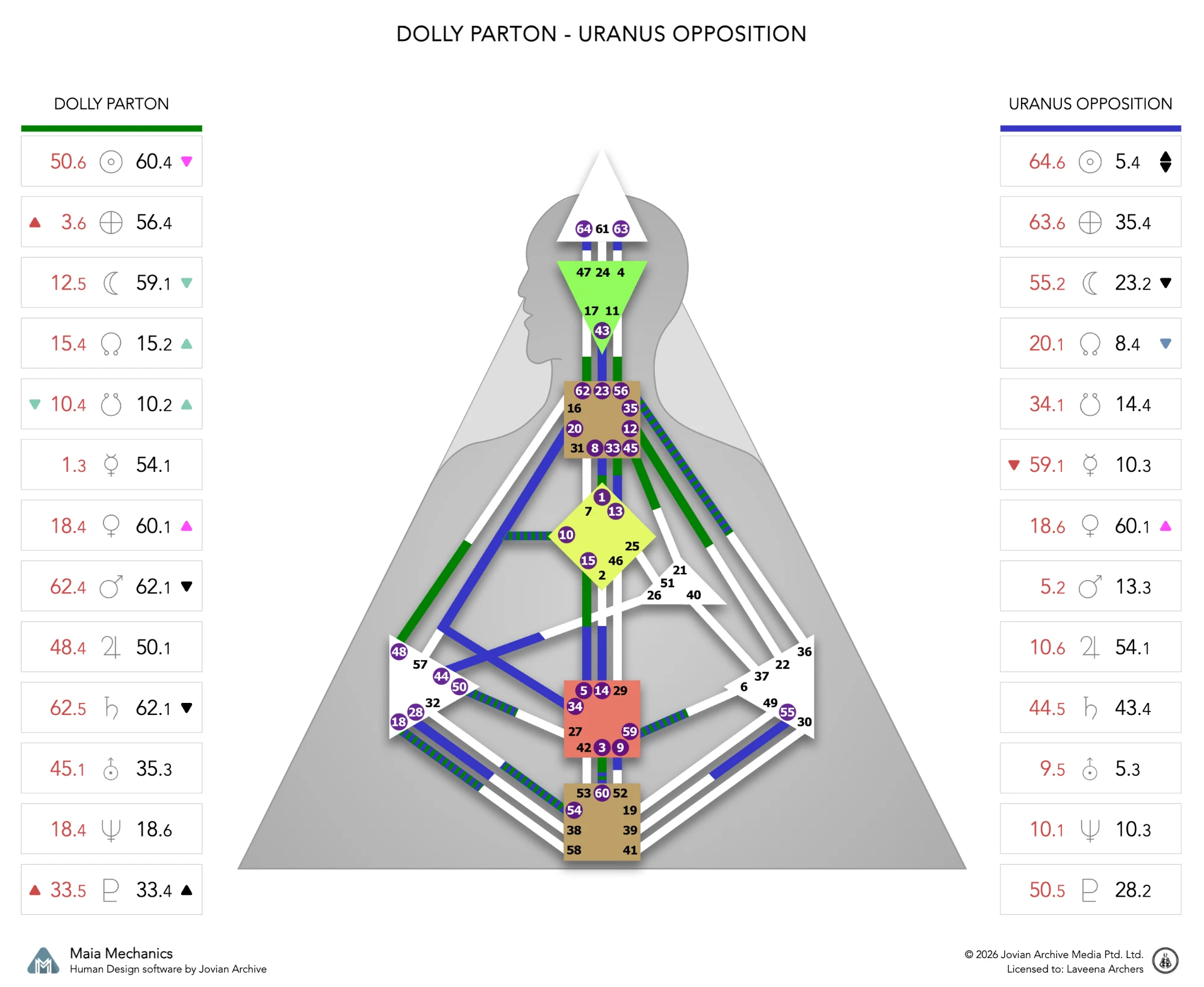 Design and Personality on the left, the December 1984 Uranus Opposition transit overlaid on the right.
The chain of introductions that turned a regional theme park into Dollywood is documented on film, from the 1982 interview through the 1986 reopening.
Chiron Return, 1996: the library built for her father
Chiron’s orbit is eccentric enough that its return doesn’t arrive on a fixed schedule the way Saturn’s does, but Parton’s fell on 19 October 1996, at 50, transiting Gate 32, Continuity, in the Spleen, the gate concerned with what is worth preserving against the fear that it won’t last. Chiron is the wounded healer placement in both astrology and BG5’s own use of the term, the point that describes where a person’s earliest injury becomes the thing they end up building a way to heal in other people.
Her father, Robert Lee Parton, never learned to read. He left school as a child to help support the family, and by her own account it embarrassed him for the rest of his life. Filling out a form, reading a newspaper, reading to his own children, none of it was available to him. In 1995, the year before her Chiron Return closed, Parton started the Imagination Library in Sevier County, her home county, mailing a free book every month to every child from birth to age five. It wasn’t built as a one-time gift. It was built for continuity from the outset, and she kept expanding it for the rest of her life rather than ever treating it as finished: by the time she died it reached all fifty states plus parts of Canada, the United Kingdom, Australia, and the Republic of Ireland, and had distributed more than 178 million books.
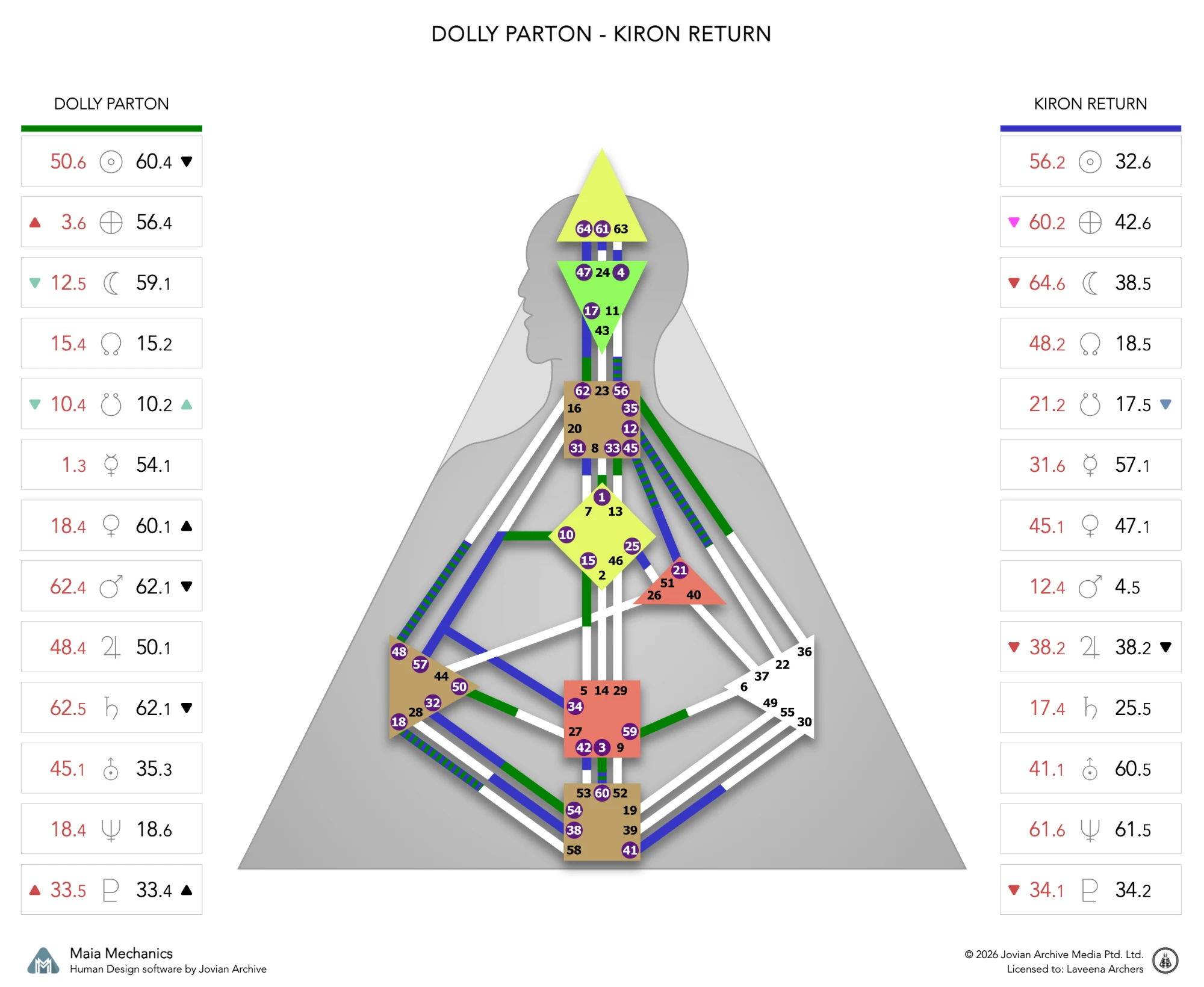 Design and Personality on the left, the October 1996 Chiron Return transit overlaid on the right.
A return carries its own temporary cross on top of whatever cross a person is born under, and hers ran Left Angle: the Cross of Limitation, 32/42 paired with 56/60. Her natal cross, the Cross of Laws, is Right Angle, which means the structures she builds normally start from her own initiative. A Left Angle window runs the opposite direction: it responds to what circumstances outside the person are actually asking for, rather than generating an agenda from inside. That distinction tracks with her own account of the Imagination Library. She didn’t say she’d been planning a literacy nonprofit. She said her father’s shame followed her around until she did something about it. A self-generated Cross of Laws project would read like a plan. This reads like an answer to a specific, external demand, which is exactly what a Left Angle window is built to produce.
Two channels also completed for the length of the return that aren’t there in her natal chart at all. The transiting Gate 21 linked to her natal Gate 45, forming the Channel of Money, the circuit concerned with controlling material resources inside a domain of one’s own. Gate 45 is the same Gatherer gate that pulled Silver Dollar City into Dollywood nine years earlier. For this one window, that same gathering instinct had a live money circuit plugged into it, and what she built with it wasn’t a one-time check. It was a funded, monthly, systemized distribution operation, run like a business rather than handed off as a donation. Separately, the transiting Gate 32 linked to her natal Gate 54, forming the Channel of Transformation: a private drive (Gate 54 sits on her natal Personality Mercury, the ambition gate) wired directly into the same Continuity gate the return was already transiting. Her own ambition, for the length of that return, had a real circuit for turning into something durable instead of just an open Spleen’s instinct for recognizing durability in other people’s projects.
Both channels closed when the return did. What she built while they were open didn’t. That’s close to the literal mechanics of planting an Incarnation Cross: a temporary connection supplies the wiring a natal chart doesn’t carry on its own, long enough to root something that keeps running on its own structure after the wiring disconnects.
Second Saturn Return, 2004–2005: the structure ratifies her
A second Saturn Return, at roughly 58, is a different event from the first. The first one, in 1975, was about leaving a structure that no longer fit. The second is rarely about leaving anything. By the time it arrives, a person has usually spent thirty years building their own structure, and the Return tends to show up as the wider world formally recognizing it rather than as another rupture. Parton’s second Return fell across the same natal degree as her first, Gate 62, Details, in the Throat, landing in a cluster through August 2004 and into the spring of 2005.
That is exactly the window in which two institutions that don’t hand out honors casually both did. The Library of Congress gave her its Living Legend Award on 14 April 2004. The following year, the National Endowment for the Arts named her a National Medal of Arts recipient, the highest arts honor the United States government gives an individual. Neither was a business decision she made; both were the country’s own record catching up to thirty years of ones she already had. Gate 62 is still about precise, factual detail, and there’s a kind of symmetry in that: the same placement that pushed her to leave Porter Wagoner’s show with a specific, dated announcement in 1974 is the one sitting under the government’s own detailed, dated citations of what she’d built by 2004.
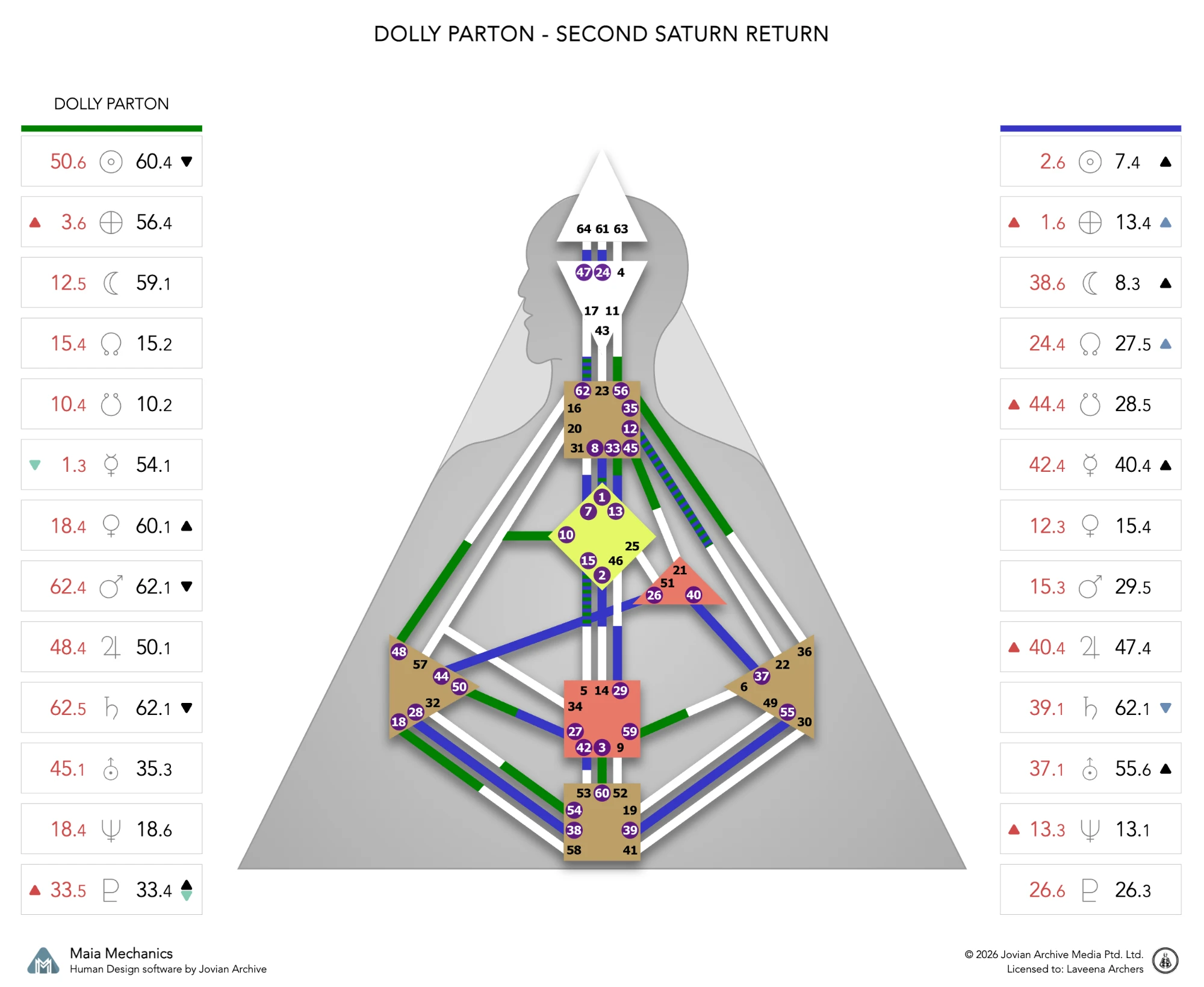 Design and Personality on the left, the 2004–2005 second Saturn Return transit overlaid on the right.
The profile and the cross
Her chart also carries a 4/6 Profile and an Incarnation Cross of Laws, built from Gate 60 (Limitation), Gate 56 (Stimulation), Gate 50 (Values), and Gate 3 (Ordering). A 4/6 spends roughly the first three decades of life testing things out through close friendships and a small trusted network, then moves into something closer to distance and role-modeling. Loosely, that tracks with a life that ran from a tight-knit Smoky Mountain family and a long professional partnership with Porter Wagoner toward a more solitary, more observed-from-a-distance later chapter.
Her birth time is on record: 8:25pm, in Sevierville, Tennessee, rated AA by Astro-Databank, meaning it traces to a birth certificate or birth record rather than a biography or a rectification. myBodyGraph’s own chart for her runs on the same time. That’s solid enough ground to read Profile and Incarnation Cross with real confidence, not as a provisional estimate.
What a million dollars bought a year early
Motivation is one of the mechanics that doesn’t move with birth time, and Parton’s is Hope, meaning sustained effort aimed at what something could become rather than what it might protect her from. The clearest example of it isn’t musical at all. In April 2020, with no vaccine yet in existence and no guarantee her money would produce one, Parton gave a million dollars to Vanderbilt University Medical Center for coronavirus research. Vanderbilt later confirmed the gift had helped fund the early work behind what became the Moderna vaccine.
When her own turn came to get the shot, in March 2021, she didn’t put out a statement. She filmed herself, guitar in hand, singing a rewritten verse of “Jolene” seconds before the needle went in: “Vaccine, vaccine, vaccine, vaccine / I’m begging of you, please don’t hesitate / Vaccine, vaccine, vaccine, vaccine / Because once you’re dead, then that’s a bit too late.” AP and the BBC both picked it up the same day. Money committed a year before there was any proof it would work, followed by a public moment she wrote herself to get other people to act on it rather than to take a bow, that’s Hope showing up as an actual business decision, not just a trait on a chart.
Perspective is the other half of Rave Psychology, the read on how a mind actually takes in the world rather than what drives it to act, and hers is Wanting: tracking what’s still needed rather than settling into whatever has already been secured. It rarely shows up as one dated decision the way Motivation does. It shows up as a refusal to let any finish line count as finished. Dollywood added a new headline attraction every several years across four decades instead of coasting on the 1986 reopening. The Imagination Library kept crossing into new countries long after it had already succeeded in one county in Tennessee. Neither expansion was necessary by the point it happened. Wanting doesn’t ask whether something is necessary. It asks what isn’t there yet.
The rest of her design sits on similarly steady ground: Hot Digestion, an Uncertainty Sense, Valleys as Environment, none of it birth-time-sensitive. The Imagination Library, above, is the same Hope-motivated pattern stretched over a much longer run than a single vaccine video, decades rather than a day.
Where the actual profit was: her open centers
Single Definition means exactly two of Parton’s nine centers are defined: the Sacral, and the Root beneath it, joined by the Channel of Mutation running from Gate 3 to Gate 60. That’s it. The other seven, Head, Ajna, Throat, G, Heart, Spleen, and Solar Plexus, are all open. Most readings of a chart like this stop at the Sacral, because the Sacral is where the famous decision lives: the Elvis no, the Wagoner split. But this site’s own model of profit centers argues that a person’s real commercial value tends to sit in the open centers, not the defined ones, because an open center has no fixed way of operating. It takes in whatever is around it, runs through every variation of it over a lifetime, and eventually turns that exposure into a kind of pattern recognition nobody with a defined center in the same spot ever develops. Read Parton’s business record against her seven open centers, and a second pattern shows up underneath the Sacral yes-or-no, one built entirely out of places she had no fixed answer of her own.
Head. An open Head takes in the mental pressure of a question without ever landing on one fixed answer to it, which means the same question can keep coming back changed. Parton wrote “Coat of Many Colors” in 1969 about a specific childhood memory: a coat her mother sewed from rags, and the other kids mocking it at school. She didn’t leave it as a song. She turned it into a 2015 NBC television movie, and the story anchors its own exhibit at Dollywood. One piece of unresolved pressure, reprocessed into a fresh product across five decades, is what an open Head looks like when it stops just aching and starts shipping.
Ajna. An open Ajna has no fixed way of thinking something through, which sounds like a liability until it becomes the reason a person can say yes to categories that share no internal logic at all. Parton never built Dollywood as a single, planned business. She added to it opportunistically, decade after decade: the park itself in 1986, the dinner attraction now called Dolly Parton’s Stampede in 1988, the Splash Country water park in 2001, the DreamMore Resort in 2015. No fixed strategic frame connects a theme park to a dinner show to a water park to a hotel. What connects them is a subjective test applied fresh each time, whether it feels like Dolly, which is exactly the kind of judgment an open Ajna is built to make.
Throat. An open Throat has no consistent voice of its own, and no built-in pressure to be noticed either. Both come from outside: whatever register the room actually needs, and whatever gets people looking, rather than one fixed way of doing either. Parton’s actual singing voice carries the first job, moving from the piercing high belt on “9 to 5” to the close, quiet harmonies of Trio, the bluegrass and folk album she recorded with Linda Ronstadt and Emmylou Harris in 1987, a range most working musicians never leave one register long enough to develop. In 2009, “9 to 5” became a Broadway musical, an entirely different vocal and structural form for the same material again. The second job, getting attention, she ran on purpose: she posed for Playboy’s October 1978 cover at the height of her pop crossover, then in 2021, at 75, had a private photo taken recreating the same look as a gift for her husband, Carl Dean, and let it become a widely covered news story the moment she shared it. None of it came from a fixed voice or a fixed need underneath. Both were amplified on demand, exactly what an open Throat is built to do.
G Center. An open G Center has no fixed identity, and Parton has said as much herself, describing “Dolly” as closer to a costume she puts on than a private self she’s revealing. That flexibility is precisely what let a string of institutions each project a different identity onto her without any of them being wrong: the Library of Congress’s Living Legend Award in 2004, the National Medal of Arts in 2005, a Kennedy Center Honor in 2006. Country legend, national treasure, philanthropist, each is a different fixed identity handed to a person who never had one of her own to defend, so she could hold all of them at once.
Heart. An open Heart has no built-in compulsion to prove its own worth, but that same openness makes it unusually good at reading what a promise is actually worth to the person receiving it. Within 48 hours of the wildfires that devastated Sevier County in November 2016, Parton and the Dollywood Foundation set up the My People Fund and started paying $1,000 a month to every family who’d lost a home, reaching more than 900 families and raising over twelve million dollars in the process. It wasn’t a foundation grant cycle running on someone else’s calendar. It was a specific, immediate, dollar-figure promise, made in public within two days and kept on schedule after that.
Spleen. An open Spleen has no fixed instinct of its own, only an unusually sharp read on what’s actually safe or true in a given moment, one that can flip in real time as the moment changes. In 2022, Parton asked to be taken off the Rock and Roll Hall of Fame ballot, saying publicly she didn’t feel she’d earned a place in a genre she hadn’t worked in. The Hall inducted her anyway that November. Her response wasn’t to relitigate the point. She changed her read on the spot, accepted, and released an actual rock album, Rockstar, in November 2023, closing the gap after the fact instead of arguing it beforehand.
Solar Plexus. An open Solar Plexus has no emotional truth of its own, but it becomes remarkably accurate at sensing what a room, or a country, needs to feel next. In September 2020, with the pandemic still grinding on and no vaccine yet available, Parton released “When Life Is Good Again,” a song written specifically to hand people something to feel besides dread. It wasn’t written from a fixed emotional position she was defending. It was timed to what the moment was actually asking for, which is the tell of an open center working correctly instead of just absorbing and amplifying static.
Seven open centers, seven different products, none of them the famous Sacral no. That’s the pattern underneath the pattern: the thing she had no fixed, defended position on was, over and over, the thing she ended up selling.
This article covers the business mechanics. The personal side of her chart, read against her life and death rather than her balance sheet, is in In Memory of Dolly Parton: A Life Run on the Sacral Yes.
Related
- Leadership Is Alignment to Your Own Authority — what it looks like to run decisions through real Authority instead of a boardroom’s preferred process
- Partnership: Why Two-Person Businesses Work or Fail — the mechanics behind choosing a structural partner well
- Jessica Alba: The Founder Who Never Took the CEO Seat — another founder’s design read against her company’s documented history
Chart images calculated and rendered with Maia Mechanics, Jovian Archive’s own charting software, cross-checked against her chart on file at myBodyGraph. Birth time sourced independently from Astro-Databank (AA rating). Saturn Return, Uranus Opposition, and Chiron Return dates calculated independently against that birth data using the Swiss Ephemeris, the same planetary engine behind the bodygraph itself; gate and line placements sourced from hd-reference.json, this site’s standard reference. Biography and business record independently verified against Britannica, dollyparton.com, The Boot on the Wagoner split, the Tennessee Encyclopedia on Dollywood, Biography.com on the Imagination Library, the Library of Congress on the 2004 Living Legend Award, the NEA on the 2005 National Medal of Arts, ABC News and WBIR on the My People Fund, the Rock and Roll Hall of Fame’s own record of her 2022 induction, and contemporaneous press coverage of the events described above, including AP News and BBC News on the March 2021 vaccine video.
If you’re a Dolly fan and want more than the business record, her full life story, the marriage, the health, the four returns read start to finish rather than filtered through decisions and deals, is told in In Memory of Dolly Parton: A Life Run on the Sacral Yes.
In memory of an ICONIC Human Design, Dr. LaVeena B. Archers, PhD
Want mechanics like this in your inbox? Subscribe to the Human Design Mastery Executive Briefs newsletter on LinkedIn for the readings behind how legendary founders and leaders actually made their calls, or read this piece’s own newsletter edition directly.
Dr. LaVeena B. Archers has spent more than thirty years as an entrepreneur and teaches the career and business application of the Human Design System. She helps business owners and entrepreneurs market themselves in a way that fits their design, lead their teams to greater efficiency and profitability, and find the work their chart was actually built for.