Pillar · Owner-operators

Human Design for Entrepreneurs

Nobody is paying you a salary while you work this out. Your Career Type is not a personality result — it is a constraint on what you can sell, how it has to reach people, and what it costs you to deliver.

Reviewed 2026-09-04 · next review 2027-09 · by LaVeena B. Archers, PhD, Education Director of Jovian Archive

Who this is for

Owner-operators. Consultants and coaches with a practice that has to pay. Founders small enough that the business does what you do, and stops when you stop. The distinguishing feature is not headcount — it is that there is no structure underneath you absorbing the cost of working against yourself. An employee running the wrong strategy is tired. An owner running the wrong strategy is unpaid.

If you run something larger, or your decisions mostly reach other people rather than your own week, the main pillar is the better door.

A business built on someone else's mechanics can still work. It just costs you more to produce every single unit of it, forever, and the cost never appears on any line of the P&L.

— Why this is a commercial question

One

Your Career Type is the first constraint on your offer

Not on your personality, and not on what you are allowed to want. On the shape of the thing you sell and the route by which it reaches a buyer.

Classic Builder Generator

Your offer has to be something people bring to you. A cold-outreach model asks you to initiate all day, which is the one thing a Builder is not built to sustain — and the work still has to be there to respond to when the calls stop.

Express Builder Manifesting Generator

Build the offer to skip steps, because you will skip them anyway. A rigid nine-module program is a promise to do the boring middle, and the middle is where an Express Builder quietly abandons things.

Initiator Manifestor

You can start the thing nobody asked for, which is a genuine commercial advantage and the reason Initiators found companies. The cost is that people resist what arrives unannounced, so informing is not a courtesy here — it is the mechanic that stops your launch being fought.

Advisor Projector

The offer is the recognition, not the effort. An Advisor selling hours is selling the one thing they have least of; an Advisor selling a read, a diagnosis or a decision is selling the thing they actually produce. This is the Type most likely to build a business that exhausts them and pays badly.

Evaluator Reflector

Whatever you sell needs to survive a month of your own sampling. Price and package on a lunar cycle rather than a launch week, and be extremely careful whose business you spend your time inside — you will become it for a while.

The constraint is not a ceiling. Every one of the five can run a profitable practice, and the field has examples of all five doing it. What differs is which business model is cheap for you to operate and which one you will be paying a tax on for as long as you keep it. All five at work.

Two

Where the income is designed to come from

Most people look for their money in their definition — the consistent, reliable parts of the chart. That is where the sustainable energy is, and it is not usually where the money is.

Profit centers read substantially from openness. An open center is where you have spent a lifetime taking in, amplifying and studying what other people simply have and never think about. That accumulated study is precisely what a client will pay for, because they cannot get it from someone for whom the thing is automatic. The article Your profit centers are in your openness is the long version, and the wisdom of the open centers is the practical one.

The counterpart is the distortion. The same openness that makes you an expert makes you vulnerable in exactly that area when you are not aware of it — which is why the undercharging problem is so often not a negotiation problem. See undercharging in a business partnership and the undefined Heart story. The whole Money & Profit category runs on this.

Pricing by design

There is no formula that reads a number off a bodygraph, and anyone selling one is selling something else. What the chart settles is what you are selling, and the number follows from that.

  • Advisors price the seeing, not the hour. An Advisor billing time is monetising the one resource they have least of. The same person pricing a diagnosis, a decision or a read is charging for output rather than endurance.
  • Builders price on response. Work you have actually said yes to is sustainable, which means you can hold a rate through the delivery without resenting it. Work taken from the mind, because the number looked good, is where scope creep and quiet discounting come from.
  • Initiators price in the informing. The impact of an Initiator's launch lands on people who did not ask for it, and the resistance that produces is a real cost that has to be funded rather than wished away.

For what the field actually charges rather than what it says it charges, the 2026 Practitioner Pricing Report sets out observed bands with the method and its limits stated. Pricing psychology for readings covers the part that happens in your own head.

Three

Building the practice

A practice is not the same object as a design. Yours has to acquire clients, onboard them, deliver, get paid, and survive the months when it does none of those. The Building a Practice category is the largest body of writing on this site aimed squarely at that, and it is written from having done it rather than from having read about it.

Two pieces worth starting with if you are weighing the professional route. The certification ROI math works through what it actually takes to earn back a BG5 credential, semester by semester. And fourteen years inside the experiment is the long view, which is a different thing from a launch plan.

A note on what this site is not: it does not certify anyone. If the credential is what you want, that is the school's job. This page is about the practice you run with it, or without it.

Four

Founders, read against their own charts

The most useful thing about a public founder is that their birth record is public too. Every chart below is calculated from a published record with its reliability rating stated, so you can re-run it and check the reading rather than take it.

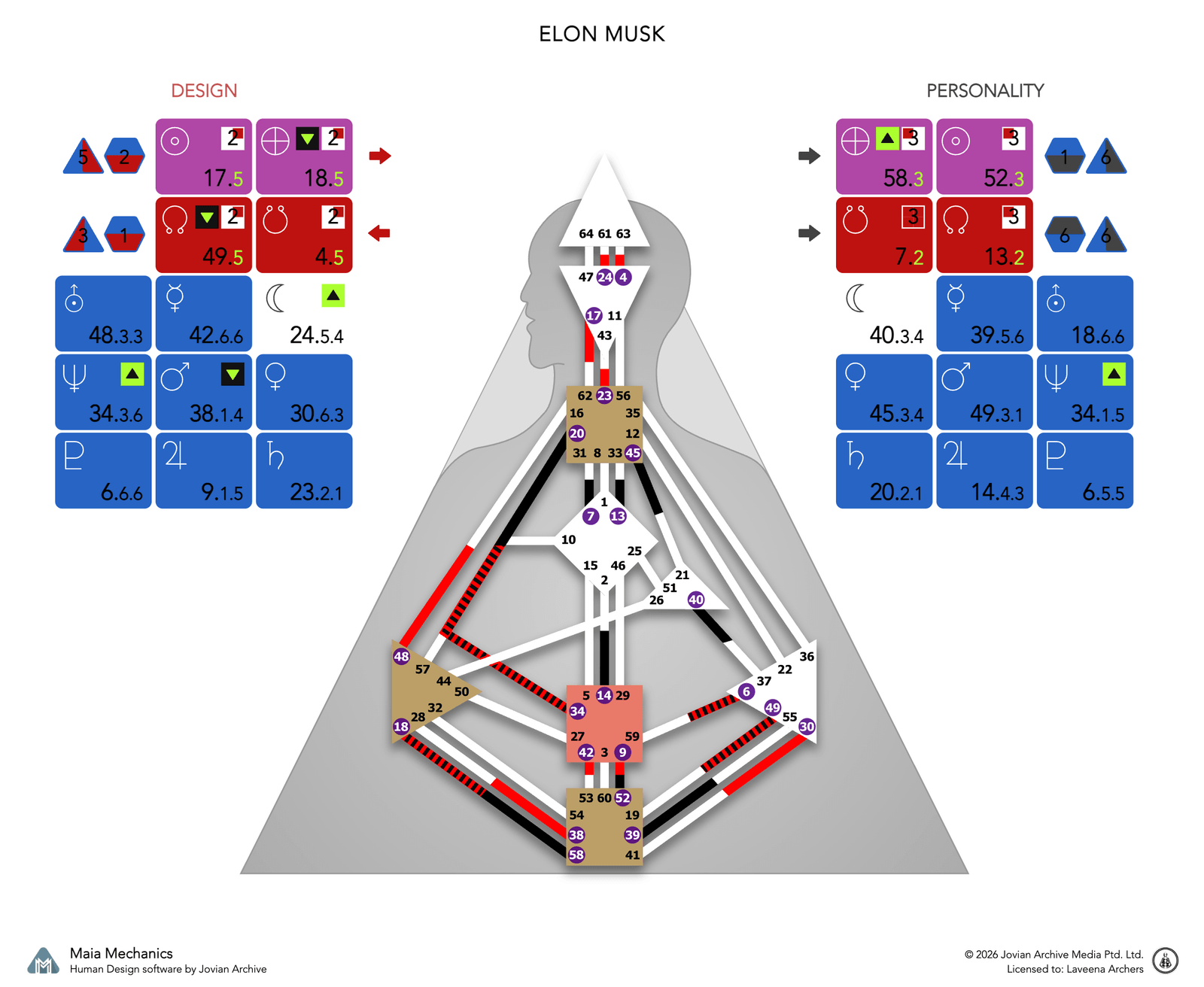
Elon Musk's bodygraph, Design and Personality sides, calculated with Maia Mechanics
Elon Musk's bodygraph. Design on the left, Personality on the right, from a B-rated birth record — which is why that article states the Type plainly and flags Profile and Authority as provisional.
  • Jobs and Wozniak — two AA-rated charts, and the partnership mechanics that made the 45/45/10 split hold together for exactly as long as it did.
  • Elon Musk — one channel, 20-34, running the Sacral straight into the Throat, and what a compressed working style is actually made of.
  • Christian Dior — the offer he refused before the one he took, read against Emotional Authority and a birth certificate to the minute.

All business-figure analyses, each with its birth record, Rodden rating and source published on the page.

Five

Cycles, and why 2027 keeps coming up

A solo business has no one to absorb a founder's transit. When your Saturn return rearranges what you are willing to keep doing, the company feels it that quarter. Knowing the dates in advance turns an inexplicable year into a planned one.

The larger shift is 2027, when the underlying program of the age changes. What that means for a practice built on the current one is the subject of when your business blueprint becomes critical and the 2027 shift, with remote work and AI displacement taken separately. The whole Cycles & 2027 category is free.

Six

Deciding with nobody to escalate to

An employee who is unsure can push a decision up. An owner cannot. Every judgment call terminates with you, several times a day, most of them small enough that you do not notice making them — and the accumulated drift of deciding the wrong way for you is most of what people later describe as having built the wrong business.

The mechanism is calculable and differs by person. Roughly half of people have Emotional Authority, which means there is no truth for them in the moment: clarity arrives over hours or days, and any answer given on the spot is the worst one available. For an owner that is not an inconvenience, it is an operating rule. Every proposal, price and partnership needs a night. The investor-vetting piece works through what that looks like against real money.

Others decide from the gut in the instant the thing is in front of them, and lose accuracy the longer they sit with it. That person taking a week to “think it over properly” is not being diligent; they are talking themselves out of a correct answer they already had. Reading a prospect's authority before you pitch turns the same mechanic outward, which is the version that changes your close rate.

This is the change to make first. It costs nothing, it needs no new offer, and it is testable against your own record inside a week. Get the decisions aligned before the profit work is the argument for that ordering.

What to stop doing

The hardest part of this for an owner is rarely the new thing. It is the permission to drop something that works, sort of, and that you are good at. Being good at something is not evidence it belongs in your business — competence and sustainability are different measurements, and an owner-operator can run on competence alone for years before the bill arrives.

The signal to watch is your Type's own cost line: frustration for a Builder, bitterness for an Advisor, anger for an Initiator, disappointment for an Evaluator. Those are not moods to manage. They are instrumentation, and in a business they are usually pointing at a specific recurring activity rather than at the whole enterprise. Reading burnout as an intake signal makes the case that the fix is upstream of capacity, and the Energy & Sustainability category is where this is worked through in detail.
Seven

The first hire, and the day you stop being a solo practice

Everything above is about one chart. At three people working together in person, something else switches on that no individual chart accounts for: a Penta, a trans-auric form with twelve seats of its own that exist whether or not anybody present is built to fill them.

This is the part owner-operators are least warned about. You hire for a skills gap, the skills gap closes, and the business gets harder anyway — because the group you now have covers a different set of the twelve seats than the group you modeled in your head. Two of those seats, Implementation and Public Relations, take roughly seventy percent of a small group's energy between them, and a business that covers neither can work extremely hard in complete obscurity.

The useful move before hiring is to read the group you would actually have, not the org chart you are drawing. The Penta calculator is free, runs in your browser, and transmits nothing — put yourself and the two or three people you work with most closely into it and look at which seats come out empty. A missing seat is a hire, a redistribution, or a deliberate decision to run without it and watch for the specific failure it produces.

One rule that does not bend: everyone charted must know and consent. This is not offered for screening or hiring decisions at any price — see the ethics page. If the gaps turn out to be real, the Team Gap Reading at $1,497 per team is the written version with the reasoning attached, and it credits against the larger team work within 60 days.

Eight

The ladder for an entrepreneur

Shorter than the full catalogue, because most of what an owner-operator needs sits in four rungs.

HD Career Design Report $97 Your own mechanics in writing. Nothing to schedule, and enough to act on.
Career Design Consultation · Level 1 $497 The same material with a person on the other end, so you can ask the follow-up.
Private Mentorship $1,497 You will not be handed a course library and wished luck.
The Working Experiment $3,997 Eight weeks actually running the business by your own mechanics, not reading about them.

Weighing one decision rather than a program? The Focused Session at $697 is one working hour, and it credits in full against the two largest containers within 30 days. Every offer and price side by side.

Frequently asked

Questions from people running something

Can I really price by design?
Not in the sense of a formula that reads a price off a chart. What the chart does is name what you are actually selling, and price follows from that. An Advisor charging by the hour is selling energy they do not have; the same person charging for a diagnosis is selling the thing they produce, and the number moves accordingly. A Builder pricing on response can hold a higher rate because the work is sustainable; an Initiator has to price in the informing they cannot skip.
Do I need the consultation before the longer work?
No. The Working Experiment and the other containers are open to buy directly. The reason most people start with the $97 report or the $497 consultation is not gatekeeping — it is that eight weeks of running your business by mechanics you have not yet seen described is a poor use of eight weeks.
What is a profit center?
The parts of your working life that are designed to generate rather than to consume. In a chart it reads from openness as much as from definition: some of what you can charge for is the wisdom you have accumulated in the centers you do not have defined, precisely because you have spent a lifetime studying what other people take for granted.
Is this for a solo practice, or does it need a team?
Solo is the common case here and the whole ladder works without a single employee. The group mechanics only switch on at three people working together in person, which is what the free Penta calculator is for — below that, what you have is one chart and, at most, a partnership.
What does it cost?
From $97 for the written report to $3,997 for the eight-week container, with Private Mentorship at $1,497 in between. Every price is published and bought online, and there is no discovery call in either direction.
What changes first?
How you decide. It is the only change on this page you can test inside a week, it costs nothing, and it does not require you to alter a single thing about your offer. Everything else — pricing, packaging, what you stop doing — is downstream of trusting your own decision mechanism enough to act on it.

Related pillars: Human Design for Business · reference: the five Career Types, the 64 gates, the Success Codes. Free tools: chart, Penta, OC16.

Reviewed 2026-09-04 · next review 2027-09

$100 off your first session

Take $100 off the Career Design Consultation · Level 1

$497 $397 first session only

Your chart read personally — Career Type, how your decisions actually resolve, and the work setting you are built for. Enter your email and the code is yours, along with a short series on the six Success Codes a career analysis is built from.

Valid 30 days, one use, on the Career Design Consultation · Level 1 only. No call, ever.