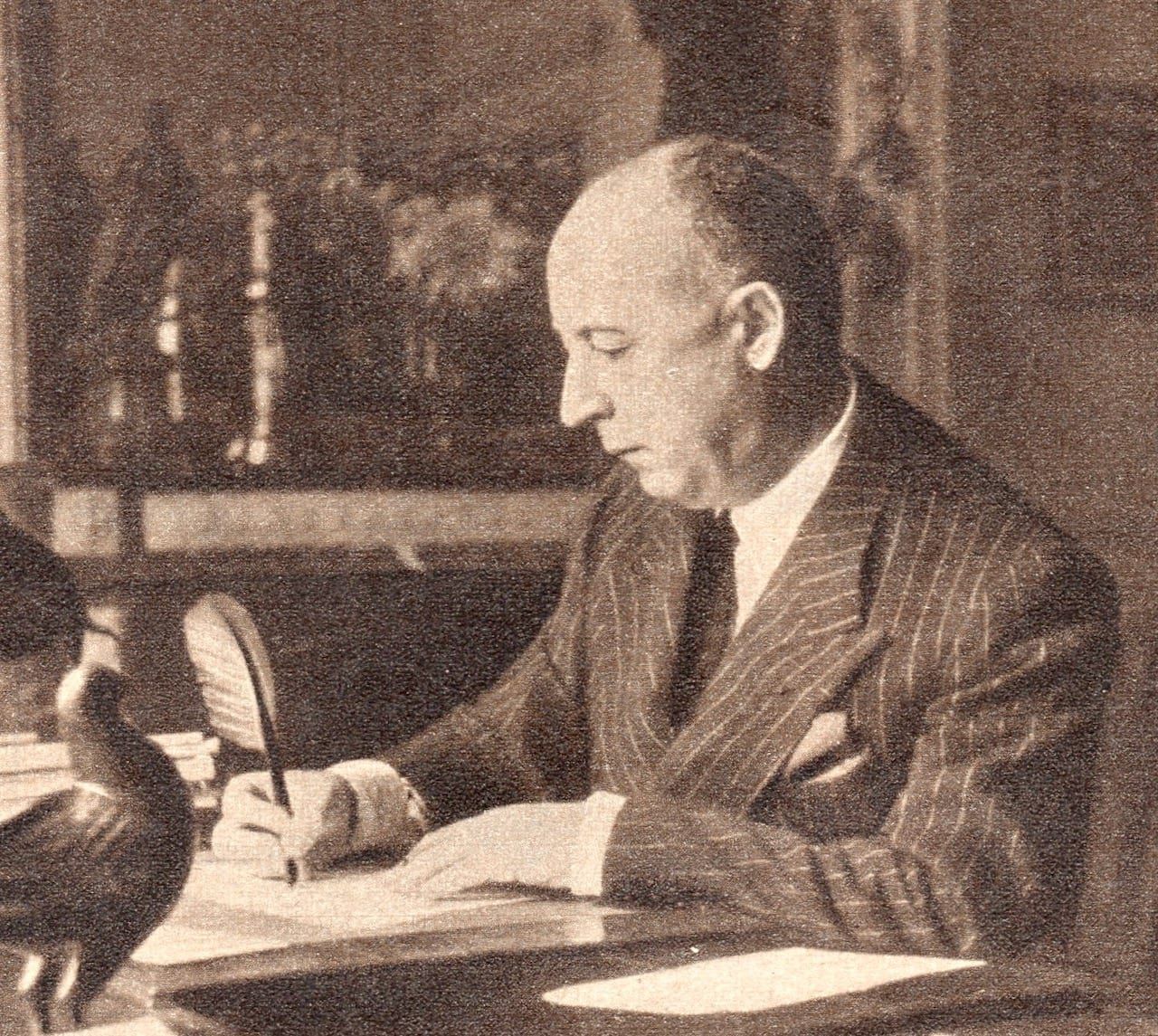
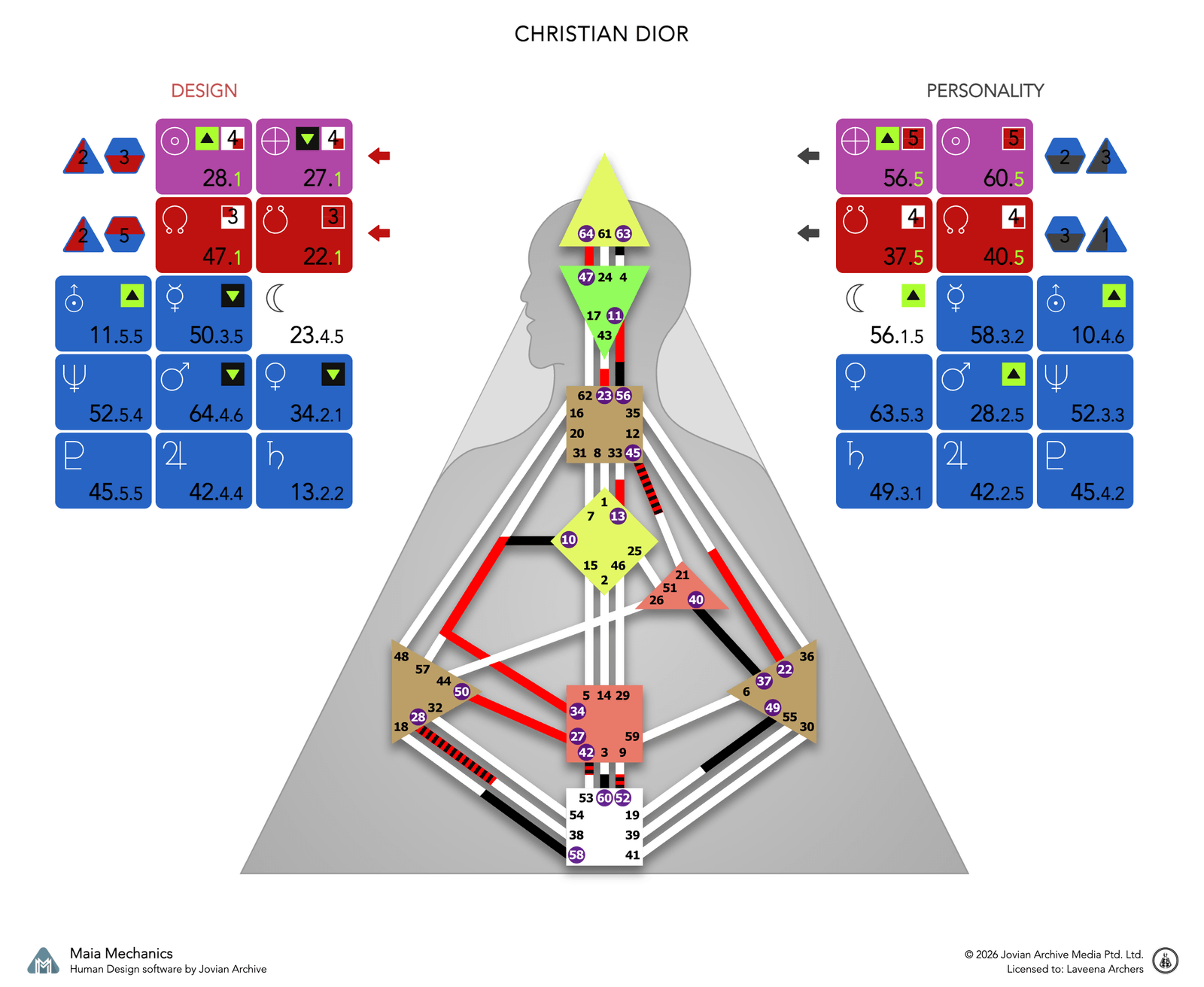
Chart calculated with Maia Mechanics, from an AA-rated birth record
Quick look: Christian Dior had Emotional Authority, and the single most important decision of his commercial life was one he refused to make on the spot. When Marcel Boussac offered him the direction of a couture house in 1946, Dior turned it down, waited, and came back with a different proposal: a house under his own name. He got it, and the name became the asset.
If you have Emotional Authority and you have ever been pressured to answer a funding offer, a partnership, or an acquisition in the room, his record is worth reading closely. The deal he is remembered for is the one he did not take first.
Where this chart comes from
Most public-figure charts rest on a guess. Where no birth time is recorded, a noon default gets substituted, and everything downstream of the minute is then presented as though it were fact.
Dior’s is a genuine exception. Astro-Databank records his birth as 21 January 1905 at 1:30am in Granville, France, sourced from the birth certificate and rated AA, its highest tier of confidence. The date and place are independently confirmed by the standard biographical record, including Wikipedia’s account and the Musée Christian Dior in Granville, which occupies Villa Les Rhumbs, the clifftop house he grew up in.
The bodygraph here was calculated from those details with the Swiss Ephemeris rather than copied off a chart website, then checked activation by activation against a Maia Mechanics render. Type, Authority, Profile, Definition and Incarnation Cross agree, and so do twenty-five of the twenty-six planetary placements.
The twenty-sixth is worth disclosing rather than hiding. His Personality Saturn sits about eleven arcseconds below the boundary between line 2 and line 3 of gate 49, close enough that our calculation returns 49.2 and Maia returns 49.3. Eleven arcseconds is smaller than the disagreement between ephemeris versions for a 1905 date, so neither reading can be called wrong. Nothing in this article depends on it: the gate is 49 either way, and a Saturn Return returns to the gate.
The recorded minute earns its keep elsewhere. Recomputing the chart across the whole of 21 January shows the design holding as a Generator with Emotional Authority, a 5/1 profile and a Triple Split definition from late on the 20th until about 3:25pm on the 21st, then changing to a Manifesting Generator with a Split. His 1:30am sits roughly five hours inside a nineteen-hour window, on a birth certificate. There is no hedging to do here, which is unusual and worth saying plainly.
What the data produces: a Generator with Emotional Authority, a 5/1 profile, a Triple Split definition, and the Left Angle Cross of Distraction 2 (60/56 | 28/27). Eight of the nine centers are defined, everything except the Root, through five channels: 64-47 Abstraction, 11-56 Curiosity, 10-34 Exploration, 40-37 Community and 27-50 Preservation.
The offer he did not take
In 1946 Marcel Boussac, the richest textile manufacturer in France, went looking for a designer. What he offered Dior was the artistic direction of a couture house he already owned, Philippe et Gaston, a going concern that needed reviving.
Dior said no. He then proposed something else entirely: not the rescue of somebody else’s label, but a new house, carrying his own name. Boussac agreed and financed it. The company was established on 8 October 1946 at 30 Avenue Montaigne, and Dior’s own house records the salons opening on 16 December that year. The first collection followed on 12 February 1947.
Read that sequence against the mechanic. Emotional Authority means there is no trustworthy clarity in the moment. The Solar Plexus runs a wave, and a decision taken at any single point on it reflects where the wave is rather than what the decision is worth. The instruction that follows is not “think harder.” It is “do not answer yet.”
Dior did not answer yet, and the wave did not run in a straight line. By his own account in his autobiography, Dior by Dior, he inspected the Gaston house, decided against it, put his counter-proposal to Boussac, and then, with the thing still unresolved, panicked and sent a telegram breaking off the negotiation altogether. He then went to Madame Delahaye, the fortune-teller he consulted before important decisions, who told him to accept whatever the terms were. He telephoned Boussac’s deputy and undid the telegram, and the agreement came together quickly after that.
A hard no, then a reversal, then a decision that held for the rest of his life: that is what a wave looks like from the outside when someone rides it to the end instead of answering in the room. The mechanically interesting part is structural rather than personal. A design with no in-the-moment authority will reach for outside confirmation while the wave completes. What arrives during that waiting is largely decoration. The waiting itself is the mechanic, and the waiting is what produced the counter-offer.
One detail deserves correcting rather than repeating, because the popular version has it backwards. Dior did find a metal star lying in a Paris street, on 18 April 1946, and kept it. But his own house dates that find to a walk on his way to meet Boussac, who had already agreed to finance a house in his name. The star is a keepsake from a decision in progress, not the omen that made it. The documented turning point is the telegram he had to take back.
The counter-offer is the whole business. Had he accepted in July, he would have been a salaried creative director at a house he did not own, which is a job. What he held out for was his name on the door, and the name is what turned out to be worth something: the licensing business built on it later reached customers who would never buy a couture dress.
There is a second mechanic underneath the bargain. Dior’s only channel touching the Heart, the will center, is 40-37 Community, running from gate 40, Aloneness, in the Heart to gate 37, Friendship, in the Solar Plexus. It is the channel of the bargain, work traded for reward inside an agreement, and it is his sole route to willpower of any kind. His capacity to commit did not exist in isolation. It existed inside a deal with somebody else, and the deal he eventually made is the one that ran the rest of his life.
Three groups, three women
Definition describes how much of your own process closes without anyone else in the room. Dior had a Triple Split: his defined centers fall into three separate groups, with nothing in his chart connecting them.
The groups are Head with Ajna and Throat, through 64-47 Abstraction and 11-56 Curiosity; G Center with Sacral and Spleen, through 10-34 Exploration and 27-50 Preservation; and Heart with Solar Plexus, through 40-37 Community alone.
A Split needs one bridge. A Triple Split needs more, and it needs them consistently, from people who are actually present rather than occasionally consulted. This is a staffing specification, not a character flaw.
The record is unusually literal about it. From the founding, Dior ran the house through a small group of people in fixed senior positions: Raymonde Zehnacker as head of the studio, who had worked with him at Lucien Lelong and left with him; Marguerite Carré as head of the workshops, brought over from Jean Patou, who turned his sketches into buildable garments; Mitzah Bricard as artistic adviser; Suzanne Luling, a friend from Granville, running the salons; and Jacques Rouet on the business side. Pierre Cardin ran the tailoring workshop. The arrangement held for the entire eleven years the house existed under Dior.
His own word for that group is worth borrowing, because later retellings have softened it. He did not describe them as pillars or muses. He called them his general staff, and the studio his little military high command: a command structure with named posts, which is a considerably better description of what a Triple Split actually needs than any metaphor about inspiration.
For a reader with a Split or a Triple Split, the useful part is not that Dior had good colleagues. It is that he had the same colleagues, in defined roles, in the same building, for the life of the company. Bridging that changes every quarter is not bridging.
His 5/1 profile says something adjacent about how he was positioned. Line 1 is the investigator, which needs a foundation laid before anything is built on it, and Dior laid an unusually long one: an art gallery through the early 1930s, then sketch selling, then technical training under Robert Piguet from 1938, then five years under Lucien Lelong from 1941. He was 41 when he founded his own house. Line 5 is the line that gets projected onto as the source of a practical answer, and in February 1947 an entire industry projected onto him at once. The commercial reading on that projection was immediate: within ten days of the first collection, the house had met its financial targets for the whole of 1947.
Line 5 also carries the other half of that mechanic, which is that a projection this size is never really about the person carrying it, and it reverses. The fabric volumes in his collections drew organized objections in still-rationed Britain, and by 1953 American women were forming clubs to protest his hemlines. Being the answer an industry has decided to want is a commercial position, not a personal quality, and it comes with the bill attached.
The Lelong years belong in the record rather than around it. Lelong’s house operated in occupied Paris, and the houses permitted to stay open dressed the wives and mistresses of German officers and of collaborators alongside wealthy French clients. Lelong, as president of the couture federation, is also credited with traveling to Berlin in 1940 to argue successfully against the German plan to relocate French couture to Germany and Austria, and he was later tried for collaboration and acquitted. Dior worked as a designer inside that. His sister Catherine joined the Resistance in late 1941, was arrested on 6 July 1944 and deported to Ravensbrück, and came back in May 1945. His first fragrance, Miss Dior, launched in 1947, is widely understood to have been named for her, though the house has never formally confirmed it.
Saturn Return (30’s), 24 February 1934: everything he had built came down
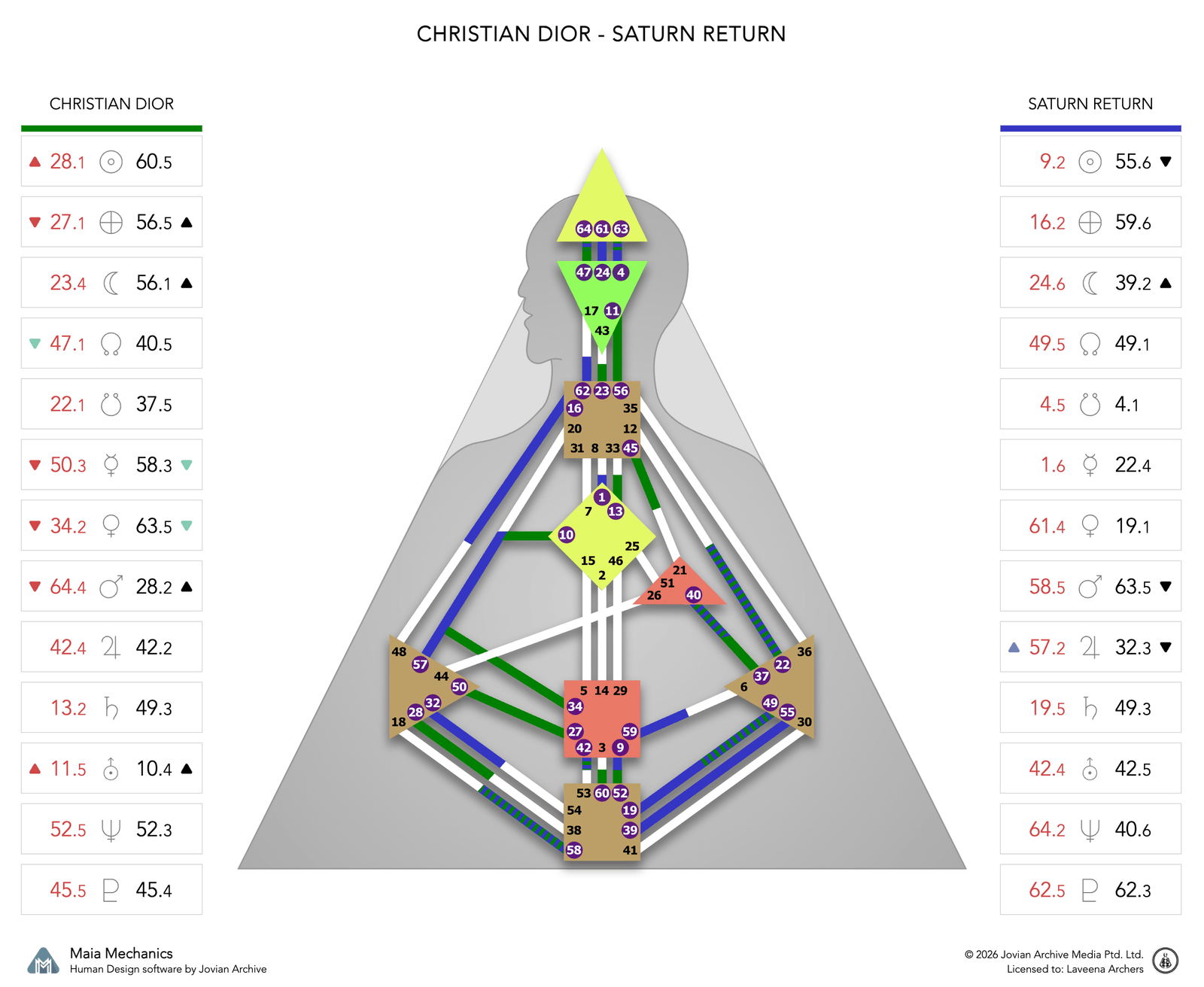 Christian Dior’s Saturn Return transit chart, age 29, calculated for 24 February 1934, 12:21 UTC.
A Saturn Return is a structural audit. Whatever has been built gets tested against reality, and what is not load bearing comes down. Dior’s fell on 24 February 1934 at 12:21 UTC, at age 29, with transiting Saturn returning to his own natal gate 49, Principles, in the Solar Plexus. The moment itself carries the Left Angle Cross of Spirit (55/59 | 9/16).
What the record shows around that date is the bottom of a collapse that had been running for three years. In 1931 his mother died, his brother was institutionalized, and his father’s fertilizer business went down in the Depression, taking the family’s money and the first of his two art galleries with it. The second gallery, run with Pierre Colle, closed at the end of 1933 when that money ran out too. Then in 1934 he had an attack of tuberculosis serious enough that friends raised funds to pay for his treatment, and he spent roughly a year out of Paris convalescing. Accounts differ on where: some place it at the family’s house at Callian in Provence, others on Ibiza.
Gate 49 sits in the Solar Plexus and is the mechanic of principles: the point at which the terms of an arrangement are found to be unacceptable and the arrangement ends. Saturn returned to it in the year every arrangement he had ended at once, including his own health.
The cycle chart does more than touch that one gate. It completes seven channels, and two of them run against his own natal activations as compromise channels: Logic (63-4) and Synthesis (49-19), the second of these landing directly on the returning gate. Three more, Perfected Form (10-57), Power (34-57) and Concentration (9-52), come in as personal connection channels, with gate 57 in the Spleen arriving from outside to complete two channels against natal gates 10 and 34 that are already his own channel of Exploration.
He did not build anything in 1934. He was ill, broke and out of the workforce. It took eight more years of somebody else’s payroll before he had a foundation worth putting his name on, which is what a line 1 usually reports and what almost nobody wants to hear.
Uranus Opposition (40’s), 11 July 1949: the year he stopped selling only dresses
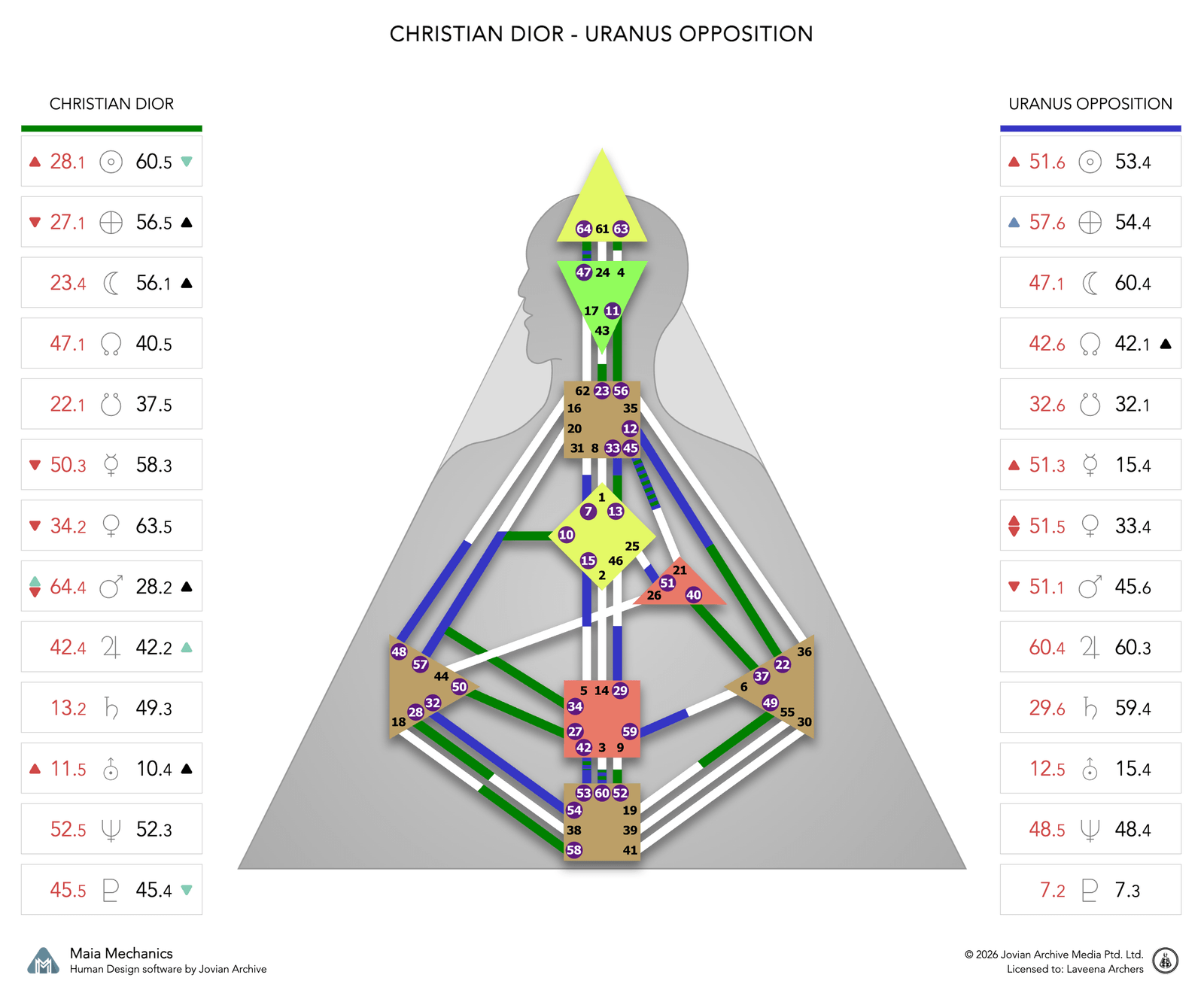 Christian Dior’s Uranus Opposition transit chart, age 44, calculated for 11 July 1949, 06:20 UTC.
A Uranus Opposition is the halfway point of that planet’s orbit, where a running structure gets pushed toward something it was not built to hold. Dior’s fell on 11 July 1949 at 06:20 UTC, at age 44, with transiting Uranus at gate 15, line 4, under a Right Angle Cross of Penetration (53/54 | 51/57).
1949 is the year the couture business model broke open, and Dior is the one who broke it. The first Dior license was granted that year, for stockings made in the United States, and the specific term he negotiated is the part worth knowing. The American hosiery manufacturer offered a flat fee of ten thousand dollars for the right to use his name. Dior waived the fee and took a percentage of sales instead, which put the royalty into fashion licensing and is the reason the arrangement scaled. From 1950 Jacques Rouet built that single deal into a program covering ties, hosiery, furs, hats, gloves, handbags, jewelry and scarves. Other Paris houses called it the cheapening of couture, and then copied it.
The mechanic worth naming is what a royalty actually changes. A flat fee is a sale: you are paid once for permission and the upside belongs to the manufacturer. A percentage makes the name a position in someone else’s revenue, with no unit ceiling, in markets the house never touches. A couture house can only sell as many garments as its workrooms can cut. Dior stopped selling garments alone and started selling a share of what his name earned for other people, and he did it at the transit whose entire business is turning a working structure inside out.
Gate 15, where the transit sat, is Extremes, in the G Center: the mechanic of range, of tolerating a spread rather than holding one setting. Read against the year, the spread is the point. The same name now sat on a hand-finished couture gown and on a pair of American stockings, and the business was built on the distance between them rather than on either end of it.
Chiron Return (50’s), 4 February 1955: the Money channel closes
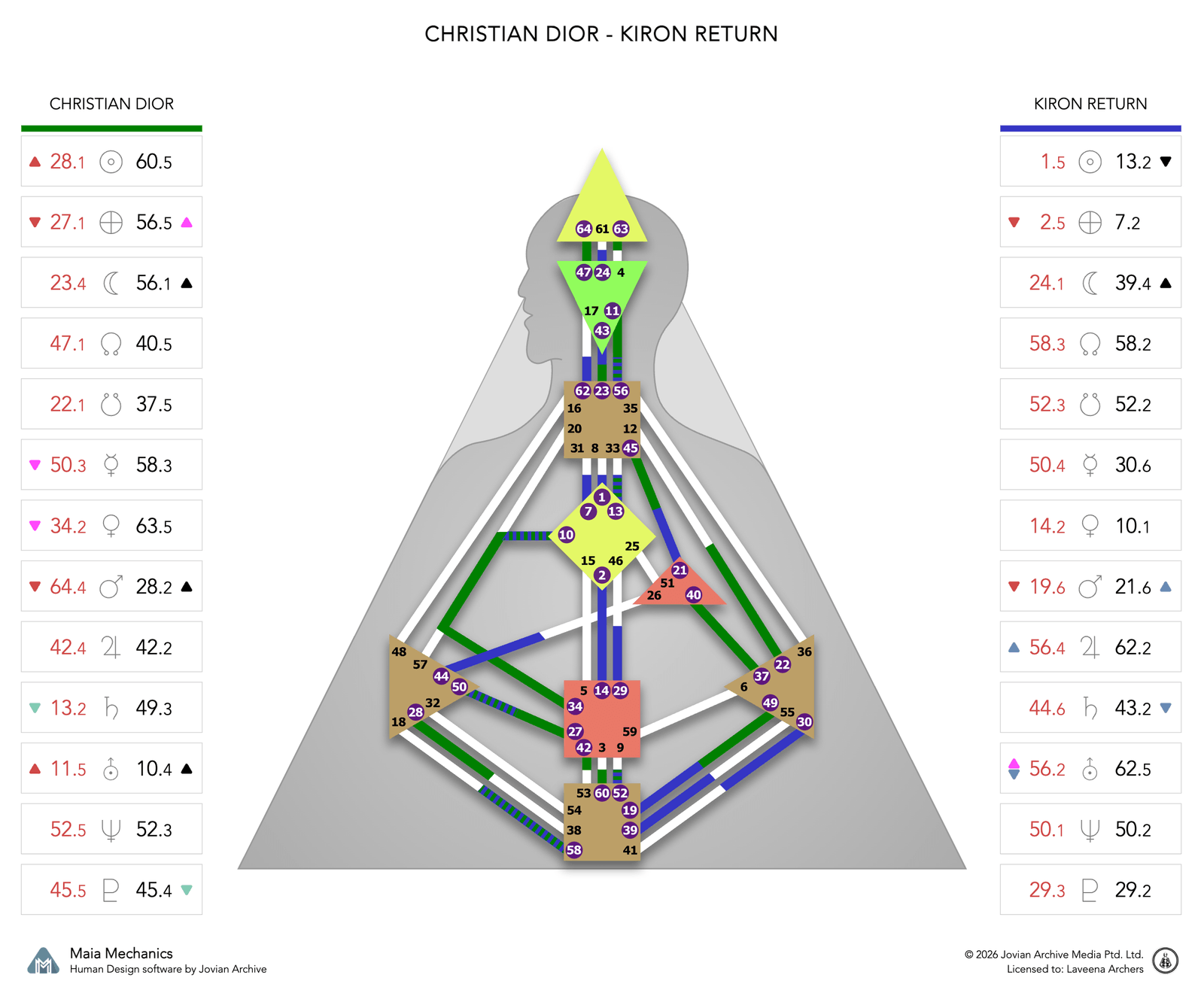 Christian Dior’s Chiron Return transit chart, age 50, calculated for 4 February 1955, 14:29 UTC.
His Chiron Return fell on 4 February 1955 at 14:29 UTC, at age 50, under a Right Angle Cross of The Sphinx (13/7 | 1/2). Maia Mechanics reports his natal Chiron at gate 60, line 5, which is the same gate and the same line as his Personality Sun. Chiron came back to the degree his Sun already occupied.
Of the four channels this cycle chart completes, one is worth the section on its own. The channel of Money (45-21) runs from gate 45, the Gatherer, in the Throat to gate 21, the Hunter, in the Heart. Dior carried gate 45 natally, as his Personality Pluto. He never carried gate 21. His Money channel was permanently half open, the voice of the gatherer without the control mechanism that normally sits under it, which is a reasonable mechanical description of a man who needed a Jacques Rouet from the first day. At his Chiron Return the transit supplied gate 21 and the channel closed. The chart also completes Synthesis (49-19), Structuring (43-23), and the Beat (2-14).
The business fact that sits against it is a scale fact. By 1955 the firm employed a thousand people across twenty-eight workshops and accounted for half the exports of the entire French couture industry. One designer’s name was carrying half a national industry’s export trade.
Two further events that year are worth reporting with their real distance from the transit rather than pulled toward it. On 20 June 1955, four months after the exact date, Dior met a nineteen-year-old student named Yves Saint Laurent and hired him on the spot as his assistant; Saint Laurent would take over the house two years later. In August, Dior lectured on fashion at the Sorbonne to an audience of around four thousand. Neither sits on the transit, and neither is being claimed to. What sits on it is the year, and 1955 is the year the house reached the size that made his succession a matter of national commercial interest rather than a private arrangement.
Dior died of a heart attack on 24 October 1957 at Montecatini, aged 52. He never reached his second Saturn Return, which would have fallen on 9 April 1963.
What his gates feed into: Penta and OC16
The Penta and the Wa are not channels in anybody’s chart. I teach them as trans-auric forms: when three to five people share physical space regularly, their individual auras morph into a single pentic aura that overrides personal awareness entirely. It runs on the Sacral alone, generative, with no mental, emotional or splenic awareness of its own, and it underpins both family analysis and small-business analysis in BG5. The Wa is the larger version of the same phenomenon, conditioning a group once it passes the ten-to-sixteen OC16 range. Neither exists at a distance. Both need people physically together, regularly.
At OC16 scale I teach six organizing channels, each anchoring a department: Management (45-21), Competitiveness (51-25), Direction (2-14), Logical Enforcement (50-27), Interaction (59-6) and Innovation, anchored at gate 60. Dior is unusual in this category. He holds a complete anchor, and it is Logical Enforcement: the channel 50-27, which is one of his own five natal channels.
Holding a full anchor is a field of potential to be recognized as that department’s head, never a guarantee, and it only operates in person, in a group of that size. But the fit with what he actually built is hard to ignore. Logical Enforcement is the department of standards, correction and whether a thing is made properly. Dior’s house ran on twenty-eight workshops, a technical director whose job was to render his sketches buildable, and a quality standard strict enough that the name later supported a licensing business, because a licensed name is worth precisely what its standards are worth.
He also carries gate 60, Innovation’s anchor gate, as his Personality Sun, and gate 45 in the Throat, one half of Management. The clusters underneath tell the same story. Six of his activated gates feed the power base of Interaction (64, 47, 11, 56, 42, 13), three feed Management (49, 37, 40), three feed Logical Enforcement (63, 58, 52), and both gates of Competitiveness’s related pair, 34 and 10, are his own channel.
A power base is not a department head. It is energy pulled into a department’s frequency for the benefit of whoever holds the full channel, and again only in person, in a group of that size. Nobody should be told they cannot run their own company because an anchor is missing from their chart.
The channel that was awareness, and the one that decided
One clarification matters here, because the two are easy to collapse into each other.
Dior carried 27-50 Preservation, running from gate 27, Caring, in the Sacral to gate 50, Values, in the Spleen. In my own teaching this channel is Gut Instinct specifically, a custodial design in which the Sacral responds directly and instinctively, and it is a stream of awareness rather than a decision-making authority.
His authority was not that channel. It was the Solar Plexus, and with a defined Solar Plexus the wave outranks everything else in the chart. So the correct reading of the 1946 negotiation is not that his instinct told him to refuse Boussac’s first offer. It is that instinct was available to him as information, and the wave was the thing that had to complete before the information could be acted on safely. He had a fast read and a slow decision, and the business exists because he let the slow one govern.
If you have a defined Solar Plexus, that is the transferable part. An instantaneous read is not the same thing as clarity, however sharp the read is and however much the room wants an answer.
The conditions the work required
Dior’s Variable reads PLL DLL, all four arrows left, with his Environment at Color 5, Valleys, and a left arrow of narrow observation.
Left arrows describe a design that runs strategically and focused rather than receptively and broadly, and the Valleys environment describes an enclosed working space rather than an open or elevated one. What is checkable is the record, not the inner experience: Dior worked from one hôtel particulier at 30 Avenue Montaigne, and the design studio stayed there while the commercial business spread to boutiques in more than twenty countries. He expanded the trademark globally and kept the workroom in one building.
I am deliberately not making a claim about how he felt in that building. The observable pattern is that a business which scaled its name across continents never scaled the room the work was done in, and for a design like this that is a sensible arrangement rather than a limitation.
Where the actual profit was: his one open center
This site’s own model of profit potential argues that the commercial edge tends to sit in the open centers rather than the defined ones. An open center has no fixed way of operating, so it takes in whatever is around it, runs every version of that pressure over a lifetime, and eventually develops a read on the terrain that a defined center in the same position never acquires.
Dior is the extreme case in this whole series, and the extreme runs the wrong way. Eight of his nine centers are defined. He has exactly one open center, the Root, which means there was almost nowhere in his design for that kind of accumulated, absorbed wisdom to gather. Most of him answered the same way every time. That is worth saying plainly rather than working around, because it is unusual and it is not automatically an advantage: a chart this defined broadcasts far more than it takes in, and the people around it feel that.
So everything the model points at, in his case, sits in one center, and it happens to be the center his own Sun is in.
The Root, carrying gates 52, 58 and 60, with no partner for any of them. Gate 52, Stillness, sits without 9; gate 58, Vitality, without 18; gate 60, Limitation, without 3. The Root is adrenalized pressure, the drive to get things finished and the source of the feeling that there is never enough time. Open, it does not generate that pressure, it absorbs whatever pressure is around it and amplifies it. The couture calendar is one of the most unforgiving clocks in commerce: two collections a year, fixed show dates, an entire house’s revenue riding on a single afternoon in a salon. He ran that clock for eleven years straight from a design studio he never moved.
Gate 60 is the one that earns the section. It is his Personality Sun, the single most defining activation in the chart, and it sits in the only center he has no fixed answer in. Gate 60 is Limitation: the mechanic of constraint accepted as the precondition for anything new. Its partner gate 3, Mutation, is the half that turns a constraint into a break, and he does not carry it. So he held the constraint without the mutation attached, permanently, as the brightest thing in his design.
Read that against what he actually sold. The New Look arrived in a Europe still rationing cloth and was received as an argument about fabric, which is to say about limitation. And from then until his death he named every collection after a shape: the Corolle and the En 8 in 1947, then the H line, the A line, the Y line. He did not sell dresses season to season. He announced a new constraint every six months and made an industry work inside it. A man whose Sun sits in Limitation, hanging, in his only open center, built a business out of manufacturing limits and selling them.
His natal Chiron sits in the same gate, at 60.5, exactly where his Sun is, and the Chiron Return section above is the moment that degree came back around.
What to do on Monday
- If your Solar Plexus is defined, take offers off the clock. Say you will answer in a week, and mean it. Anyone who cannot wait a week was not offering you a good deal.
- When you are offered a role inside somebody else’s structure, work out what the counter-offer is before you answer. Dior’s counter-offer was the entire business.
- If you have a Split or a Triple Split, name your bridges as roles and keep them filled by the same people. Bridging that turns over is not bridging.
- Check whether your Money channel (45-21) is complete. If you have the Throat end without the Heart end, the control side of the money function is a hire, not a discipline problem.
- Separate your fast read from your decision, in writing. Note the instinct when it arrives, then decide later and see whether the two agreed.
If you want to run your own chart against any of this, you can generate one from your birth data at myBodyGraph.com.
Related
- Triple Split Leadership Style: what the definition Dior had asks for in a working team
- Human Design and Emotional Authority in Negotiations: the mechanic behind the offer he declined
- Walt Disney, Human Design, and the Loan He Took Out on His Own Life: another founder who financed a name before it was worth anything
Dr. LaVeena B. Archers has spent more than thirty years as an entrepreneur and teaches the career and business application of the Human Design System. She helps business owners and entrepreneurs market themselves in a way that fits their design, lead their teams to greater efficiency and profitability, and find the work their chart was actually built for.
Common questions
What is Christian Dior's Human Design type?
He was a Generator with Emotional Authority, a 5/1 profile and a Triple Split definition, calculated from an AA-rated birth certificate of 21 January 1905 at 1:30am in Granville, France. Eight of his nine centers carried definition through five channels; only the Root was undefined.
Why does it matter that Dior had Emotional Authority?
Emotional Authority means there is no reliable clarity in the moment, because the emotional wave has to run its course before a decision is sound. Dior's most consequential business decision fits that mechanic exactly. Offered the direction of an existing couture house in 1946, he declined it, swung as far as telegraphing to break off the negotiation entirely, then reversed and proposed a house under his own name instead.
What does a Triple Split definition say about how someone should staff a business?
A Triple Split has three separate groups of defined centers with nothing in the chart joining them, so the bridging comes from other people, and it needs more than one of them, consistently. Dior ran his house through a fixed senior group from the founding, including Raymonde Zehnacker, Marguerite Carré, Mitzah Bricard, Suzanne Luling and Jacques Rouet, and the arrangement held for the entire eleven years the house existed under him.
Do his major transits line up with anything real in his business record?
Closely. His Saturn Return fell on 24 February 1934, the year his gallery had just closed, his family's money was gone and tuberculosis took him out of work for a year. His Uranus Opposition fell on 11 July 1949, the year the first Dior license was granted. His Chiron Return fell on 4 February 1955, the year the house employed a thousand people and accounted for half of French couture exports.