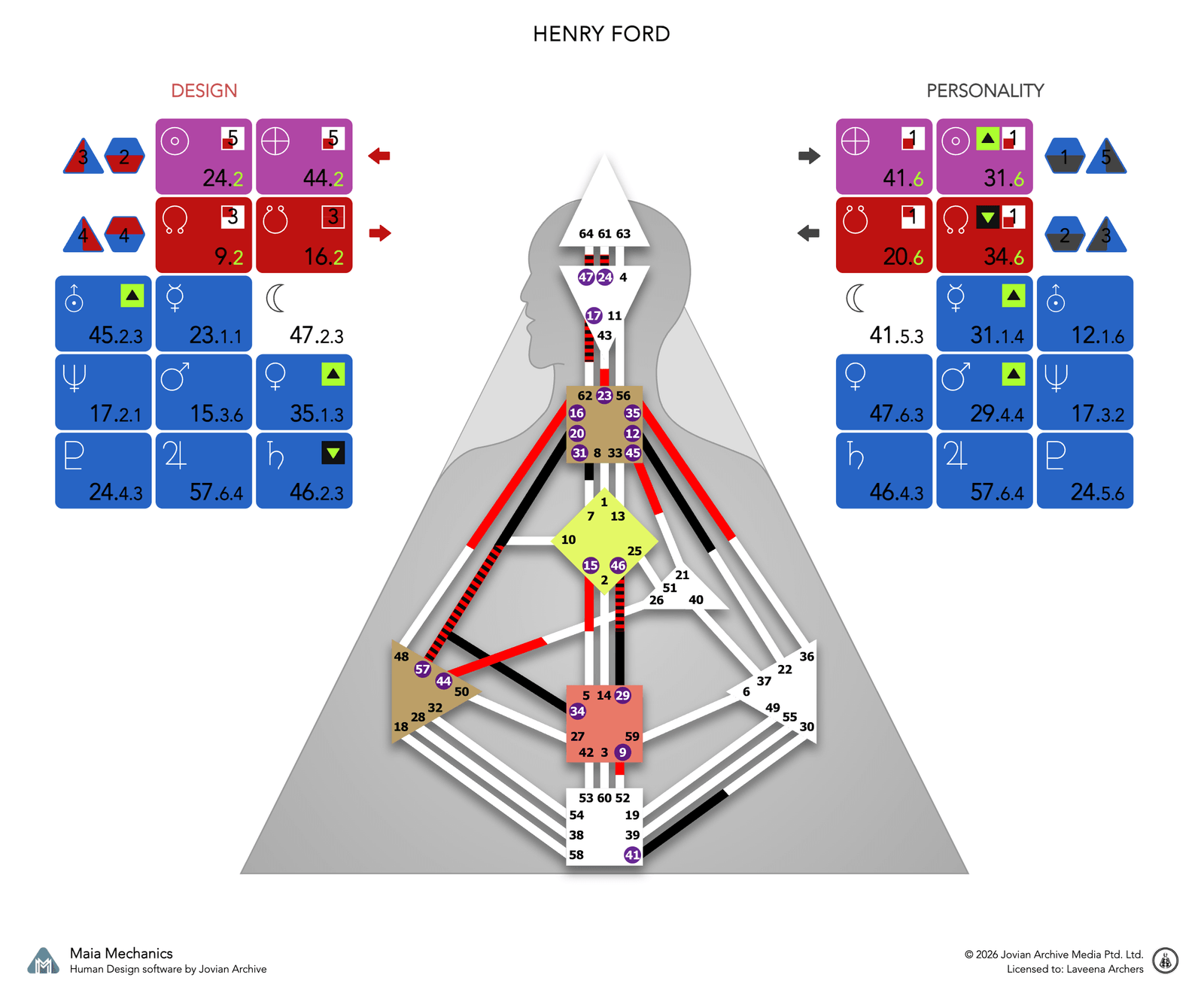
Chart calculated with Maia Mechanics, from a Rodden B-rated birth record
Quick look: Henry Ford is remembered as the man who invented the assembly line. His own account of it, given in 1922, is more modest: he said the idea came “in a general way” from watching a Chicago meatpacker’s overhead trolley move carcasses past a line of butchers. His chart explains why that is not false modesty but an accurate report. Three of his nine centers, Head, Heart and Solar Plexus, carry no activation at all, and the fourth, Ajna, carries real weight that never resolves into a channel on its own. He was a Manifesting Generator with Sacral Authority, built to respond fast and correctly to what was already in front of him, not to generate ideas from nothing.
That matters past the trivia of who thought of what first. A chart built this way needs something specific from the people around it, and the record shows exactly what Henry Ford got and, later, what happened once he stopped getting it.
Where this chart comes from
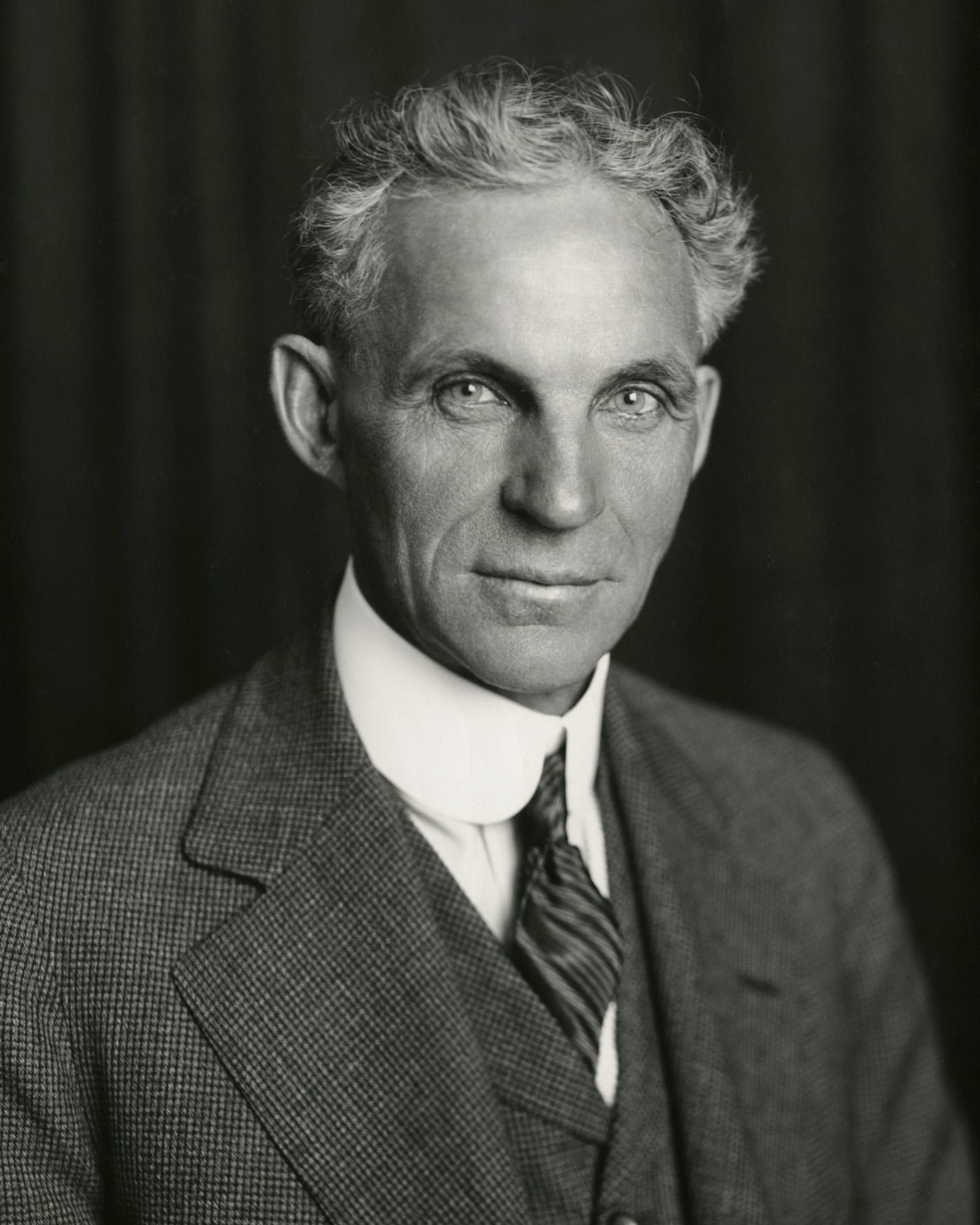
Ford’s birth is recorded as 30 July 1863 in Greenfield Township, Michigan, now part of Dearborn. The time most commonly cited, 7:00am, comes from Sidney Olson’s 1963 biography Young Henry Ford and is preserved on Astro-Databank via its astrotheme.com mirror with a Rodden rating of B, meaning it traces to a biographical source rather than a birth certificate. A second, disputed account places the birth closer to 1:45pm or just after 2:00pm, a time Astro-Databank’s own notes say Ford did not give personally. You can generate a chart yourself from either time at myBodyGraph.com, which is where a reading like this one starts.
Michigan had no standardized time zone in 1863, so the birth chart below uses local mean solar time for Greenfield Township’s longitude, converting to Universal Time by adding 5 hours 33 minutes to the recorded clock time.
Rather than treat the time dispute as a reason to hedge everything, I recomputed the chart at every hour of the birth day using the Swiss Ephemeris. Type and Authority hold at all twenty-four hours: Manifesting Generator, Sacral Authority, full stop, regardless of which account is right. Profile and Definition shift only in the pre-dawn hours, settling into their final form by about 4:35am local and holding steady from there through the entire rest of the day, well past both the recorded 7:00am time and the disputed early-afternoon one. Nothing below is a hedge. It is a claim about what the data actually supports.
What the chart produced
The result: a Manifesting Generator with Sacral Authority, a 6/2 Profile, a Single Definition, and what the standard Human Design nomenclature calls the Left Angle Cross of The Alpha (31/41 | 24/44). Four of the nine centers carry definition, connected into one continuous shape rather than split into separate islands: the G Center, the Sacral, the Spleen and the Throat.
Four channels are defined:
- 46-29, Discovery, G Center to Sacral. Commitment that runs through the body rather than the mind, the willingness to stay physically engaged with something until it works.
- 34-57, Power, Sacral to Spleen. Raw, instinctive force paired with in-the-moment clarity about what is safe to act on right now: Gut Intuition, in this teaching’s terms, Sacral power fused directly to a Splenic read rather than routed through the mind.
- 20-57, The Brainwave, Throat to Spleen. Intuitive awareness that gets spoken or acted on the instant it arrives, with no interval for deliberation: Gut Knowing, the direct expression of that same Splenic read out through the Throat.
- 20-34, Charisma, Throat to Sacral. The channel that makes a Generator type Manifesting: gut response reaching the mouth and the hands directly, without routing through the mind first.
Every one of those four channels touches the body, the instinct, or the immediate present. None of them touches the Ajna or the Head. That absence is the chart’s most consequential feature, and it is worth its own section.
Three centers with nothing in them
Most open centers carry some theme even when they are undefined: a gate or two, pressure without resolution. Ford’s chart is unusually clean in three places. The Head carries no activation whatsoever, not one of its three gates. The Heart, sometimes called the Will center, is equally empty. The Solar Plexus carries nothing either, which is the mechanical reason his authority is Sacral rather than Emotional.
The Ajna is different, and more interesting. Every activation it carries lands on just three gates: 17 (Opinions), 24 (Rationalization) and 47 (Realization). None of their partner gates is present anywhere in the chart, so the Ajna never completes into a full channel on its own. Gate 17 waits on 62 for Acceptance, gate 24 on 61 for Awareness, and gate 47 on 64 for Abstraction, and the transit sections below show two of those three switching on from outside at the moments that mattered most. The pressure to rationalize and form an opinion about experience is real and heavily concentrated. The capacity to run that pressure through a self-generated, always-on process is not there. It has to be switched on from outside, by a transit or by someone else’s chart, or it sits as raw, unresolved material.
That is close to a mechanical description of a mind that processes what is put in front of it exceptionally well and does not originate material on its own. Ford’s own words support the reading better than any interpretation could. In 1922, describing the 1913 Highland Park assembly line, he said: “I believe that this was the first moving line ever installed. The idea came in a general way from the overhead trolley that the Chicago packers use in dressing beef.” The idea traces further still, to Ford engineer William Klann, who visited a Swift & Company slaughterhouse in Chicago, watched an overhead trolley carry beef carcasses past a line of workers each making a single cut, and brought the observation back to Highland Park. Nobody in that chain invented continuous-flow production from nothing. Klann watched it, reported it, and an empty Head with a loaded, hanging Ajna took the raw observation and rationalized it, gate 24’s own keynote, into the most consequential manufacturing system of the twentieth century.
What James Couzens supplied
Ford’s Single Definition means his four defined centers already form one connected whole. Unlike a Split Definition chart, which is mechanically built to need a bridge from someone else’s design before it runs as a complete circuit, Ford’s own energy is whole on its own terms. He was not structurally incomplete in the way BG5 uses that word.
But three of his centers carry nothing at all, and one of those three, the Heart, is the center responsible for a fixed, self-generated sense of what something or someone is worth and the willpower to hold a position on it. Ford had none of his own. Read the early business record against that absence and a real historical figure sits almost exactly where the mechanic predicts one would be needed.
James Couzens was one of twelve original investors when Ford Motor Company incorporated on 16 June 1903 with $28,000 in cash, and he took the company’s secretary seat at the first stockholders’ meeting. By 1906 he was General Manager, running the financial and administrative side of the business while Ford ran manufacturing. Couzens was central to the boldest financial decision of Ford’s first decade, the five-dollar, eight-hour workday announced on 5 January 1914, a decision that required exactly the kind of fixed conviction about what workers were worth that an open Heart does not generate on its own. Couzens resigned in 1915, after growing friction with Ford, and went on to serve as mayor of Detroit and then a United States senator. He never returned to the company.
The years that follow are not proof of anything by themselves, but they are consistent with what left when Couzens did. Every deal covered elsewhere in this piece after 1915, the Dodge lawsuit response, the 1921 refusal of outside financing, the Lincoln acquisition, ran through Ford alone or through subordinates who answered to him rather than checked him. The company’s later and more troubling turns, an increasingly unchecked security apparatus under Harry Bennett, a newspaper venture that ran a years-long antisemitic campaign under Ford’s own name, were not restrained by anyone playing the role Couzens had played. None of this says Human Design explains a business partnership or its absence. What it offers is a specific, checkable fact: the center responsible for fixed conviction about worth was empty in Ford’s own chart, and the one documented partner who supplied that function left in 1915, six years before the company’s most consequential unilateral moves.
Where the actual profit was: his open centers
Ford has four defined centers and five open ones. This site’s own model of profit potential argues that the real commercial edge tends to sit in the open centers rather than the defined ones, because an open center has no fixed way of operating. It takes in whatever is around it, runs every variation of that pressure across a lifetime, and converts the exposure into a read nobody with a defined center in the same position ever develops.
Ford is the strongest case for that model in this whole series, because the openness is so extreme. Three of his five open centers carry no activation at all. Most charts have at least a gate or two sitting in an open center, some theme without resolution. His Head, Heart and Solar Plexus are simply blank.
Two of the five are covered above and do not need repeating: the empty Head that took its most consequential idea from a Chicago slaughterhouse, and the empty Heart that ran on James Couzens’s conviction until 1915 and then ran on nobody’s. The loaded, hanging Ajna is the third, and it is the commercial engine of the company. A mind with three concentrated gates of opinion, rationalization and realization, and no fixed circuit to run them through, is built to take in raw external material and organize it into something usable. That is not a lesser form of invention. It is the description of a manufacturing standard: watch what already works, strip it to its operation, and make it repeatable.
The empty Solar Plexus is the fourth, and it is worth naming precisely because the absence is the advantage. An open Solar Plexus with no gates at all generates no emotional wave of its own and carries no fixed emotional theme. It is the mechanical reason his Authority is Sacral rather than Emotional: he did not have to wait for anything to clear. He answered in the moment, completely, which is exactly what the Dodge response below looks like. A price-cutting, volume-first manufacturing business run on immediate yes-or-no decisions about concrete things is that emptiness turned into an operating model.
The fifth is the one nothing else in this piece has touched. The Root, carrying gate 41, Contraction, alone. Its partner gate 30 is absent, so the channel of Recognition never closes. The Root is adrenalized pressure, the drive to get things finished, and gate 41 is the specific mechanic of pressure held under constraint, the pinch before a new cycle starts. Open, that pressure is taken in from whatever is around it and amplified, which produces the characteristic sense of never being finished and never having enough time. Ford ran a company whose entire competitive claim was cycle time: twenty minutes to five minutes on the magneto line, then the same logic applied to everything else in the building. The man with one hanging gate of constrained pressure in an open Root built his fortune on removing seconds from an operation.
Four defined centers gave him a body that responded fast and correctly. The five open ones are where the business actually was, and the record of what happened after 1915 is a fair description of what an open Heart costs when nobody is filling it.
Authority under pressure: the Dodge lawsuit
Sacral Authority produces a gut response to something concrete already in the room. It does not deliberate hypotheticals well, and under real pressure it tends to answer fast and completely rather than negotiate a middle position. The clearest documented test of that in Ford’s career is Dodge v. Ford Motor Co.
By the mid-1910s the Dodge brothers, former Ford suppliers turned minority shareholders who had left to build their own competing company, sued Ford for withholding special dividends. Ford’s own stated position was that profits belonged in expansion and price cuts rather than shareholder payouts. In February 1919 the Michigan Supreme Court ruled against him and ordered the dividend paid, a direct, dated, external constraint on his authority over his own company.
Ford’s response was not a negotiated settlement. It was a complete, gut-level countermove: he threatened to leave Ford Motor Company and start a rival to compete directly with it, a threat credible enough that it panicked the remaining minority shareholders into selling. Through 1919 he bought out every outside stockholder, financing the purchase in part through new bank debt, and brought the company to full family ownership with no outside check on his authority left at all. That is Sacral Authority answering a concrete threat with total, immediate resolution rather than partial compromise, and it is worth naming that Couzens, who might have argued for a different route, had already been gone for close to four years by the time the court ruled against him.
Saturn Return (30’s): September 1892
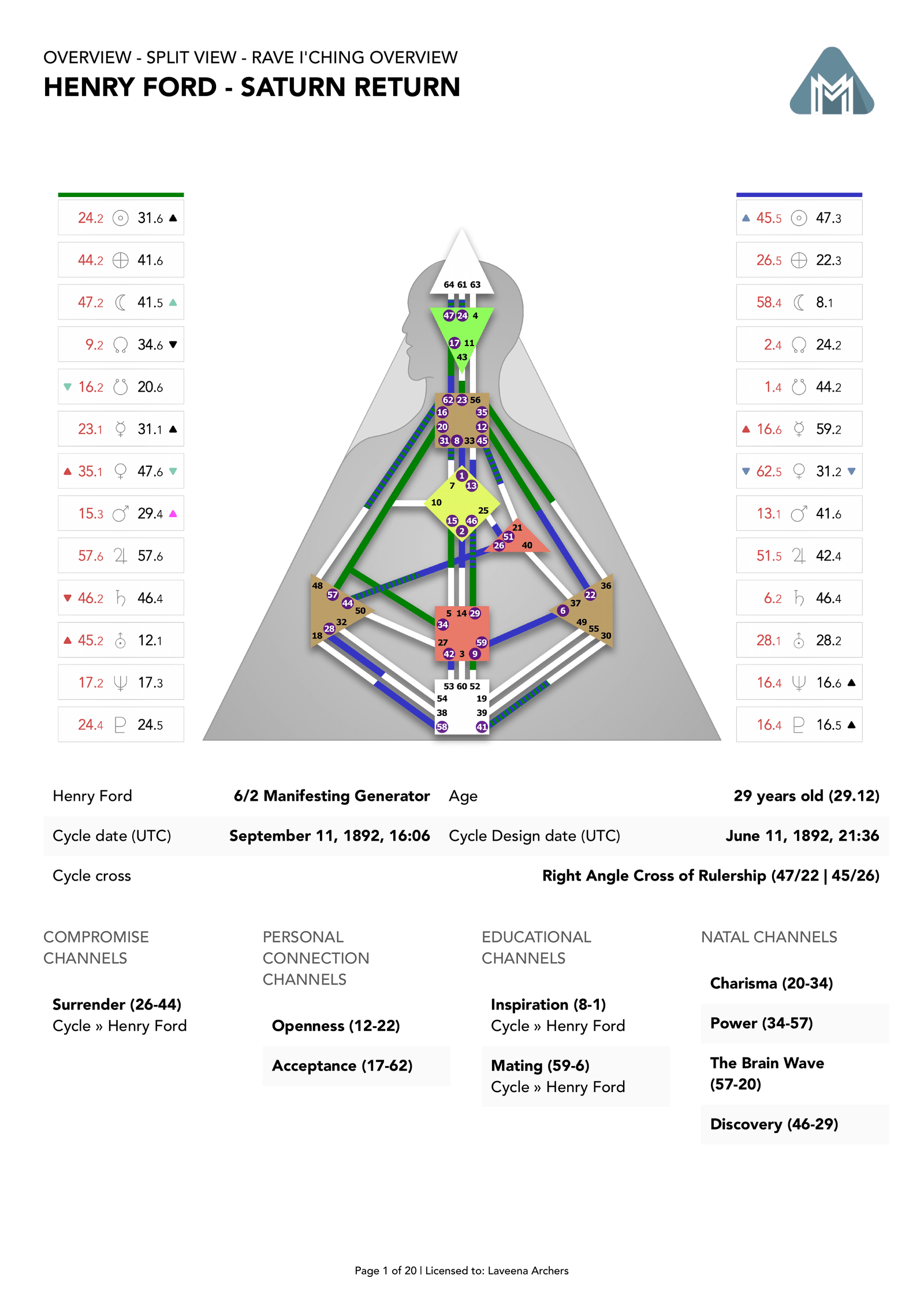 Design and Personality on the left, the 11 September 1892 Saturn Return transit overlaid on the right.
A Saturn Return arrives roughly every twenty-nine and a half years, when transiting Saturn returns to the exact degree it held at birth. Because it is a return by definition, it always lands on a person’s own natal Saturn gate and line. For Ford that is gate 46, Determination, in the G Center, a placement about being correctly positioned in the physical world rather than about mental resolve.
The return fell on 11 September 1892, age 29. Transiting Earth sat in gate 22, Openness, completing the 12-22 Openness channel against Ford’s own natal gate 12, Caution, a gate that never completes into a channel on its own anywhere in his natal chart.
Ford had joined the Edison Illuminating Company as a night engineer in the fall of 1891, roughly a year before the return, and the company’s own photographic record places him among its staff as an engineer by March 1893, with most accounts placing his promotion to Chief Engineer within the following year. That position gave him workshop access and time that biographers connect directly to the experimental engine work that followed, first a small gasoline engine tested at home in the winter of 1893, then the Quadricycle he test-drove through Detroit on 4 June 1896. A Saturn Return in the gate of being correctly placed physically, landing squarely inside the years his day job put him exactly where the next fourteen years of his life needed him to be, is as literal a reading of that gate as the record offers.
Uranus Opposition (40’s): 1902–1904, exact January 1903
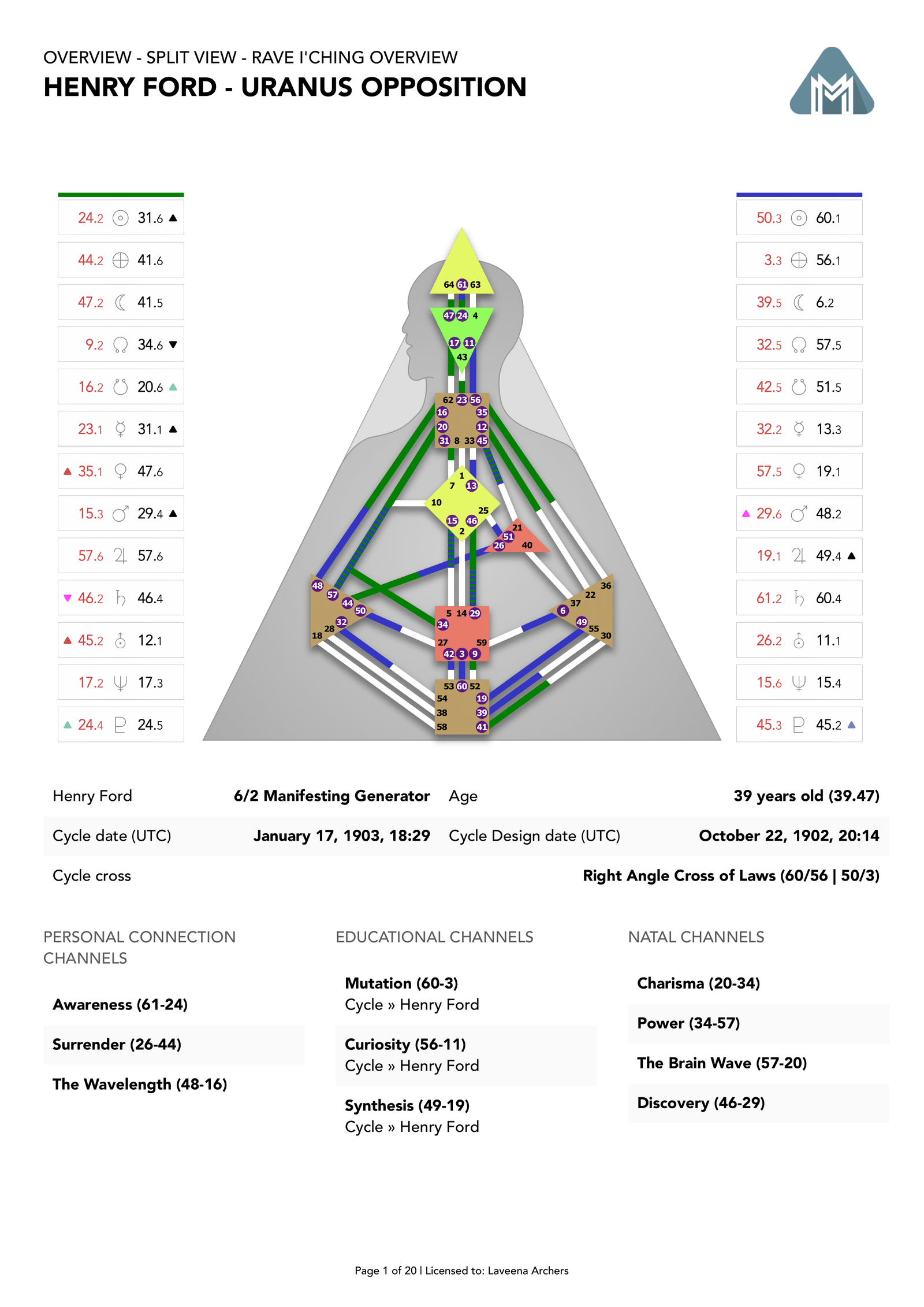 Design and Personality on the left, the 17 January 1903 Uranus Opposition transit overlaid on the right.
A Uranus Opposition arrives once, at midlife, when transiting Uranus reaches the point directly opposite its natal position. It is the cycle most associated with a sudden break from an established pattern. Ford’s opposition point sits at gate 11, Ideas, and the exact crossing fell on 17 January 1903.
That date sits almost exactly at the midpoint of how Ford Motor Company actually got built. On 20 August 1902, Ford signed a memorandum of agreement with coal dealer Alexander Malcomson to go into the automobile business together, witnessed by C. Harold Wills; the venture was renamed Ford & Malcomson, Ltd. that November. Ford Motor Company was incorporated on 16 June 1903. Split the 300 days between those two dates exactly in half and the middle lands on 17 January 1903 — the same day as the transit.
The cycle chart for that date completes six channels. The clearest uses Ford’s own chart directly: 61-24, Awareness, running Head to Ajna, forms from his own natal gate 24, Rationalization, sitting on his Personality Pluto and never completing on its own anywhere in his natal chart, meeting the cycle’s gate 61, Inspiration. Two more of the six also draw on gates that are genuinely his and otherwise hanging: 16-48, The Wavelength, and 26-44, Surrender. The remaining three, 11-56 Curiosity, 3-60 Mutation, and 49-19 Synthesis, exist entirely within the cycle’s own two-sided chart. Gate 60, Limitation, paired with gate 3, Mutation, is the one worth naming on its own: the channel of forcing new order out of a constrained starting position, activating on the day sitting exactly between an informal partnership and a filed corporation.
One more date belongs to this stretch, past the far edge of it. On 12 January 1904, Ford and his riding mechanic Ed Huff drove a car nicknamed the Arrow across the ice of Lake St. Clair at 91.37 miles an hour, a new land speed record, in a car the company would soon market as the 999. It fell almost exactly a year after the exact opposition: a partnership signed on paper had become, by then, a company with a public reputation for speed.
Chiron Return (50’s): 1911–1913
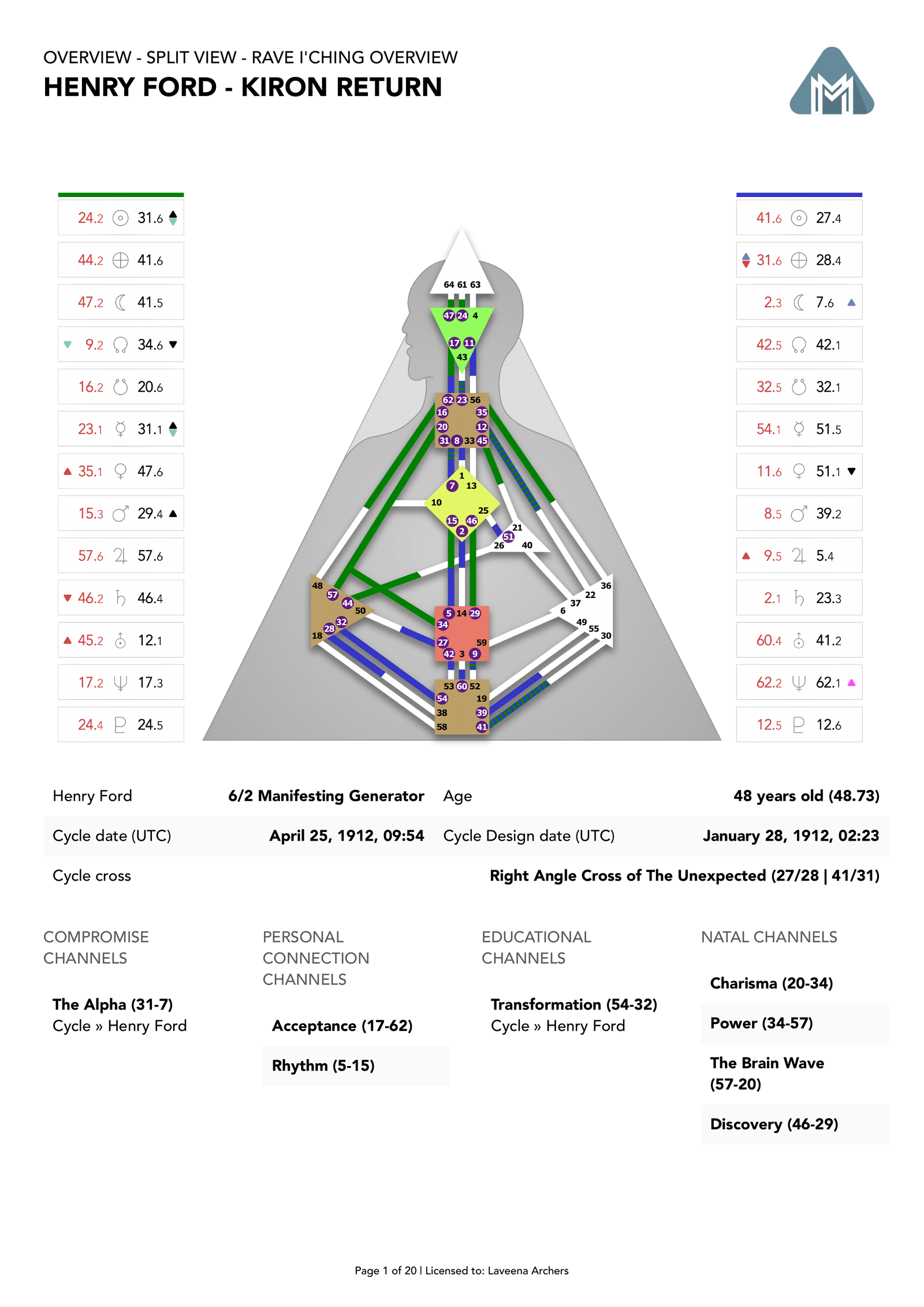 Design and Personality on the left, the 25 April 1912 Chiron Return transit overlaid on the right.
Chiron’s orbit is eccentric enough that its return does not arrive on a fixed schedule the way Saturn’s does. Ford’s natal Chiron sits at gate 37, Friendship, in the Solar Plexus, one of his three empty centers. The return crossed in three passes between 25 April 1912 and 18 February 1913, always in that same gate and line, because a return is by definition a crossing of one’s own natal degree.
The exact crossing, on 25 April 1912, completed 31-7, The Alpha, running Throat to G Center, from Ford’s own natal gate 31, Influence, the same gate that anchors the Personality side of his Incarnation Cross and, as the second Saturn Return below shows again, keeps finding its missing partner through transits rather than carrying one natally. The same moment completed 17-62, Acceptance, from his own natal gate 17, Opinions, one of his three concentrated Ajna gates, meeting the cycle’s own gate 62, Details.
About a year later, in April 1913, Ford’s engineers began building magnetos on a crude moving belt at Highland Park, twenty-nine workers each performing one operation as a flywheel was pushed down the line, cutting assembly time from twenty minutes to five within months. It was the first working version of what became the full moving assembly line that October. A concentrated, hanging Opinions gate wired into Acceptance, the channel of organizing raw material into detail everyone can use, and the leadership gate from his own Incarnation Cross wired into The Alpha, in the same moment roughly a year ahead of turning somebody else’s observation about a slaughterhouse into an accepted, replicable industrial standard, is a legible setup for what followed.
Second Saturn Return (60’s): 1921–1922
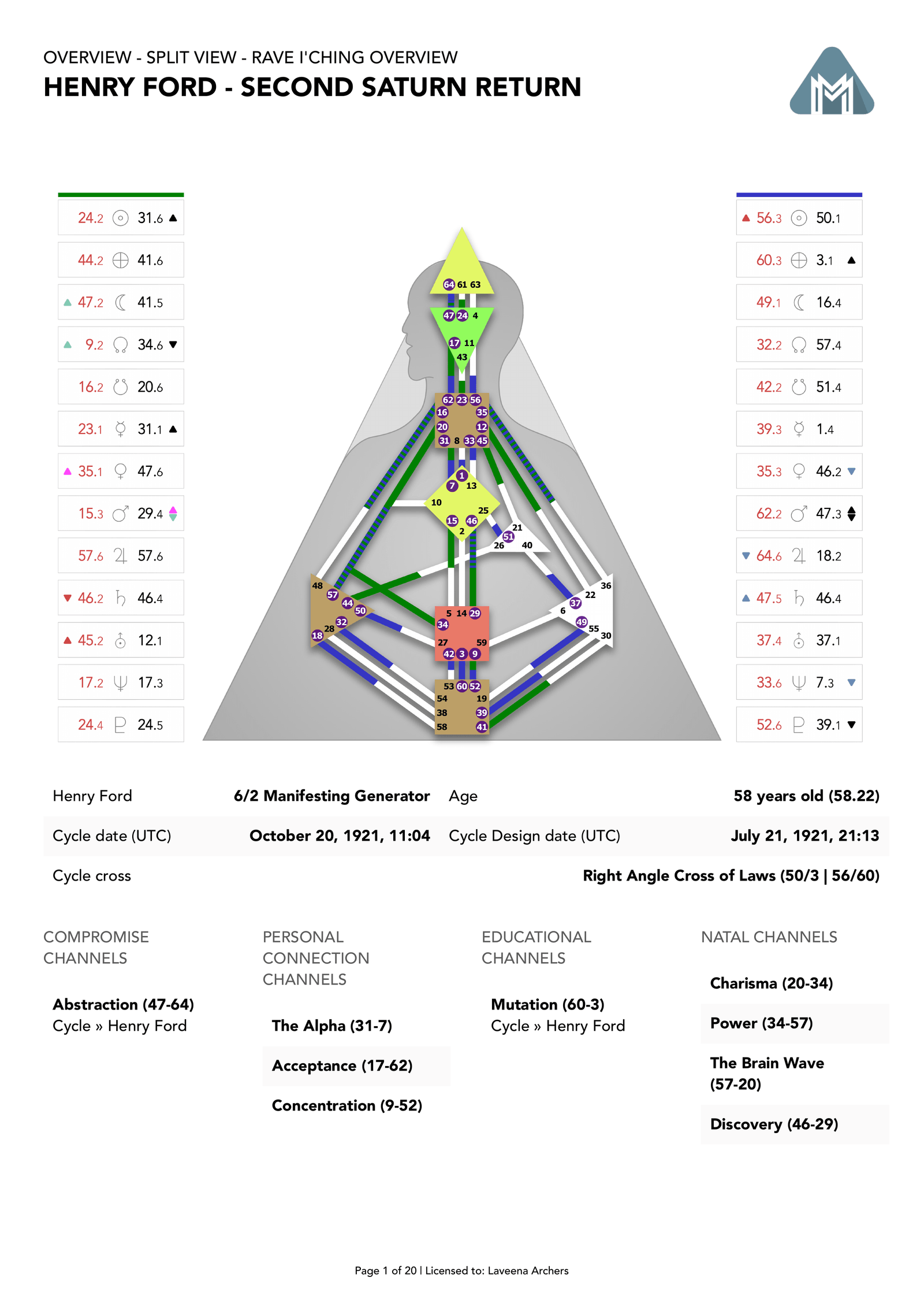 Design and Personality on the left, the 20 October 1921 Saturn Return transit overlaid on the right.
A second Saturn Return, arriving near 58 for a life long enough to reach it, is a different event from the first. Where the first is usually about leaving a structure that no longer fits, the second tends to arrive as an existing structure being ratified, extended, or handed off. Ford’s fell across three passes between 20 October 1921 and 2 July 1922, always in his own natal gate 46, Determination.
The first and third passes both completed 31-7, The Alpha, running Throat to G Center, built from Ford’s own natal gate 31, Influence, the gate that anchors the Personality side of his Incarnation Cross and never completes into a channel anywhere in his natal chart on its own. On 20 October 1921 the missing gate 7 arrived by transiting Neptune; on 2 July 1922 it arrived again by transiting Venus. Twice inside nine months, the leadership gate that names his own Incarnation Cross got switched into the specific channel Human Design calls The Alpha.
Between those two passes, on 4 February 1922, Ford Motor Company acquired the Lincoln Motor Company from its founder Henry Leland for $8 million, a struggling luxury automaker absorbed into Ford’s own operation at his son Edsel’s urging. The acquisition followed directly on the heels of the 1920–21 postwar recession, when Ford had refused bank financing, forced dealers to accept cars on cash consignment, and paid off $58 million in obligations by April 1921 without ceding control to outside lenders, the kind of independence a company only gets to protect if it comes through a crisis solvent enough to go shopping the following winter. A gate named for leadership, permanently present in his own chart but never wired into a working circuit until the transits handed it one, switched on twice in nine months around the acquisition of a rival automaker’s company and its founder’s name.
Where this reading stops
None of what is above should be read as covering the whole record, and one part of it deliberately is not covered here. From 1920 to 1925, Ford’s newspaper, the Dearborn Independent, ran a sustained campaign of antisemitic material, including the pamphlet series later published as The International Jew, beginning in May 1920. A libel trial in March 1927 ended in mistrial; on 30 June 1927 Ford released a public apology, and the paper closed by the end of that year. That history is documented in detail by the United States Holocaust Memorial Museum and by Ford’s own museum, and it belongs in any honest account of the man’s public life.
It is deliberately absent from the mechanical readings above. No transit in this piece lines up with it cleanly enough to ground a reading the way the four cycles above do, and a bodygraph is not equipped to explain, predict, or excuse a specific set of harmful beliefs regardless of what a transit happened to be doing. What the chart offers is a set of mechanics about how a person processes information, makes decisions, and needs support. It says nothing about the content of what a person, once wrongly convinced of something, chooses to publish. Readers deserve the full record, not a version edited down to the parts a chart can explain.
What this is worth to you
Check where your own ideas actually originate. If your Head and Ajna are open or hanging rather than defined, your strength is likely in recognizing and organizing what is already in the world, not manufacturing concepts from nothing. Ford built the most consequential industrial system of his century by watching someone else’s slaughterhouse. Treat that as a business model, not a lesser form of genius.
Name what your empty centers need supplied, specifically. An open Heart does not need a cofounder in the abstract. It needs someone who can generate fixed conviction about worth and hold a position under pressure, the way Couzens did for Ford’s first decade. Look for the actual function, not just a warm body.
Watch what happens when that person leaves. The value of a structural gap does not disappear when the person filling it does. It just goes unfilled, and the record shows what that costs over enough time.
Expect your authority to resolve completely under pressure, not partially. Sacral Authority given a concrete threat tends to answer it all the way, not negotiate a fraction of the way. Ford’s response to the Dodge ruling was to buy out every shareholder in the company rather than accept a partial check. Know that about yourself before the pressure arrives.
If you want to run your own chart against any of this, you can generate one from your birth data at myBodyGraph.com.
Related
- Ted Turner, Human Design, and the Deals He Answered Instead of Starting: another Manifesting Generator with Sacral Authority whose defining moves were all responses, not inventions
- Steve Jobs, Steve Wozniak, and the Human Design Behind Apple’s Founding Partnership: what a founding partnership supplies when it works
- Your Profit Centers Are in Your Openness: why the commercial edge tends to sit in the centers with no fixed answer of their own
Chart mechanics, Incarnation Cross, defined channels and centers were calculated independently from Ford’s recorded birth data using the Swiss Ephemeris, cross-checked against hd-reference.json, this site’s standard gate and channel reference. Saturn Return, Uranus Opposition and Chiron Return dates, transit gate and line placements, and the channels each completes are Maia Mechanics’ own output, not an independent estimate. The natal and transit charts above are Maia Mechanics renders. Birth data and Rodden rating are recorded on Astro-Databank via astrotheme.com. Business and biographical detail is independently verified against Ford Motor Company’s own history pages, the Henry Ford museum’s collections, and, for the Dearborn Independent campaign, the United States Holocaust Memorial Museum.
In memory of an ICONIC Human Design, LaVeena B. Archers, PhD
I’ve spent more than thirty years as an entrepreneur and teach the career and business application of the Human Design System. I help business owners and entrepreneurs market themselves in a way that fits their design, lead their teams to greater efficiency and profitability, and find the work their chart was actually built for.
Common questions
What was Henry Ford's Human Design type?
He was a Manifesting Generator with Sacral Authority, a 6/2 profile and a Single definition, calculated from a Rodden B-rated birth record of 30 July 1863 at 7:00am in Greenfield Township, Michigan. Four of his nine centers carried definition: the G Center, Sacral, Spleen and Throat. The Head, Ajna, Heart, Solar Plexus and Root were all open, and three of those five carried no gate activation whatsoever.
Does the disputed birth time change any of this?
No. Recomputing the chart at every hour of the birth day shows Type and Authority holding at all twenty-four. Profile and Definition hold from roughly 4:35am local onward, which comfortably covers both the recorded 7:00am time and the disputed early-afternoon account. Nothing in this piece is hedged on the birth time, because the data does not require it.
What is unusual about Henry Ford's chart?
Three of his nine centers carry zero gate activation: the Head, the Heart (Will) and the Solar Plexus. Most charts have some pressure or theme sitting in an open center even when it isn't defined. Ford's Head and Heart are simply empty, and his Ajna carries real weight but never completes into a channel on its own.
Do his major transits line up with his business record?
Closely. His first Saturn Return in September 1892 fell during his years at Edison Illuminating Company, where he was made Chief Engineer by 1893. His Uranus Opposition in January 1903 landed almost exactly at the midpoint between signing the partnership that became Ford Motor Company and its incorporation five months later, and completed a channel named Mutation. His Chiron Return in April 1912 preceded the Highland Park moving assembly line breakthrough by about a year and completed a channel named The Alpha, anchored on his own natal Sun gate. His second Saturn Return in 1921–22 bracketed the Lincoln Motor Company acquisition and twice completed that same channel, The Alpha.