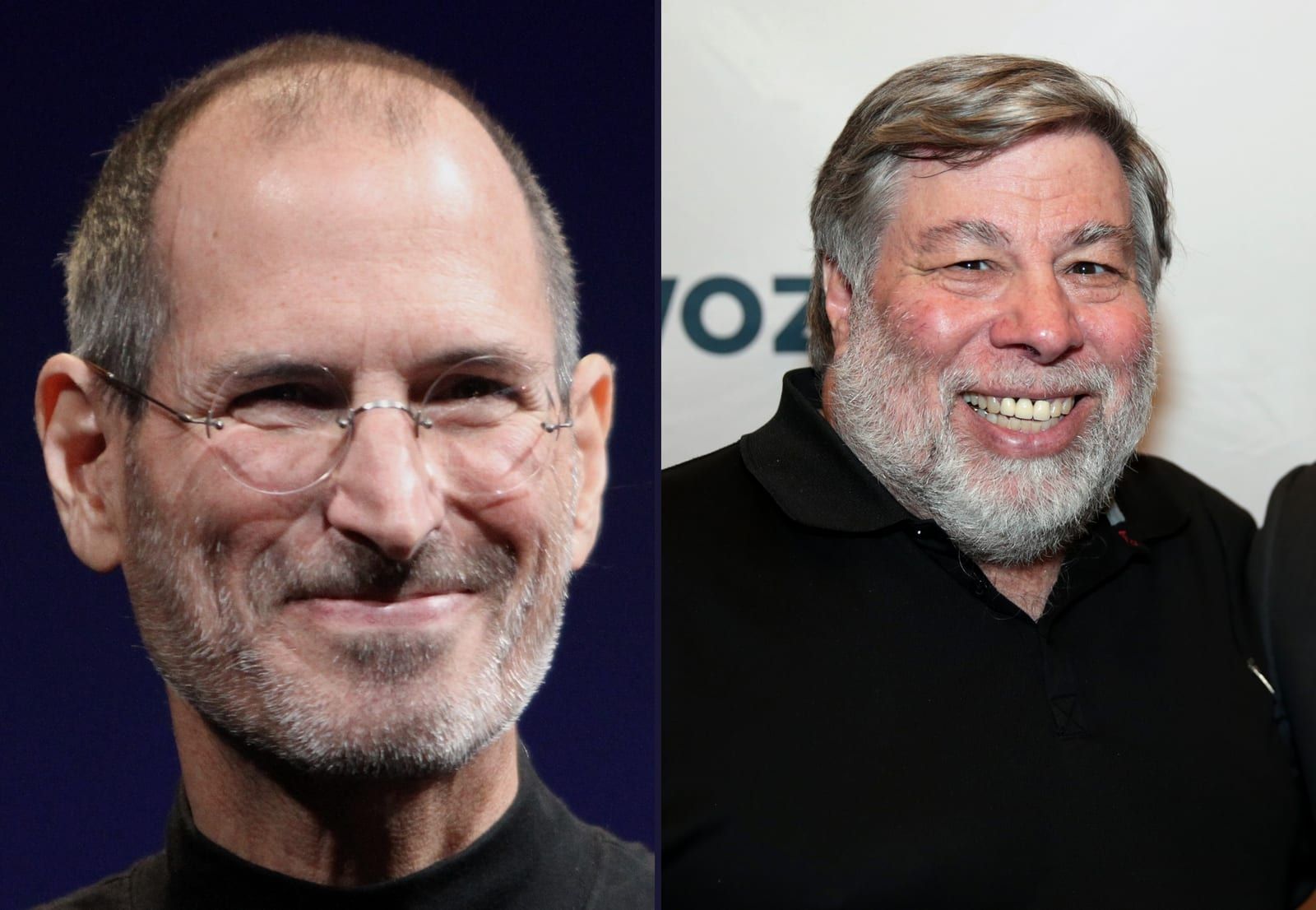
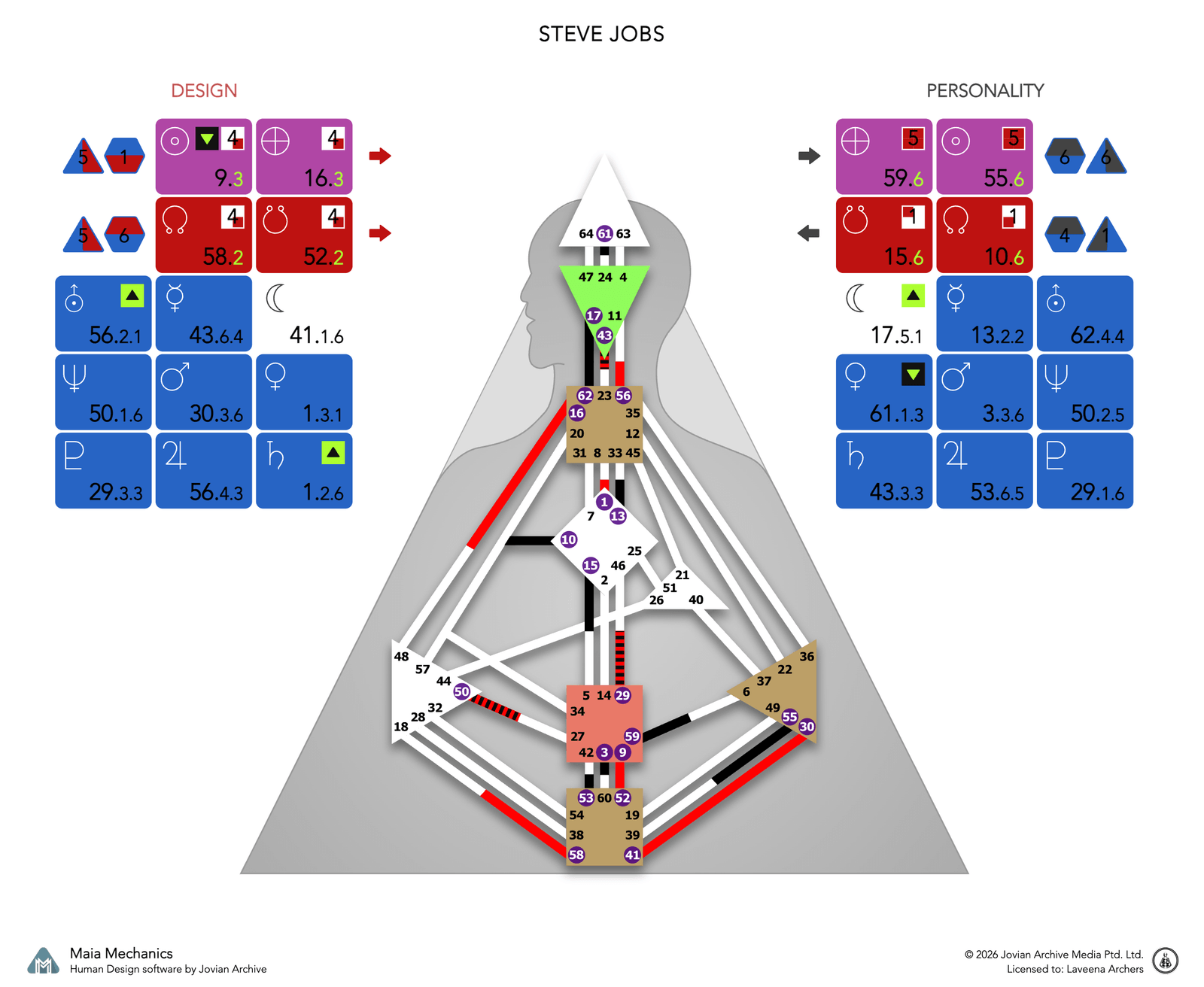
Chart calculated with Maia Mechanics, using the publicly listed AA-rated birth time
Quick look: Steve Jobs is a Generator with defined Solar Plexus (Emotional) Authority and Split Definition. Steve Wozniak is a Projector, the type I teach as the natural Advisor role in a business partnership. On April 1, 1976, they founded Apple Computer together, with a third partner, Ronald Wayne, who sold his 10 percent stake back twelve days later for $800. What their two charts share, a companionship connection in the throat, two electromagnetic pulls, and one gate of Jobs’s that Wozniak’s design quietly compromised, reads as the mechanical shape of a partnership that outlasted the paper it was written on.
Two charts, one caveat worth naming up front
I teach this exact pairing in my BG5 Business Certification, and I open it the same way there that I’ll open it here: Wozniak’s birth time carries a high reliability score, but Jobs’s does not. He was born in 1955, and the publicly recorded time, 7:15 PM in San Francisco, is rated AA on Astro-Databank, sourced to a birth certificate. That’s the highest public rating available, and it’s the time I’ve used to calculate the chart below. But in my own class, working from an unrectified chart, I’ve pointed out that a birth time recorded to the exact quarter-hour is worth a second look, and that even a few minutes’ shift can move a chart’s Profile and Authority. I’m naming that here rather than pretending the AA rating settles every question, because a fact-checked piece shouldn’t quietly skip the caveat I’d raise with a live class.
With that on the table: Jobs’s chart, run at 7:15 PM on February 24, 1955, comes back as a 6/3 Profile Generator with Solar Plexus Authority, Split Definition, and the Left Angle Cross of Spirit 1 (55/59 | 9/16). Wozniak, born August 11, 1950, at 9:45 AM in San Jose, an AA-rated time with no such caveat attached, comes back a Projector.
Wozniak, read as the Advisor
I teach the Projector’s natural seat in a business as the Advisor, and Wozniak’s design fits the role in a way that goes beyond type alone. He’s a natural leader, independent in how he takes in and processes information, and his motivation runs on what’s actually needed rather than what he personally wants. He has no defined Emotional Authority of his own, which means he’s built to read Jobs’s emotional system from the outside, using trusted sounding boards rather than an internal wave, to figure out where things stand. Both men carry the same Profile line pairing that shows up as an objective-leader signature, which is a shared reality between them even though their Types, and the strategies that come with those Types, are not the same.
Wozniak was the engineer. The circuit boards, the floppy disk controller, the machine itself, all of it came out of a Projector working from what the moment actually called for, not from a plan he’d originated on his own.
The companionship in the throat, and what it cost each of them
I ran the two charts together in Maia Mechanics as an actual Connection chart rather than working from memory, and the composite comes back with a Single Definition, meaning the two charts, laid on top of each other, connect into one continuous circuit rather than staying in separate islands. Both men have defined, communication-and-action Throats, and they share the same strength there: a companionship connection, the Channel of Acceptance, running through Gates 17 and 62. My own teaching describes what that specific pairing sounds like from the outside: two people speaking with what reads as the same voice, not identical, but aligned enough in tone and delivery that neither one talks over the other by accident. It’s a connection built around thinking things through in detail and having the facts to back up an opinion once it’s spoken, which tracks with two men who spent years building and rebuilding the same machine before they ever showed it to anyone else.
The companionship isn’t free for either of them. The connection chart shows two compromise channels running in opposite directions. Wozniak’s unconscious design compromises Jobs’s Gate 43, the gate of insight and breakthrough, in the Channel of Structuring: there were moments Jobs could feel a breakthrough clearly and still find himself unable to land it in words Wozniak could fully receive. Running the other way, Jobs’s design compromises Wozniak’s Gate 52, in the Channel of Concentration, the gate of stillness and single-pointed focus: the pull of Jobs’s own design could pressure Wozniak, the deep, methodical engineer, out of the sustained quiet his best work required. Neither compromise is global. Both sit inside a connection built, on the whole, for exactly the opposite: two people who, by every account of how Apple actually got built, understood each other well enough to finish each other’s half of the work.
On top of the companionship, the connection chart shows five electromagnetic channels between them, not the two I’d first pulled from an old class example: Perfected Form (Gates 10 and 57), Discovery (46 and 29), The Wavelength (48 and 16), Judgment (18 and 58), and Inspiration (1 and 8). Electromagnetics are where each person holds one side of a strength the other doesn’t have, and the pull between the two sides is what my own teaching calls, without much subtlety, yummy and juicy: real chemistry, not just compatibility. One electromagnetic connection is enough to spark a working relationship on its own; Jobs and Wozniak’s charts carry five, on top of the companionship they already share in the throat, which is a genuinely unusual amount of pull for two people to be running between them.
The connection chart also shows two dominance channels, gates where one person’s design consistently sets the tone and the other adjusts to it: Recognition (Gates 30 and 41), running from Jobs to Wozniak, and Abstraction (47 and 64), running from Wozniak to Jobs. Dominance isn’t a power struggle by itself; it’s simply where the initiating energy in that specific exchange belongs to one person more than the other. That two separate dominance channels run in opposite directions between them, one each way, reads as a partnership built for neither man to dominate the whole relationship, only specific, separate pieces of it.
Not a Penta, and not trying to be one
I’ve taught this specific pairing with a line I want to be precise about here, because it cuts against how the founding is often told: Jobs and Wozniak are not Penta people together. A Penta, in the BG5 model, is a three-to-five-person group with its own leadership seats and its own group-level mechanics, and adding a third person into a two-person dynamic like theirs, even a well-meaning one, can create more friction than it resolves. What their two charts do carry, instead, is two separate large-group strengths, gates built for scale rather than for a small, fixed team. Apple did eventually become an OC16-and-beyond organization, the large-group structure I teach as the Wa, but that scale wasn’t present in the founding partnership itself. The founding was two people, later three on paper, and the large-group strengths in both men’s charts point toward where the company was headed, not toward what it needed to become a legal entity on April 1, 1976.
What actually happened on April 1, 1976
Apple Computer Company was founded that day by Jobs, Wozniak, and a third partner, Ronald Wayne, an engineer roughly a decade older than either of them who Jobs brought in partly to serve as a tie-breaking vote between two strong-willed 20-somethings. The partnership agreement split ownership 45 percent to Jobs, 45 percent to Wozniak, and 10 percent to Wayne. Twelve days later, worried about being held personally liable for the young company’s debts after the Byte Shop, a Mountain View computer store, placed an order for 50 fully assembled Apple I boards at $500 each, Wayne sold his stake back to Jobs and Wozniak for $800. It’s one of the most expensive early exits in business history, and it left the company in the hands of the two men whose charts carry the companionship connection and both electromagnetics described above.
Two Saturn Returns (30’s), both landing inside Apple’s turbulent middle years
A Saturn Return is a structural accounting, the point where whatever’s been built over the previous 29-plus years gets tested against reality. Both men’s returns fell squarely inside the decade that reshaped Apple most violently.
Steve Wozniak: September 20, 1979
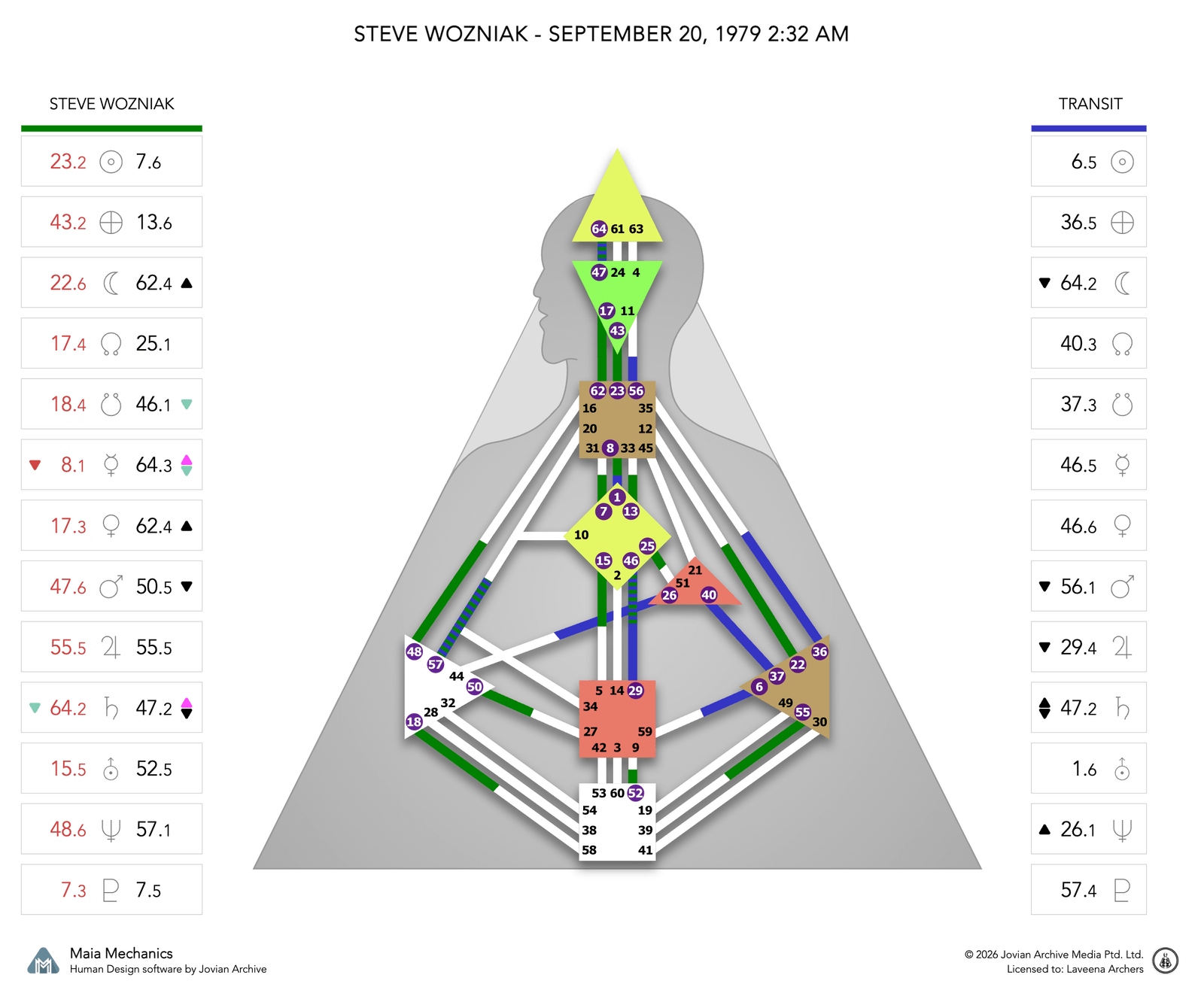 Steve Wozniak’s Saturn Return transit chart, age 29, via Maia Mechanics.
Wozniak’s Saturn Return fell on September 20, 1979, three years after Apple’s founding and roughly a year before the company’s December 1980 IPO, the offering that made him, on paper, one of the youngest self-made millionaires in the country. By 1979 the Apple II, the machine Wozniak designed almost entirely on his own, had already become the product the entire company was built on top of. His return landed at the exact moment the market was confirming that the machine worked, commercially as well as technically.
Steve Jobs: November 25, 1984
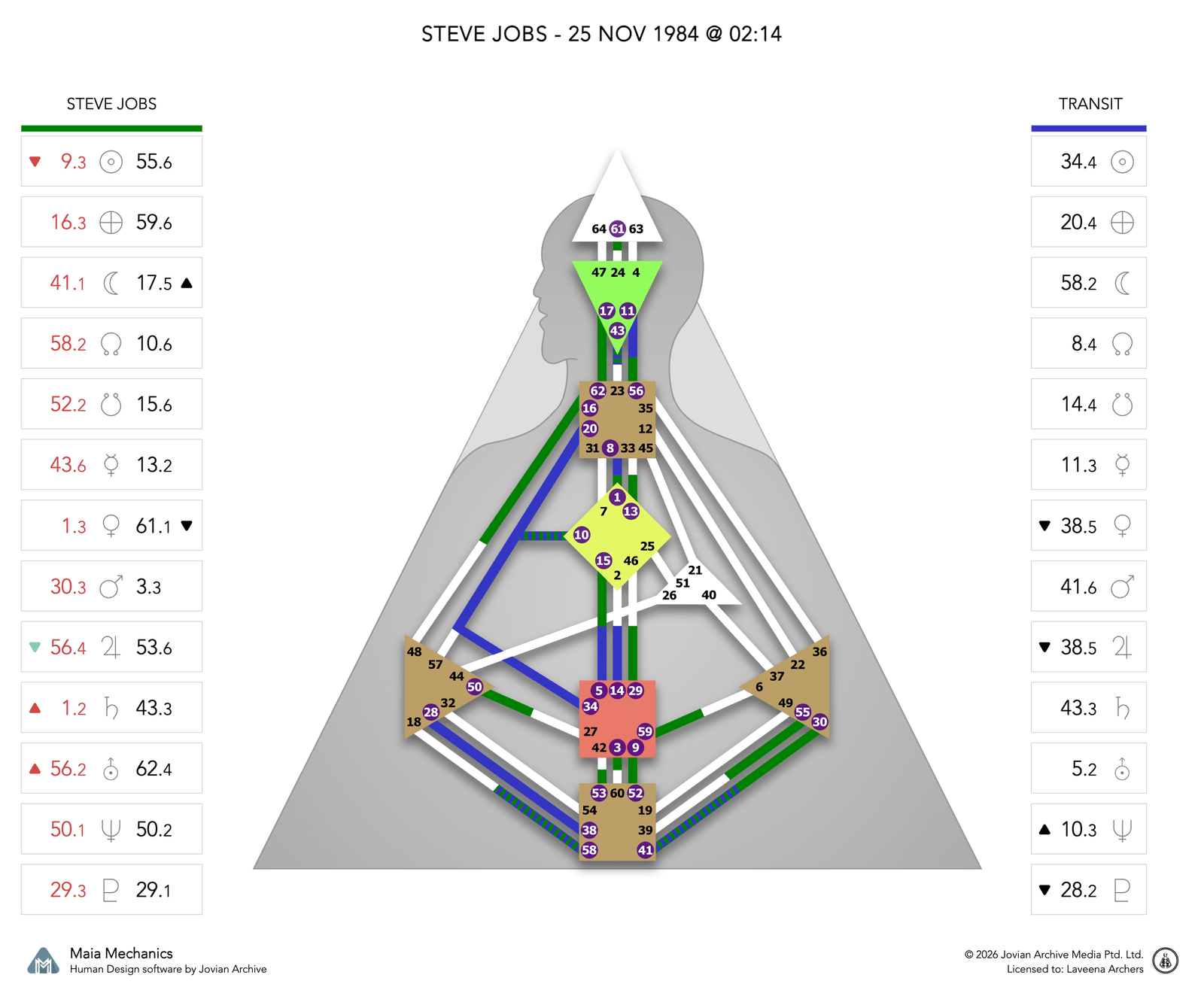 Steve Jobs’s Saturn Return transit chart, age 29, via Maia Mechanics.
Jobs’s Saturn Return fell on November 25, 1984, ten months after the January 1984 launch of the Macintosh and eight months before the boardroom fight that would push him out of Apple entirely, in September 1985. Transiting Saturn returned that day to the exact gate and line of his natal Personality Saturn, Gate 43, Line 3, the same compromised gate his partnership with Wozniak touches directly. A Saturn Return sitting on the exact gate that his own founding partner’s design put pressure on, arriving less than a year before the company forced him out, is as specific a piece of dated structural timing as this chart offers.
Two Uranus Oppositions (40’s), on either side of a return
A Uranus Opposition is a break from an established pattern, the point where the structure that’s been running gets pushed toward something it was never built to hold.
Steve Wozniak: August 12, 1992
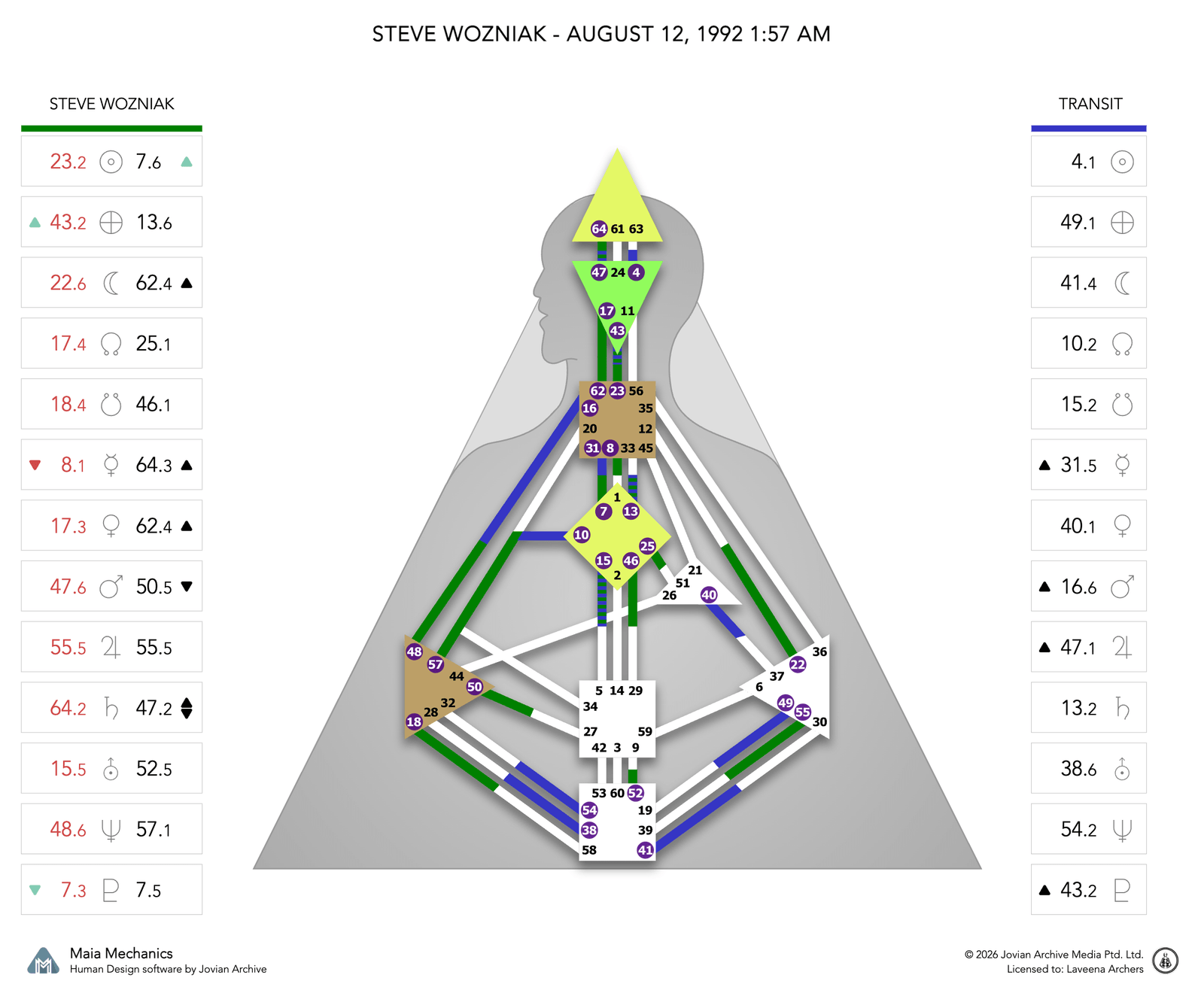 Steve Wozniak’s Uranus Opposition transit chart, age 42, via Maia Mechanics.
By 1992, Wozniak had been out of any operating role at Apple for years, having left day-to-day involvement in the mid-1980s to teach fifth-grade computer classes and fund technology programs in Los Gatos schools, work he was still doing when this transit crossed his chart. The break from the pattern, engineer-executive back to hands-on teacher, was already years old by the time Uranus caught up to it structurally.
Steve Jobs: February 27, 1997
Jobs’s Uranus Opposition fell on February 27, 1997, one month before Apple’s board voted, on March 20, 1997, to formally return him to the company as an advisor following its purchase of NeXT, the company he’d built during his twelve years away. The pattern that broke was the exile itself. Every year since his 1985 departure had run on the assumption that Jobs and Apple were finished with each other; this transit landed at almost the exact moment that assumption stopped being true.
A note on scope: this reading covers the Saturn Return and Uranus Opposition for both men. Maia Mechanics, the software used to calculate these charts, doesn’t currently track Chiron, so the Chiron Return isn’t part of this piece.
What this reading doesn’t claim
None of this says Human Design explains why Apple succeeded, or that two compatible charts guaranteed a working partnership. Plenty of companionship connections and electromagnetic pulls exist between people who never build anything together, and plenty of successful partnerships run between charts with none of these specific mechanics at all. What the two charts offer is a structural account of one specific pairing: a shared voice built for detail and follow-through, two separate pulls of chemistry on top of it, one narrow compromise sitting inside all of it, and a founding that, by design as much as by history, was never trying to be a three-or-more-person Penta in the first place. Forty-five years later, the partnership those two mechanics describe is still the one most people mean when they say the word “Apple.”
Related
Curious what your own chart looks like? Get your own natal chart, Saturn Return, and Uranus Opposition, rendered the same way, plus the full keynote PDF, for $37.
- Should You Build Your Coaching Business Alone? A Projector Case Study — a Projector deciding whether to build solo or bring in partners
- Bill Gates: The Decision He Didn’t Have to Sell — another founding partnership’s design read against a defining early decision
- The Four Settings You Can Work In — Solo, Partnership, Penta, and OC16, and why group size is its own mechanic
Chart calculated with Maia Mechanics software. Steve Wozniak’s birth data (August 11, 1950, 9:45 AM, San Jose, California) carries an AA reliability rating on Astro-Databank. Steve Jobs’s birth data (February 24, 1955, 7:15 PM, San Francisco, California) also carries a public AA rating, though the specific time recorded to the exact quarter-hour is worth the caveat noted above. The founding of Apple Computer Company on April 1, 1976, the 45/45/10 ownership split between Jobs, Wozniak, and Ronald Wayne, Wayne’s sale of his stake twelve days later for $800, and the Byte Shop’s 50-unit order are part of the widely documented public record of Apple’s early history.
In memory of an ICONIC Human Design, LaVeena B. Archers, PhD
I’ve spent more than thirty years as an entrepreneur and teach the career and business application of the Human Design System. I help business owners and entrepreneurs market themselves in a way that fits their design, lead their teams to greater efficiency and profitability, and find the work their chart was actually built for.