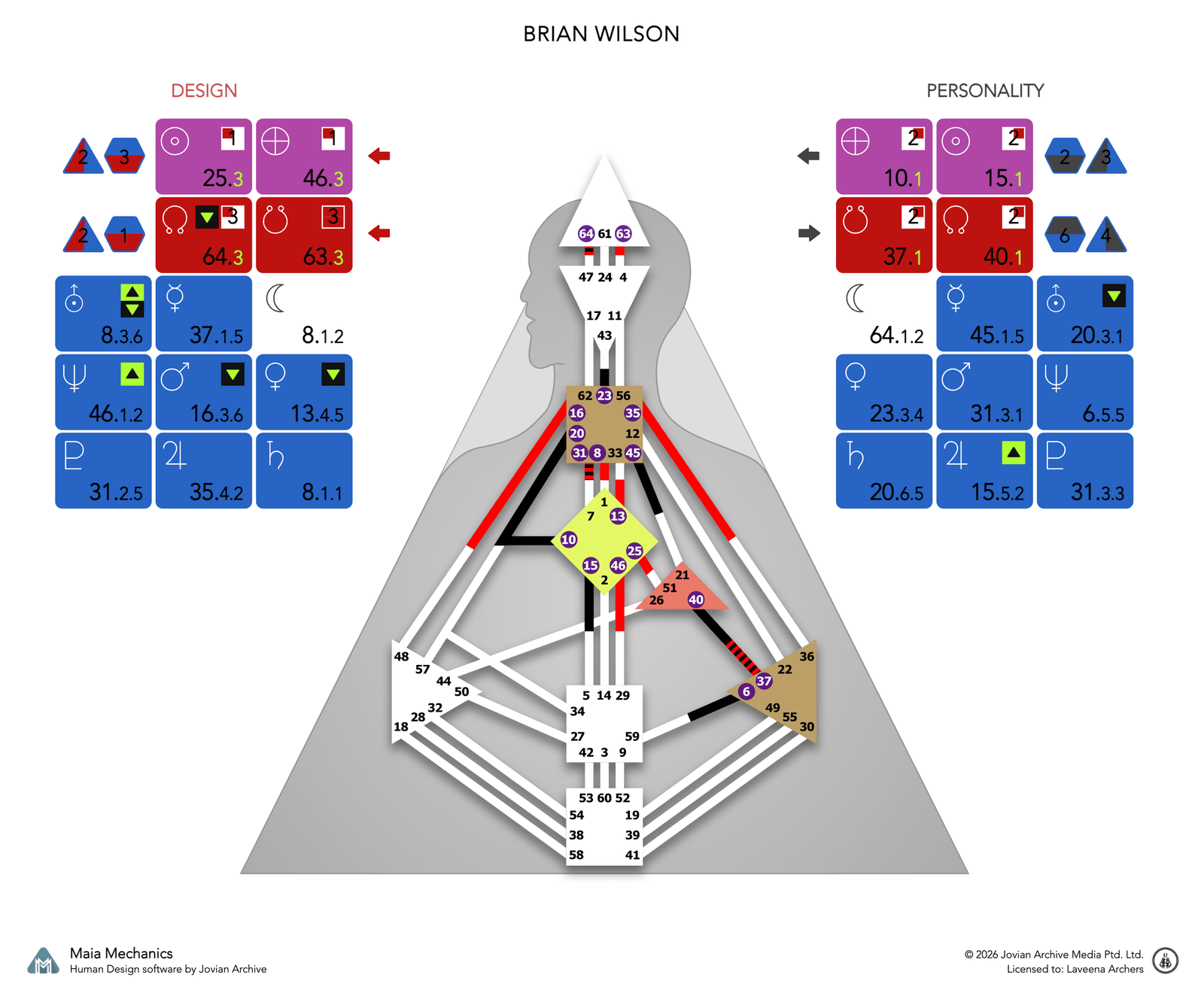
Chart calculated with Maia Mechanics, from an AA-rated birth record
Short answer: The Beach Boys began as five relatives and neighbors rehearsing in one small house in Hawthorne, California, and they are one of the only classic bands on record where every founding member’s birth time is certificate-grade. Their five charts, read as a single group, complete five of the six channels a Penta actually operates on. The sixth, the commitment channel that stabilizes a group into one body, hangs open in all five charts on the same side, which is as clean a mechanical picture of this band’s later history as the charts of any group analyzed on this site.
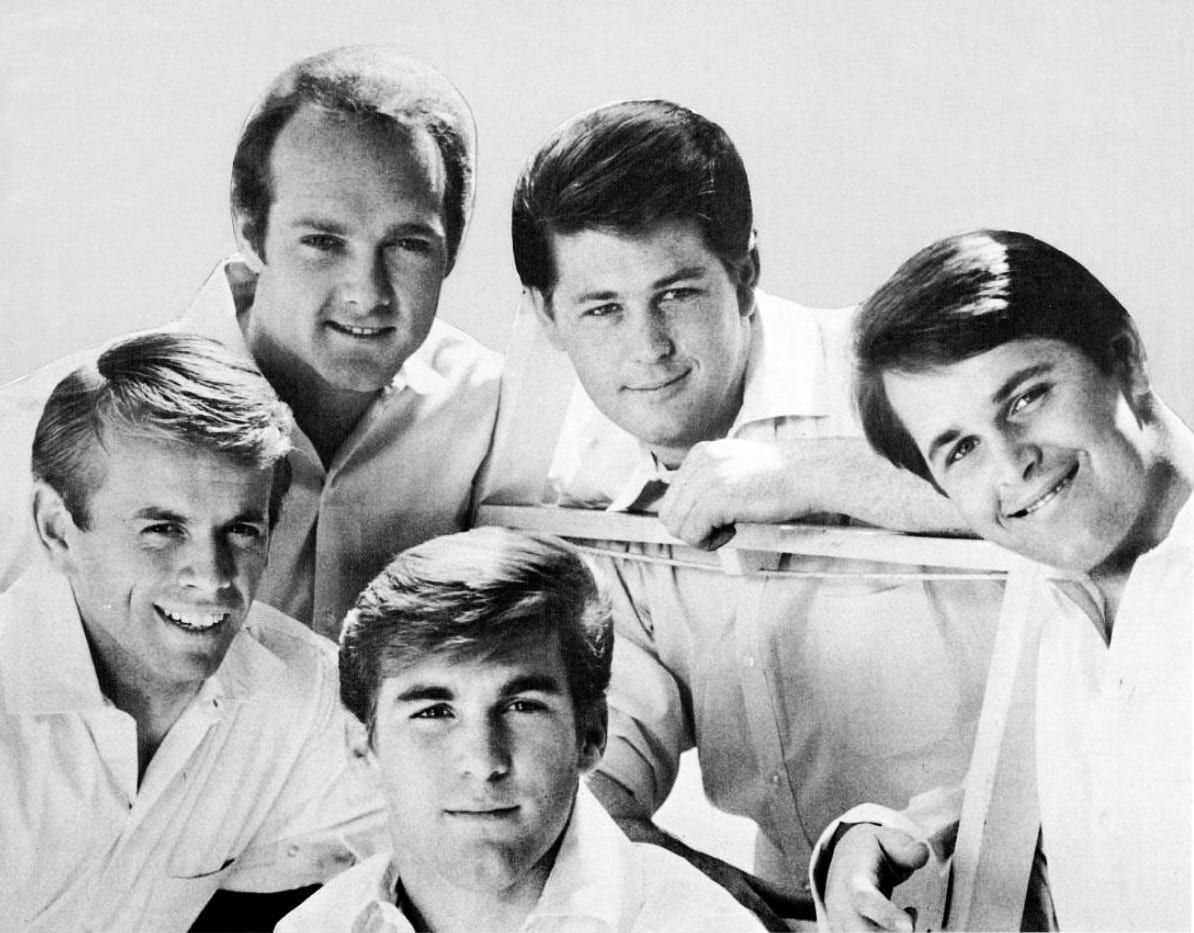 The founding five in a 1965 trade advertisement: Brian, Dennis, and Carl
Wilson, Mike Love, and Al Jardine. Public domain.
The founding five in a 1965 trade advertisement: Brian, Dennis, and Carl
Wilson, Mike Love, and Al Jardine. Public domain.
Where these charts come from
All five birth records carry Astro-Databank’s AA rating, its highest confidence category. Brian Wilson: June 20, 1942, 3:45 AM Pacific War Time, Inglewood, California, quoted from his birth certificate. Dennis Wilson: December 4, 1944, 10:56 PM, Los Angeles, quoted birth certificate. Carl Wilson: December 21, 1946, 10:48 AM, Los Angeles, quoted birth certificate. Mike Love: March 15, 1941, 10:55 AM, Los Angeles, from his birth certificate as Lois Rodden’s own client. Al Jardine: September 3, 1942, 10:14 AM Eastern War Time, Lima, Ohio, birth certificate in hand. No noon defaults, no rectifications, no “sources vary.” Five for five.
Each bodygraph was calculated in-house from those records using the Swiss Ephemeris, because the entire second half of this piece depends on comparing exact gate activations across five charts, and a borrowed chart with a few minutes of silent error in it would corrupt every comparison that follows.
Five individual charts
Brian Wilson is a Projector with Emotional authority, a 1/3 profile, and a Split Definition. His defined channels are 20-10 (Awakening) and 40-37 (Community). He is the only Projector in the group, four Sacral beings and one man with no Sacral at all, and the only other emotional decision-maker besides Al Jardine. A Projector is not built to generate for hours on end; he is built to see into the other people in the room and to guide energy he does not himself carry. The band’s own account of who arranged the voices around the microphone is not in tension with that.
Brian Wilson’s bodygraph, calculated with Maia Mechanics from an AA-rated
birth record.
Dennis Wilson, the only surfer in the band, is a Generator with Sacral authority, a 2/4 profile, and a Single Definition running Root, Sacral, and Spleen. His defined channels are 9-52 (Concentration) and 18-58 (Judgment). Nothing in his definition reaches the Throat or the G; his was the pure engine-room chart of the group.
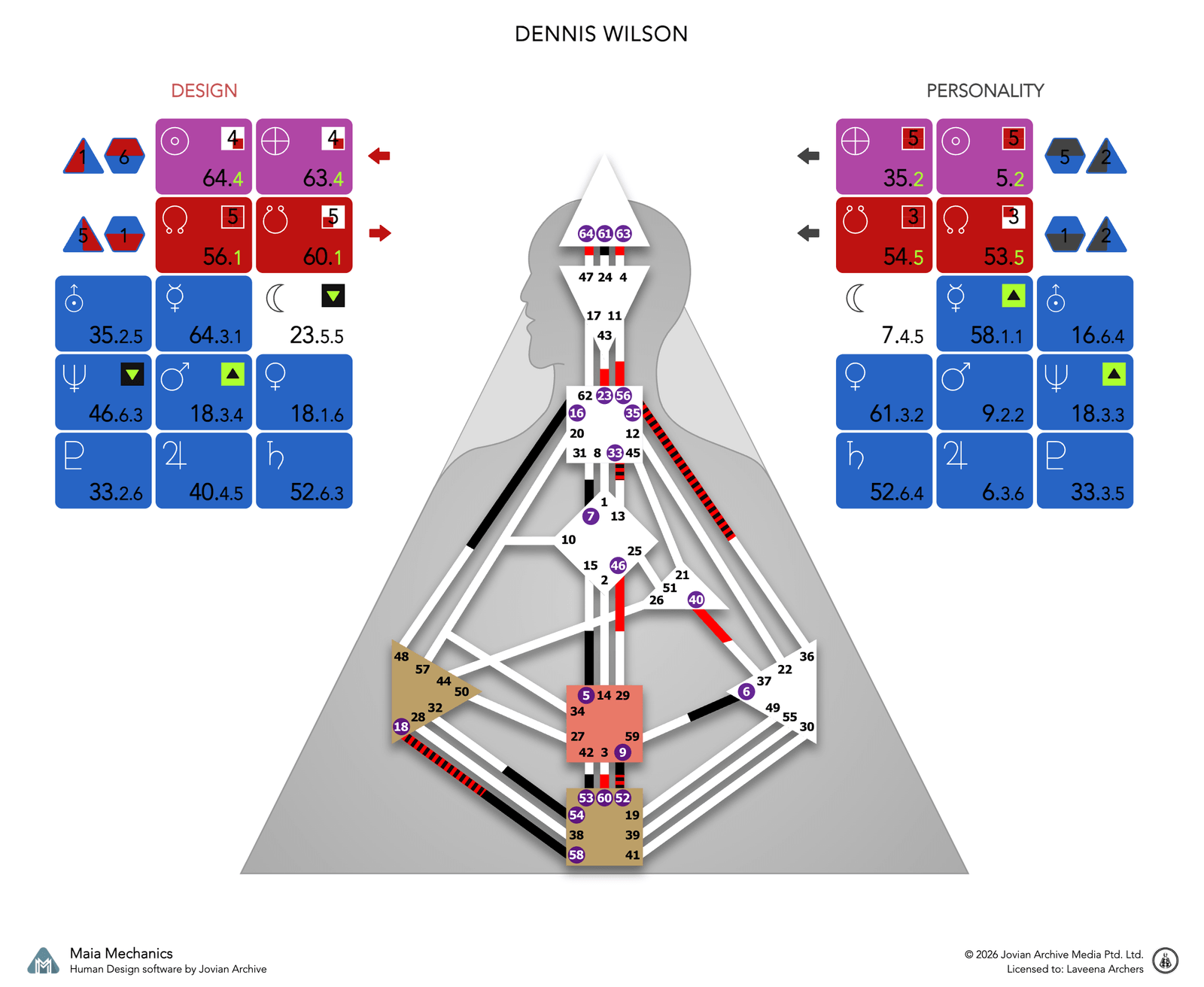 Dennis Wilson’s bodygraph, calculated with Maia Mechanics from an AA-rated
birth record.
Dennis Wilson’s bodygraph, calculated with Maia Mechanics from an AA-rated
birth record.
Carl Wilson is a Generator with Sacral authority, a 2/4 profile, and a Single Definition made of exactly one channel: 15-5, Rhythm, connecting G Center to Sacral. In Penta work 15-5 is the magnetic field, the channel that pulls separate people into one shared tempo and holds the group’s culture, its “this is how we do things here.” Carl, fourteen when the band formed, is remembered across every era of the band as the one who held the group together on the road, and his entire definition is the holding-together channel.
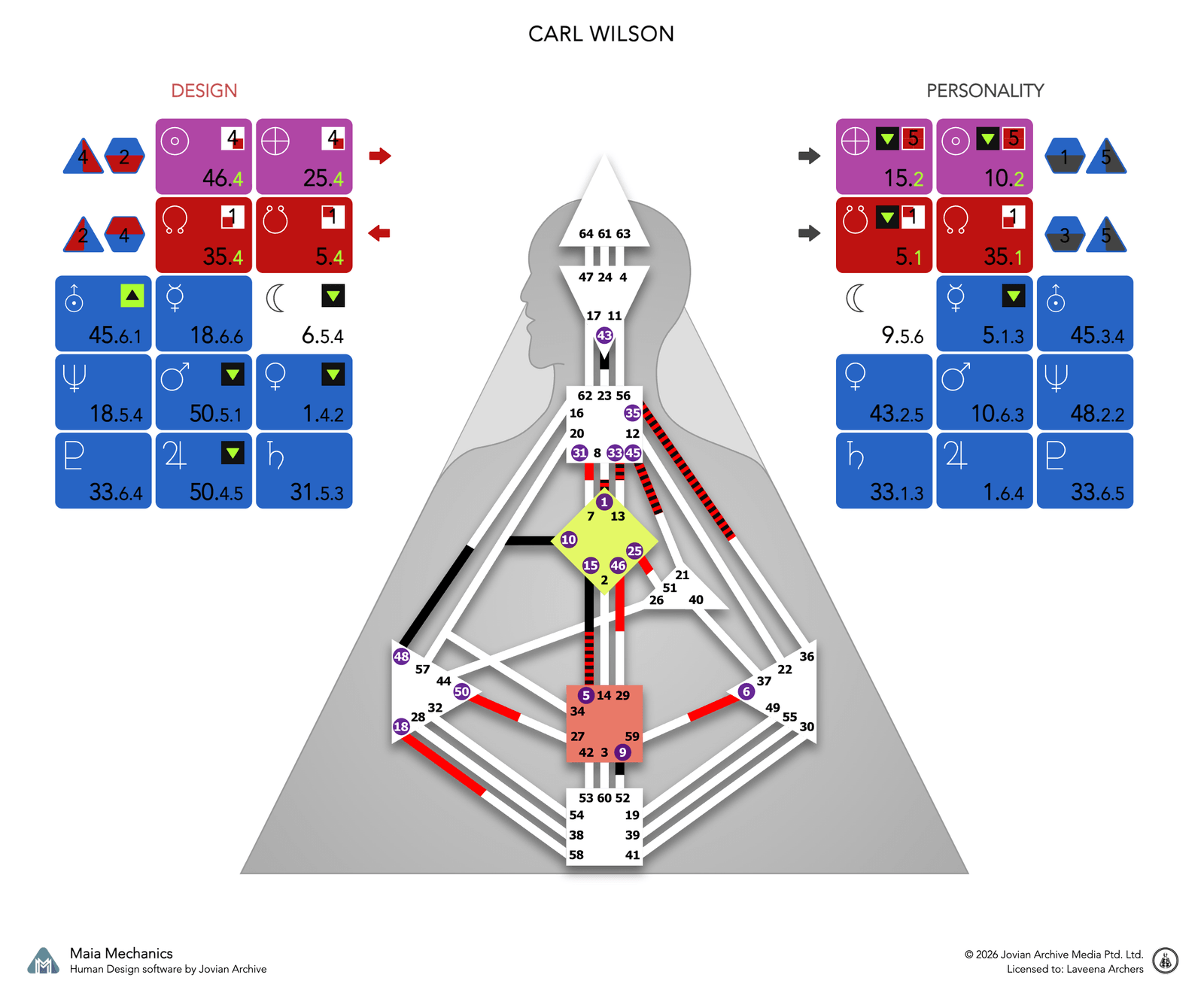 Carl Wilson’s bodygraph, calculated with Maia Mechanics from an AA-rated
birth record.
Carl Wilson’s bodygraph, calculated with Maia Mechanics from an AA-rated
birth record.
Mike Love is a Manifesting Generator with Sacral authority, a 3/5 profile, and a Single Definition. His defined channels are 31-7 (The Alpha), 2-14 (The Beat), and 27-50 (Preservation). Sit with the first two. In this work, 31-7 is the leadership channel of a small group, planning and administration, the alpha function, and 2-14 is the material engine and its steering, the wealth gate joined to direction. Love is the only member who carries either one, and he carries both, whole, in his own chart. Whatever else five decades of press coverage have said about Mike Love, the mechanics say the group’s built-in alpha seat and its built-in commercial engine sat in his bodygraph.
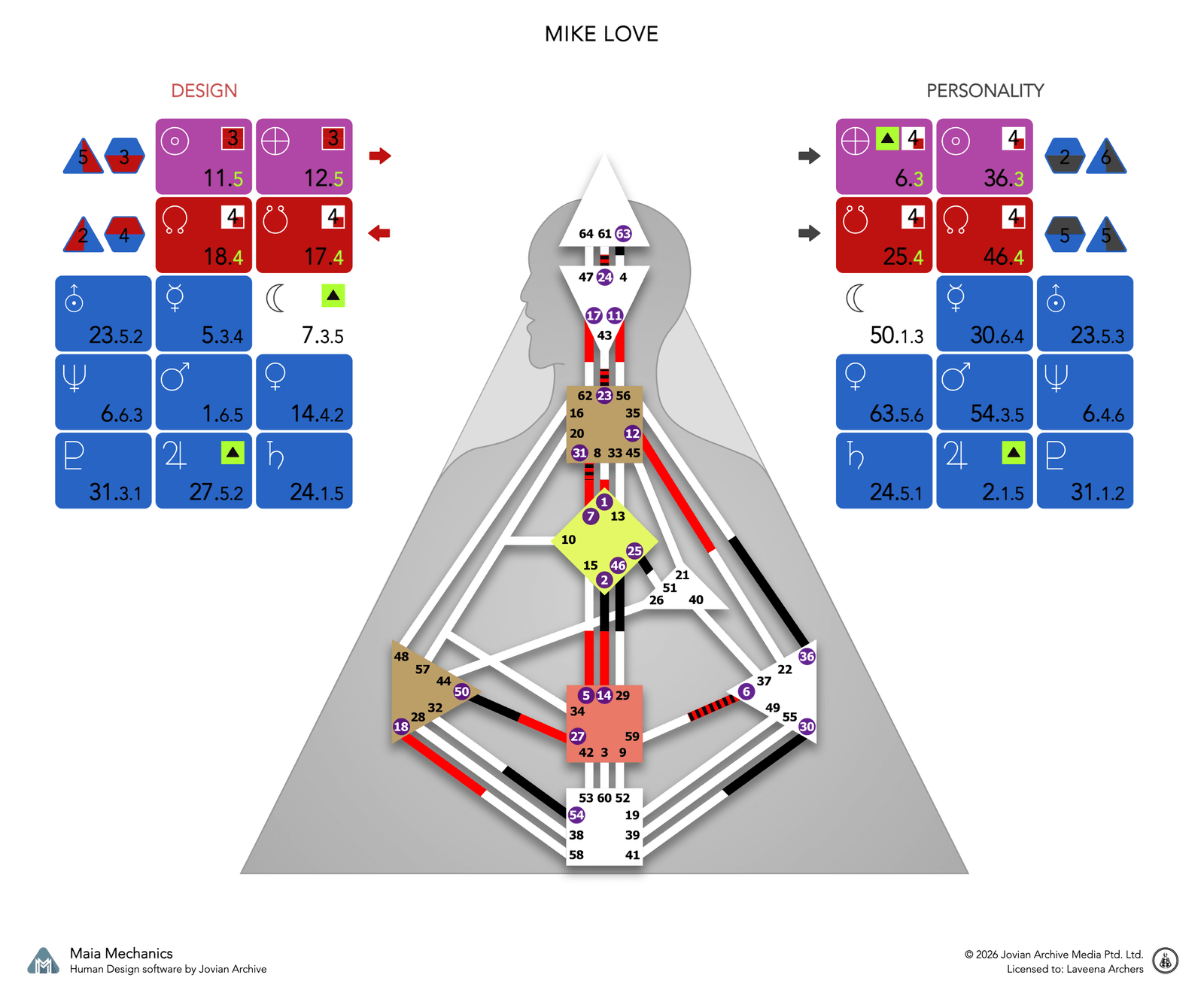 Mike Love’s bodygraph, calculated with Maia Mechanics from an AA-rated
birth record.
Mike Love’s bodygraph, calculated with Maia Mechanics from an AA-rated
birth record.
Al Jardine is a Generator with Emotional authority, a 5/2 profile, and a Single Definition. His defined channels are 15-5 (Rhythm), 40-37 (Community), and 59-6 (Mating). Two of those duplicate other members’ definition: he carries the same Rhythm channel as Carl and the same Community channel as Brian. In group mechanics that duplication is reinforcement, a second person holding the same function so the group doesn’t lose it when one of them is out of the room, and Jardine is literally the member whose 1962-63 absence tested that.
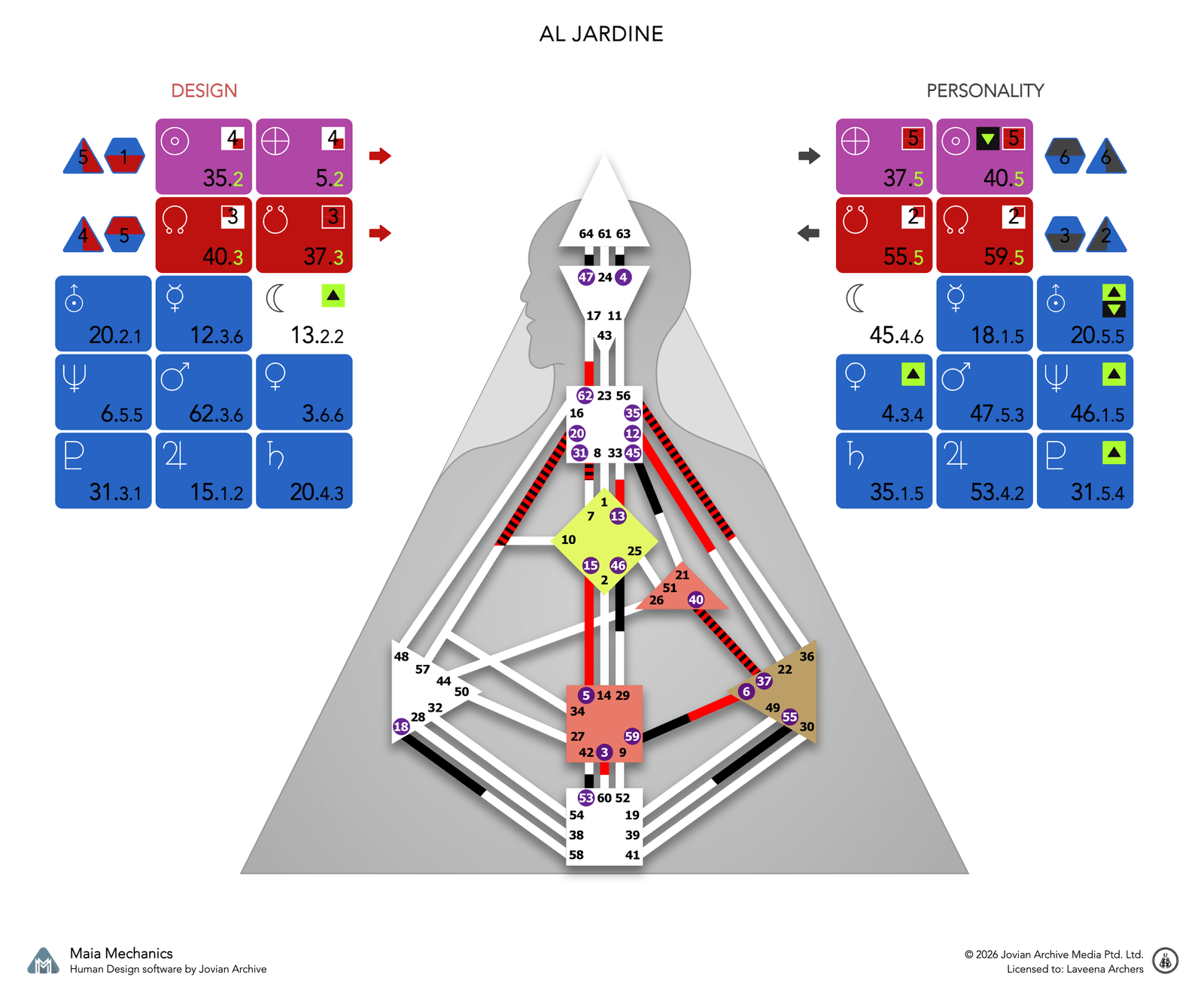 Al Jardine’s bodygraph, calculated with Maia Mechanics from an AA-rated
birth record.
Al Jardine’s bodygraph, calculated with Maia Mechanics from an AA-rated
birth record.
What a Human Design Penta actually is
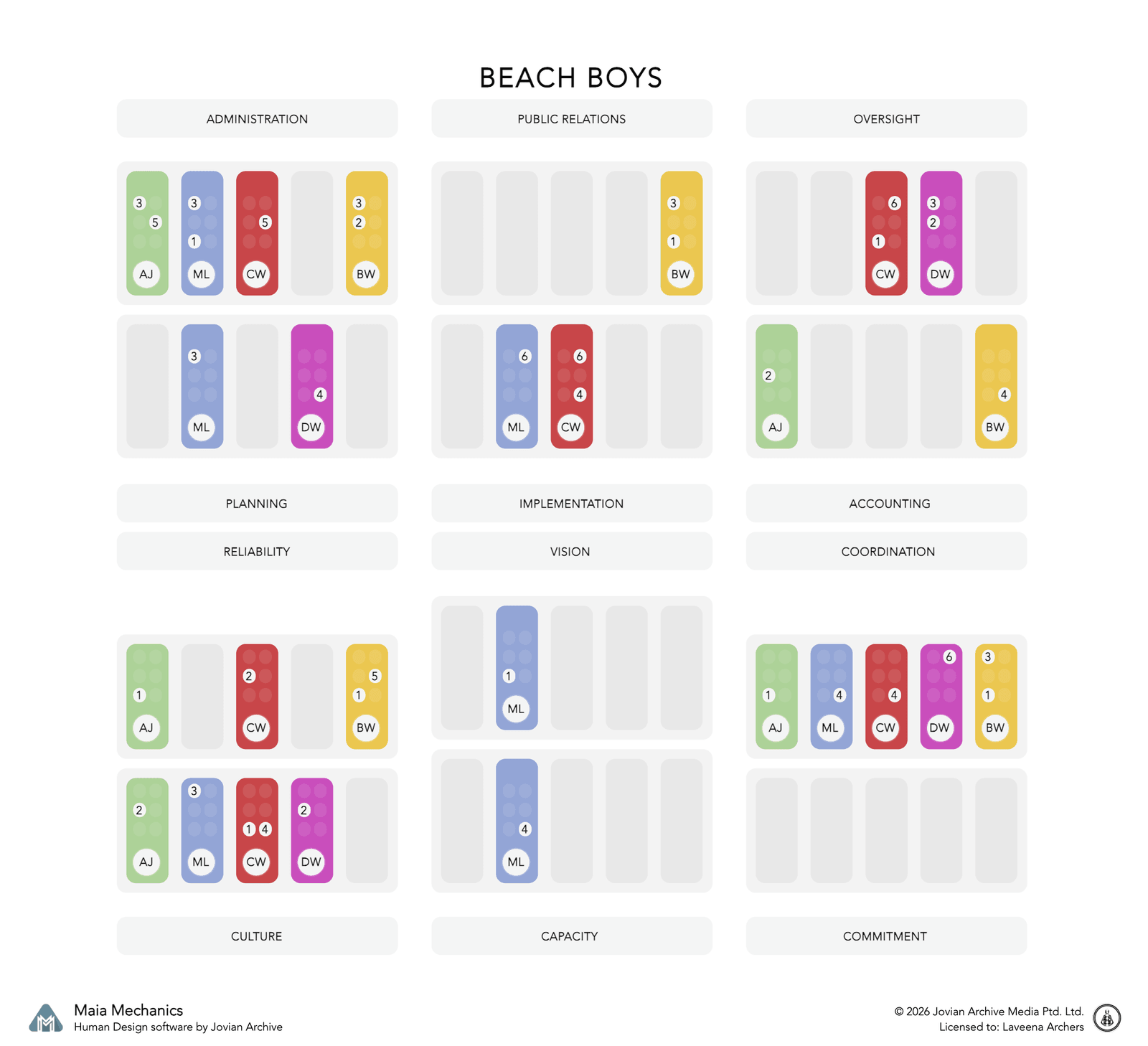 The founding five as a Penta, calculated with Maia Mechanics. AJ is Al
Jardine, ML is Mike Love, CW is Carl Wilson, DW is Dennis Wilson, BW is
Brian Wilson.
The founding five as a Penta, calculated with Maia Mechanics. AJ is Al
Jardine, ML is Mike Love, CW is Carl Wilson, DW is Dennis Wilson, BW is
Brian Wilson.
A Penta is a trans-auric form: an auric entity generated by the merged auras of three to five people who are physically together, with its own structure that dominates the room while it exists. It is not a metaphor for teamwork. It runs on a specific stream of channels connecting Sacral through G Center to Throat, and each of those channels is a group-level function: 15-5 pulls people into one rhythm and culture, 46-29 stabilizes the merged aura through commitment, 2-14 is the material engine and its direction, 8-1 is the group’s public expression, its ability to be seen, 31-7 is planning and administration, the alpha function, and 33-13 is accounting and oversight, the one place a group looks back and tallies what actually happened. A function can be carried by one person whole or assembled across two people, one gate each, and where nobody physically present carries a piece at all, the group has a gap in that function. The gap does not care how talented the individuals are. It is the group itself that is missing the part.
Size matters too. Five is the Penta’s maximum, and five is taught as hierarchical tension: a five is always seeking its potential and always carrying the drive to split and grow, the group-level version of the genetic push to reproduce. Hold that thought against this band’s actual timeline.
Who was actually in the room
The co-presence here is about as documented as it gets. The three Wilson brothers grew up sharing one small house at 3701 West 119th Street in Hawthorne, a site since designated a California Historical Landmark for what happened in it: over Labor Day weekend 1961, with their parents out of town, the brothers, cousin Mike Love, and friend Al Jardine used the family’s emergency food money to rent instruments and rehearse “Surfin’” in the living room. That fall the five recorded it at World Pacific Studio in Los Angeles; their first paid concert followed on New Year’s Eve 1961 in Long Beach. From there the five toured near-continuously until December 23, 1964, when Brian broke down on a flight to Houston and came off the road for good, and the in-person configuration changed shape: the touring four onstage, and the full group re-forming in the studio for the vocal sessions. Those sessions were themselves dense physical co-presence, the five (with Bruce Johnston by then a sixth voice) stacked around single microphones at Western Recorders and Columbia through the Pet Sounds vocal dates of early 1966, and then in Brian’s own Bel Air house, converted into a studio, for the six-week homemade run that produced Smiley Smile in 1967. The band that started in a living room ended up, six years and an era later, back in one.
The clearest surviving record of the five-man configuration at work is television footage from the touring years, months before the December 1964 flight that ended them: the founding five, one stage, one blend.
The channels none of them carries alone
Comparing each member’s incomplete, “hanging” gate activations against the other four’s activated gates surfaces eleven channels that exist in no single member’s chart and complete only in the shared aura. The most consequential sit in the Penta’s own operating stream, so start there.
8-1, Inspiration, the public expression. Brian carries gate 8, the gate of contribution, alone; Carl and Mike Love each carry gate 1, creative self-expression, alone. The channel through which a group gets seen and heard completes only when Brian is in the room with Carl or Love. A Penta is taught, bluntly, as a marketing machine, most of its energy funneling up into being noticed, and this group’s noticing-machinery was a Brian-plus-one construction.
33-13, The Prodigal, accounting and oversight. Dennis and Carl carry gate 33, oversight of what happened; Brian and Al carry gate 13, the listener, the keeper of the record. This is the only place a Penta looks back at the past and tallies it, and it completes here across four of the five, in either direction. For a group whose later decades were spent in courtrooms re-litigating what exactly happened in the 1960s, songwriting credits, royalties, who contributed what, it is at least worth noticing that the looking-back function existed only between specific pairs of them.
15-5 and 2-14, already covered. Rhythm is carried whole twice over, by Carl and by Al, with Brian, Dennis, and Love all hanging gates into it; every single member participates in the rhythm channel one way or another, which for a vocal-harmony band is the least surprising sentence in this piece. The Beat is Mike Love’s, whole. Planning and administration, 31-7, is also Love’s, whole, though every other member feeds it: Brian, Carl, and Al each hang gate 31, the influence gate, toward the channel only Love completes, and Dennis hangs the planning gate 7 into it from the other side.
And the sixth: 46-29, Discovery, the aura stabilizer. This one never completes. Every one of the five carries gate 46, the love of the body, the pull toward embodiment and harmony. Not one of them carries gate 29, the commitment gate, the yes that binds. In Penta teaching this channel is what homogenizes separate frequencies into one entity, the function that makes a group feel like a single body it wants to stay inside; the 46 without the 29 is taught as the side that turns on itself, the “it’s my fault, we’re not more committed” seat. Five men holding the harmony gate with no commitment anchor anywhere in the room: the group that could blend five voices into one chord on tape and then spent fifty years struggling to stay in one room. A gap doesn’t cause a history. It does describe, precisely, what the room never had.
Beyond the operating stream, the wider set of eleven includes all three channels of the head-to-Ajna pressure system, 64-47, 61-24, and 63-4, completing across various pairs (Dennis, notably, hangs a gate into every one of them); 16-48, Wavelength, the skill-and-depth channel, completing between Brian or Dennis and Carl; 43-23, Structuring, completing into Carl’s hanging gate 43; and 35-36, where four members’ gate 35 meets Mike Love’s gate 36. None of these exists in any single chart. All of them lived only in the room.
What that adds up to
Put five certificate-grade charts in one Hawthorne living room and the group that forms has a double-reinforced rhythm-and-culture channel, a whole commercial engine and a whole alpha seat (both in the same cousin), a Brian-dependent publicity channel, a four-way accounting function, three head-pressure bridges, and no stabilizer. That is not a value judgment about five men. It is the specific shape of this specific group, and it tracks the record: a band whose sound, its actual product, was the rhythm and blend the room generated; whose commercial frontman and whose studio visionary were different people carrying different mechanics; and whose one missing function, binding commitment, is the one thing no era of its history managed for long. The teaching says a five carries hierarchical tension and the drive to split. This five split exactly where the mechanics are thinnest: not over the music, which the room made effortlessly, but over commitment and accounting, the functions that only existed between specific pairs or not at all.
What to do on Monday
- If your team’s product is genuinely made in a room together, treat the room as the asset. This band’s catalog is what a fully-armed Penta stream sounds like on tape; the sessions were never the problem.
- Check who carries your group’s alpha and engine channels before the fight, not after. If both live whole in one person, the leadership question has a mechanical answer that titles and talent won’t override.
- Look for your missing gate. If a function hangs open on the same side in everyone, the group will keep reaching for it and blaming itself for not holding it. Name it, then fill it: hire it, contract it, or accept its absence deliberately.
- Reinforcement is not redundancy to cut. Two people carrying the same channel (here, Rhythm twice over) is what let the group survive one of them leaving. If only one person carries a load-bearing channel, plan for their absence now.
- When a member stops traveling with the team, redraw the group. The five-man Penta that boarded planes until December 1964 and the studio Penta that stacked vocals afterward are different mechanical objects, and managing them as if they were the same group is how gaps get missed.
Related
- Barry, Robin, and Maurice Gibb: The Bee Gees’ Penta: the three-brother creative Penta this five-man analysis extends
- Rainier, Grace, and Their Three Children: Monaco’s Palace Penta: the other five-person Penta on this site, with the opposite result: no gaps in the stream
- The Four Settings You Can Work In: Solo, Partnership, small business, and large business as distinct mechanical settings
- Kris, Kim, and Khloé: The Penta Nobody Named: the conventional family-business Penta
In memory of an ICONIC Human Design, LaVeena B. Archers, PhD
I’ve spent more than thirty years as an entrepreneur and teach the career and business application of the Human Design System. I help business owners and entrepreneurs market themselves in a way that fits their design, lead their teams to greater efficiency and profitability, and find the work their chart was actually built for.
Common questions
What is a Penta in Human Design?
A Penta is a group of three to five people whose auras merge into one trans-auric form whenever they are physically together. It has its own structure and its own gaps, and it exists only while the people are actually in the same room. Five is its maximum size, which makes a five-man band the mechanic at full capacity.
Why these five and not later Beach Boys like David Marks or Bruce Johnston?
This piece analyzes the founding five who formed the group in the Wilsons' Hawthorne living room in 1961: Brian, Dennis, and Carl Wilson, Mike Love, and Al Jardine. Later members mattered to the band's history, but the founding unit is the five whose in-person formation is documented from the first rehearsal to the first recordings, and five is the most a single Penta can hold anyway.
How unusual is the birth data behind this analysis?
Very. All five founding members carry Astro-Databank's AA rating, meaning birth-certificate-grade times: four quoted from birth certificates, and Al Jardine's certificate physically in hand. Most classic bands cannot produce even one AA time; this one produces five, largely because California birth certificates record the minute of birth.
What does it mean that nobody in the group carries gate 29?
Gate 29 is one half of Channel 46-29, taught in Penta work as the aura stabilizer, the commitment that binds a group into one body. All five members carry gate 46, the other half, and no one carries the 29. So the group could always feel the pull toward harmony and embodiment, and never had the in-room mechanism that locks commitment in. A gap like that doesn't predict events, but it names a function the room simply never had.
Wasn't Al Jardine out of the band for a while?
Yes, and it matters for the mechanics. Jardine left in February 1962 to continue his studies and returned in 1963, with David Marks filling his chair in between. The full founding five's in-person windows are 1961 to early 1962, then late 1963 to December 1964 on the road, plus the studio vocal sessions afterward. A Penta only exists while its people are physically present, so the analysis holds for exactly those windows.