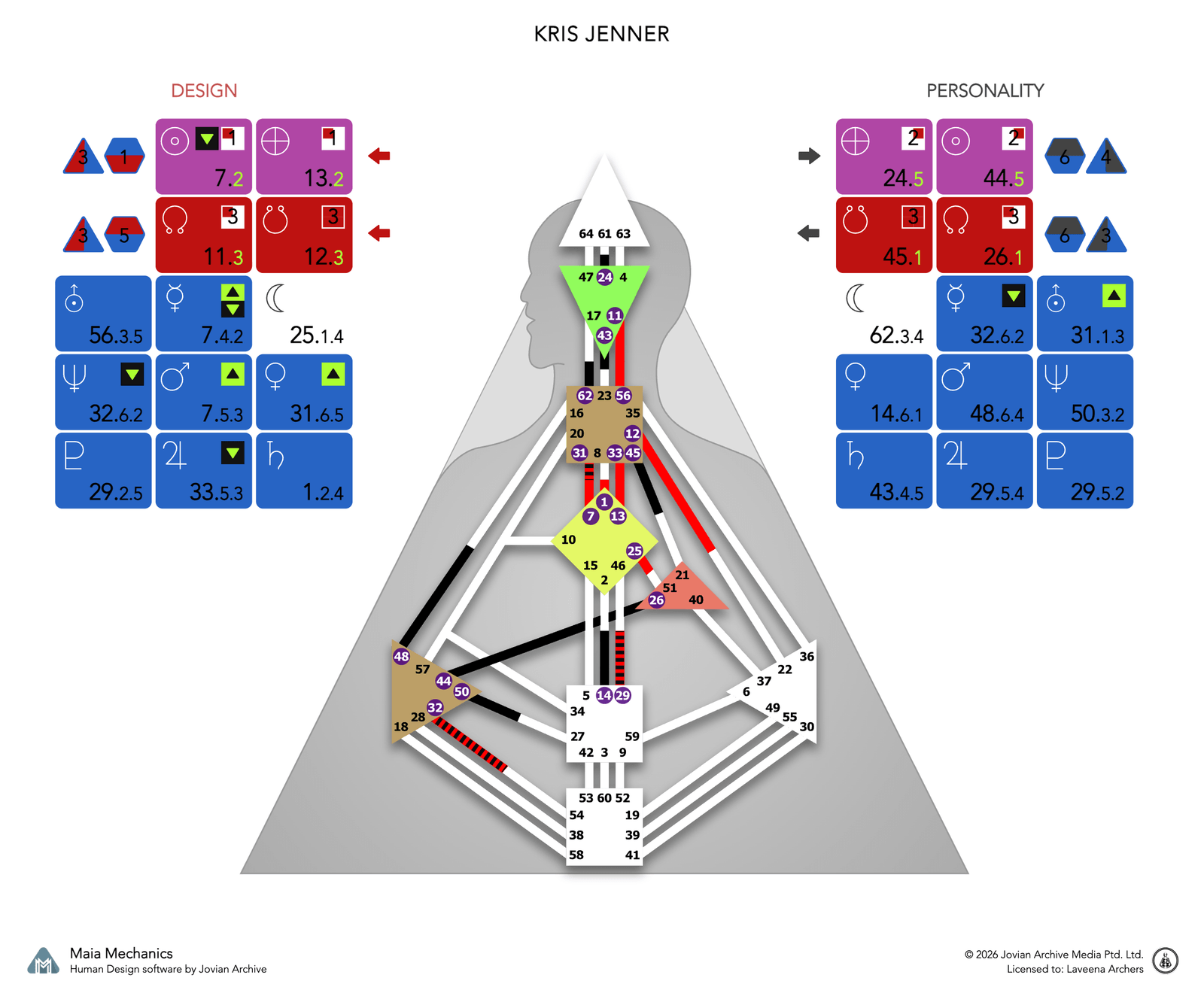
Chart calculated with Maia Mechanics, from an AA-rated birth record
Short answer: Kylie Jenner and Kendall Jenner run their own separately staffed companies. Kris Jenner, Kim Kardashian, and Khloé Kardashian are the three who are documented, again and again, actually in the same room: production meetings for The Kardashians, the family’s own geographic cluster in Hidden Hills and Calabasas, joint appearances at business functions. That in-person consistency turns three individual charts into something none of them carries alone, and their bodygraphs show exactly where that extra structure comes from.
 Kris Jenner, 2025. Photo by Gage Skidmore, CC BY-SA 3.0.
Where these charts come from
Public charts for well-known people are usually built on a guess. When no birth time is on record, a noon default gets used, and details that depend on the minute get presented as fact anyway.
All three birth records here carry Astro-Databank’s AA rating, its highest confidence category, meaning each is sourced from a birth certificate in hand. Kris Jenner: November 5, 1955, 2:47 AM PST, San Diego. Kim Kardashian: October 21, 1980, 10:46 AM PDT, Los Angeles. Khloé Kardashian: June 27, 1984, 10:55 PM PDT, Cedars-Sinai, Los Angeles.
Each bodygraph was calculated in-house from those records using the Swiss Ephemeris, not copied from a chart site or an app. That distinction matters more here than in most single-person pieces, because the entire second half of this analysis depends on comparing exact gate activations across three charts, and a few minutes of error in any one birth time would quietly break the comparison.
Three individual charts
Kris Jenner is a Projector with Splenic authority, a 5/2 profile, and a Split Definition across two groups: Ajna, G Center, and Throat in one; Heart and Spleen in the other. Her defined channels are 11-56 (Curiosity), 31-7 (The Alpha), 33-13 (The Prodigal), and 26-44 (Surrender).
A Projector’s strategy is to wait for recognition and invitation rather than to initiate, and Splenic authority is instinctive and immediate: a knowing that arrives once, in the moment, rather than something that gets checked against feelings or time. Read against the public record, that matters more than it might first appear. A Projector succeeds by being deeply recognized for what she sees in someone else and by getting that person into their own success first. Whatever the popular “momager” framing implies about control, the mechanic underneath a Projector’s success is seeing what someone else has and positioning it correctly, not initiating on her own behalf.
Kris Jenner’s bodygraph, calculated with Maia Mechanics from an AA-rated
birth record.
Kim Kardashian is a Generator with Sacral authority, a 3/5 profile, and a single Definition running Root, Sacral, and Spleen as one connected group. Her defined channels are 34-57 (Power) and 3-60 (Mutation).
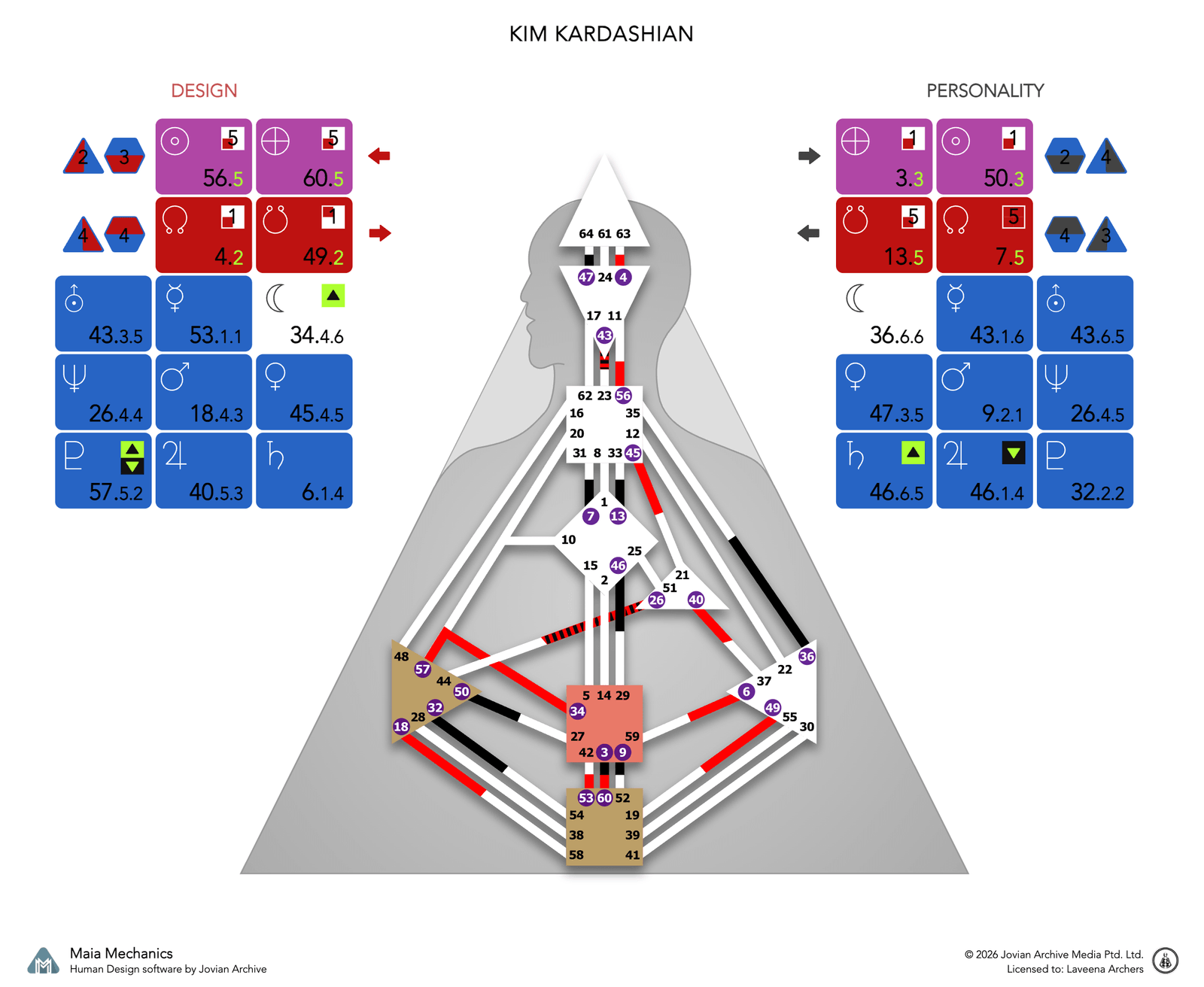 Kim Kardashian’s bodygraph, calculated with Maia Mechanics from an AA-rated
birth record.
Kim Kardashian’s bodygraph, calculated with Maia Mechanics from an AA-rated
birth record.
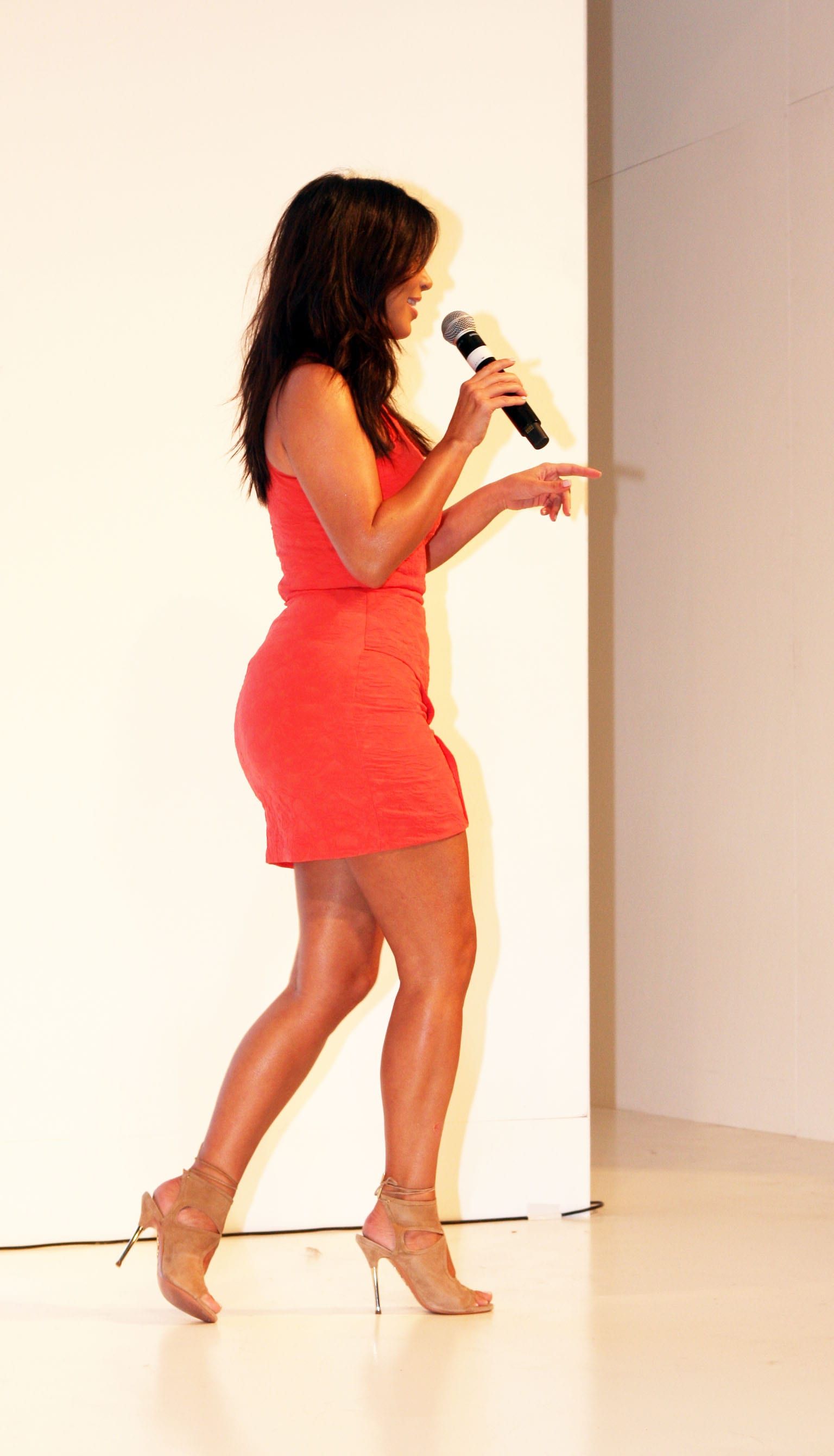 Kim Kardashian at Parramatta Westfield, Sydney, Australia, 2014. Photo by Eva
Rinaldi, CC BY-SA 2.0.
Kim Kardashian at Parramatta Westfield, Sydney, Australia, 2014. Photo by Eva
Rinaldi, CC BY-SA 2.0.
A Generator’s authority is the Sacral response itself: a yes or no that answers something already in front of her, generated moment to moment rather than decided in advance. That is a sustainable, responsive engine, not an initiating one, and it is worth noting given how much of Kim Kardashian’s business history (SKIMS, KKW, the original reality format itself) reads as response to opportunity that showed up rather than a market gap she went out looking for.
Khloé Kardashian is a Manifesting Generator with Emotional authority, a 4/6 profile, and a single Definition connecting Root, Sacral, Solar Plexus, Spleen, and Throat. Her defined channels are 12-22 (Openness), 9-52 (Concentration), 18-58 (Judgment), and 55-39 (Emoting).
A Manifesting Generator carries the Generator’s sustained energy with the capacity to move faster and skip steps, and Emotional authority means no decision taken in the moment is reliable. Clarity for her arrives across a wave, not in the room, which is a different rhythm from both her mother and her sister and matters for how the three of them actually work together, not just how each of them works alone.
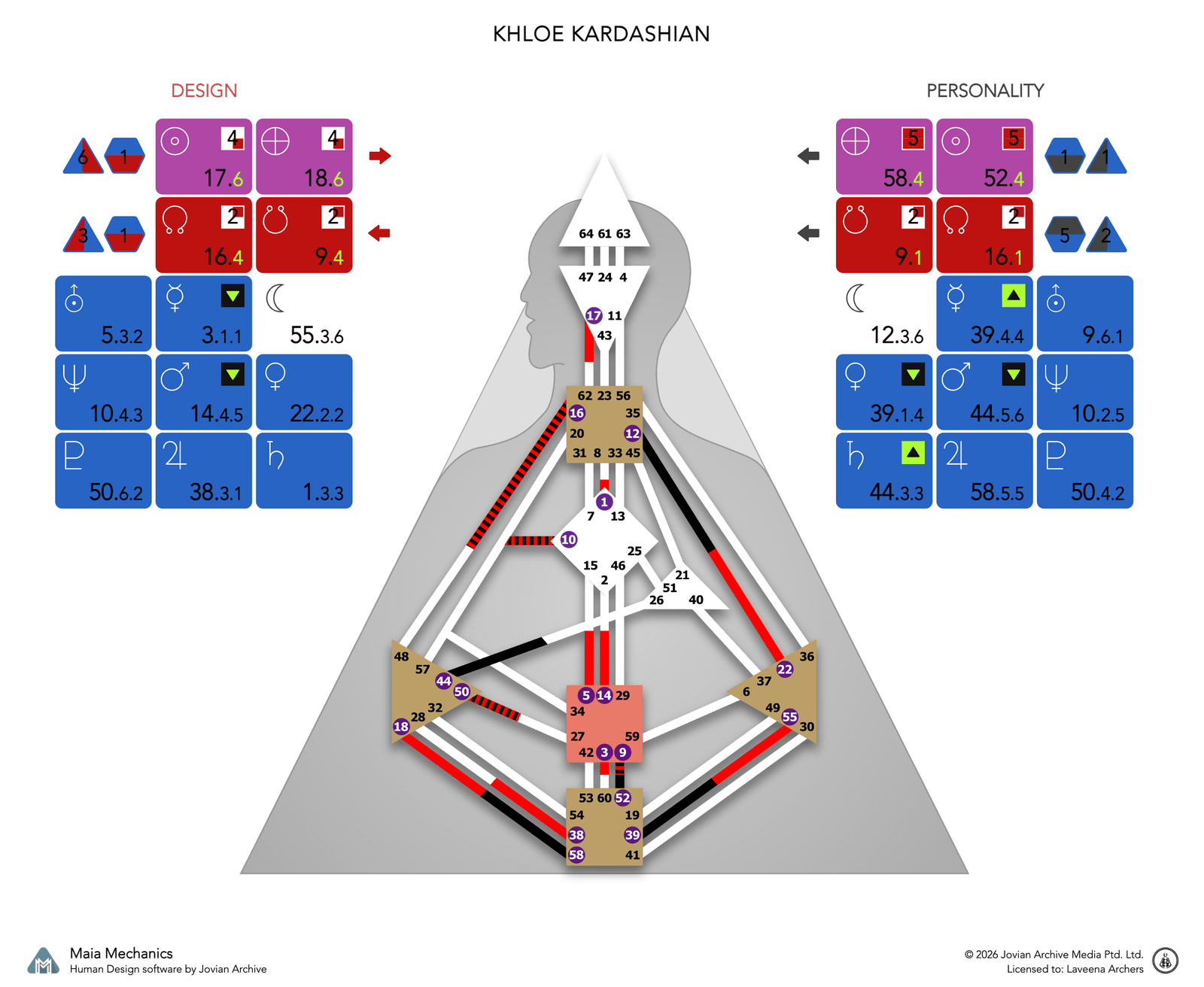 Khloé Kardashian’s bodygraph, calculated with Maia Mechanics from an
AA-rated birth record.
Khloé Kardashian’s bodygraph, calculated with Maia Mechanics from an
AA-rated birth record.
 Khloé Kardashian, 2011. Photo by Eva Rinaldi, CC BY-SA 2.0.
What a Penta actually is
None of what follows works unless the underlying mechanic is correct, so it’s worth being exact about it. A Penta is a trans-auric form: an auric structure generated by the interaction of individual auras rather than belonging to any one person on their own, and that puts it outside the ordinary sense of the word “team.” Every other structure in Human Design analysis (an individual’s own chart, a two-person Partnership) is self-contained; a Penta isn’t. It only forms when three to five people are physically together, and once it does, it dominates. Their auras merge, and something with its own shape and its own requirements takes over.
That form runs on the connections from the Sacral through the G Center into the Throat: generative drive moving up into identity and out into voice and action. It has no fixed awareness system of its own, no Head, no Ajna answering questions from the top down, no Spleen offering instinct, no Solar Plexus running an emotional wave. It is, structurally, a pure driving force, and the individuals inside it behave according to what the group needs rather than according to their own separate design while they’re in it.
This is also why gaps matter so much in a genuine, in-person Penta. If none of the people physically present carry a given piece of that Sacral to Throat structure, the group has a real gap in that function, and no amount of individual talent elsewhere compensates for it, because the group itself is what’s short a part. And the reverse is just as mechanical: bring the right person into the room, and a gap that existed a moment ago stops existing, because the Penta has just picked up an activation it didn’t have when that person was somewhere else. This is what makes the in-person requirement structural rather than a nice-to-have. The form is generated by whoever is actually standing there, not by whoever holds a title, is on an org chart, or would in theory be capable of doing the job remotely.
Who’s actually in the room
Kylie Jenner and Kendall Jenner run genuinely separate operations: Kylie Cosmetics and Skin with their own staff and supply chains, Kendall’s modeling career and 818 Tequila with their own. They are part of the same family brand, but not part of the daily working core this piece is analyzing. Kris, Kim, and Khloé are the three who are consistently documented in the same physical space for business purposes: the production meetings and on-camera business discussions that make up The Kardashians, the geographic proximity of a family clustered in Hidden Hills and Calabasas, and joint appearances at business functions across skincare, shapewear, and licensing deals. That in-person dynamic is on full display when Kim calls in professional PR coaches to run the family, Kris and Khloé included, through media training together.
That’s the group whose Penta is actually worth computing, because a Penta computed from people who aren’t physically together most of the time is, at best, theory. Here, the theory has an actual in-person group to test it against.
The channels none of them carries alone
Comparing each woman’s individually incomplete, or “hanging,” gate activations against the other two’s defined gates surfaces four channels that do not exist in any single chart. Each only comes alive in the specific paired aura named.
Channel 17-62, Acceptance (Ajna to Spleen). Kris has gate 62 on its own, with no gate 17. Khloé has gate 17 on its own, with no gate 62. Neither carries the finished channel alone. Together, in the same room, it completes.
Channel 16-48, Wavelength (Throat to Spleen). Kris has gate 48 alone, with no gate 16. Khloé has gate 16 alone, with no gate 48. This is the second channel that only exists between this specific pair, in person.
Channel 29-46, Discovery (Root to G Center). Kris has gate 29 alone, with no gate 46. Kim has gate 46 alone, with no gate 29. This one bridges the Kris and Kim pairing specifically, not the Kris and Khloé pairing above.
Channel 10-34, Exploration, and Channel 10-57, Perfected Form (both G Center to Sacral and G Center to Spleen). Khloé has gate 10 alone, completing neither channel by herself. Kim already carries both gate 34 and gate 57 defined on her own side (her own Channel 34-57, Power). So Khloé’s gate 10 bridges to Kim’s side twice over, producing two separate completed channels the moment the two of them are physically together.
Four channels, none present in any one woman’s individual bodygraph, all requiring a specific pairing’s shared aura to switch on. This is the same mechanic taught in Penta work generally, not a metaphor for chemistry: a gap in one person’s chart gets filled by whoever else in the room happens to carry the missing piece, and the fill only holds while that person is actually there. Take Khloé out of the room and Channel 17-62 and Channel 16-48 go dark. Take Kim out and Channels 10-34, 10-57, and 29-46 go with her. These aren’t backup systems. They’re proximity-dependent, in the most literal sense the word can carry in this framework.
What that adds up to
Individually, none of these three women’s charts connects anywhere near as much territory as the combined, in-person structure does. Put the three of them in the same room and the group picks up an Ajna to Spleen connection, a Throat to Spleen connection, a Root to G Center connection, and two separate G Center to Sacral and G Center to Spleen connections that exist nowhere in any one chart on its own. That is a materially richer, more connected structure than any one of the three carries solo, and it is worth being precise about why it happens: not because three successful women happen to like working together, but because their specific gate activations are built to complete each other’s gaps only in physical proximity.
This is also, in miniature, the actual argument for why a Penta needs to be analyzed as three to five people physically together rather than as a theoretical org chart. A gap that never gets filled because the right person was analyzed but never actually in the room is still a gap. A gap that gets filled because the right two people were standing next to each other on a production day is a different business reality entirely, and it shows up in results, not in theory.
What to do on Monday
- Stop analyzing your core team as individuals only. If three to five of you are consistently in the same physical space for business, run the comparison across all of you, not each of you separately.
- Identify who is actually, physically present most consistently, not who holds the title. The Penta responds to presence, not to the org chart.
- Look for the gaps that only close when a specific pairing is in the same room. If a channel only completes between two particular people, protect that pairing’s actual proximity rather than assuming a video call preserves it.
- Before hiring to “fill a gap,” check whether the gap is already being filled, invisibly, by whoever is physically there most often. You may be solving a problem the room already solved.
- If your team is genuinely remote, don’t assume the in-person mechanics still apply. They don’t. That’s a different structure with different rules, and it needs a different kind of analysis.
Related
- The Four Settings You Can Work In: the mechanics of Solo, Partnership, small business, and large business as distinct settings
- Leadership Is Alignment to Your Own Authority: what authority does under real pressure
- Bill Gates: Human Design and the Decision That Built Microsoft: another founding group tracked from Penta through OC16 into Wa scale
I’ve spent more than thirty years as an entrepreneur and teach the career and business application of the Human Design System. I help business owners and entrepreneurs market themselves in a way that fits their design, lead their teams to greater efficiency and profitability, and find the work their chart was actually built for.
Common questions
What is a Penta in Human Design?
A Penta is a group of three to five people whose auras merge into a single trans-auric form the moment they're physically together in the same space. It has its own structure, its own set of gaps to watch for, and it only exists while the people are in the same room.
Why does a Penta require the people to be physically together?
The Penta is generated by aura, not by agreement or org chart position. A channel that only completes across two people's charts is only active while those two people are actually in each other's presence. Remote coordination, texting, or shared ownership doesn't produce the effect. Proximity does.
Why aren't Kylie Jenner and Kendall Jenner included in this analysis?
Kylie Cosmetics and Skin, and Kendall's modeling and 818 Tequila ventures, are separately staffed operations. Kylie and Kendall are part of the wider family brand, but they are not part of the daily in-person working core this piece is analyzing. Their charts are outside the scope of this particular Penta.
Does one person always complete another person's gate?
Only when the specific two gates that finish a channel are split between two specific people, and only while those two people are in the same aura. It isn't automatic across any three people. It's a mechanical match between the actual charts involved, which is why computing it requires each person's individual bodygraph first.
Is a Penta the same as a company's org chart?
No. Org chart position and Penta structure can diverge completely. A person can hold the title and still not be the one who is physically present most consistently, and it's the physical presence, not the title, that the Penta mechanic responds to.