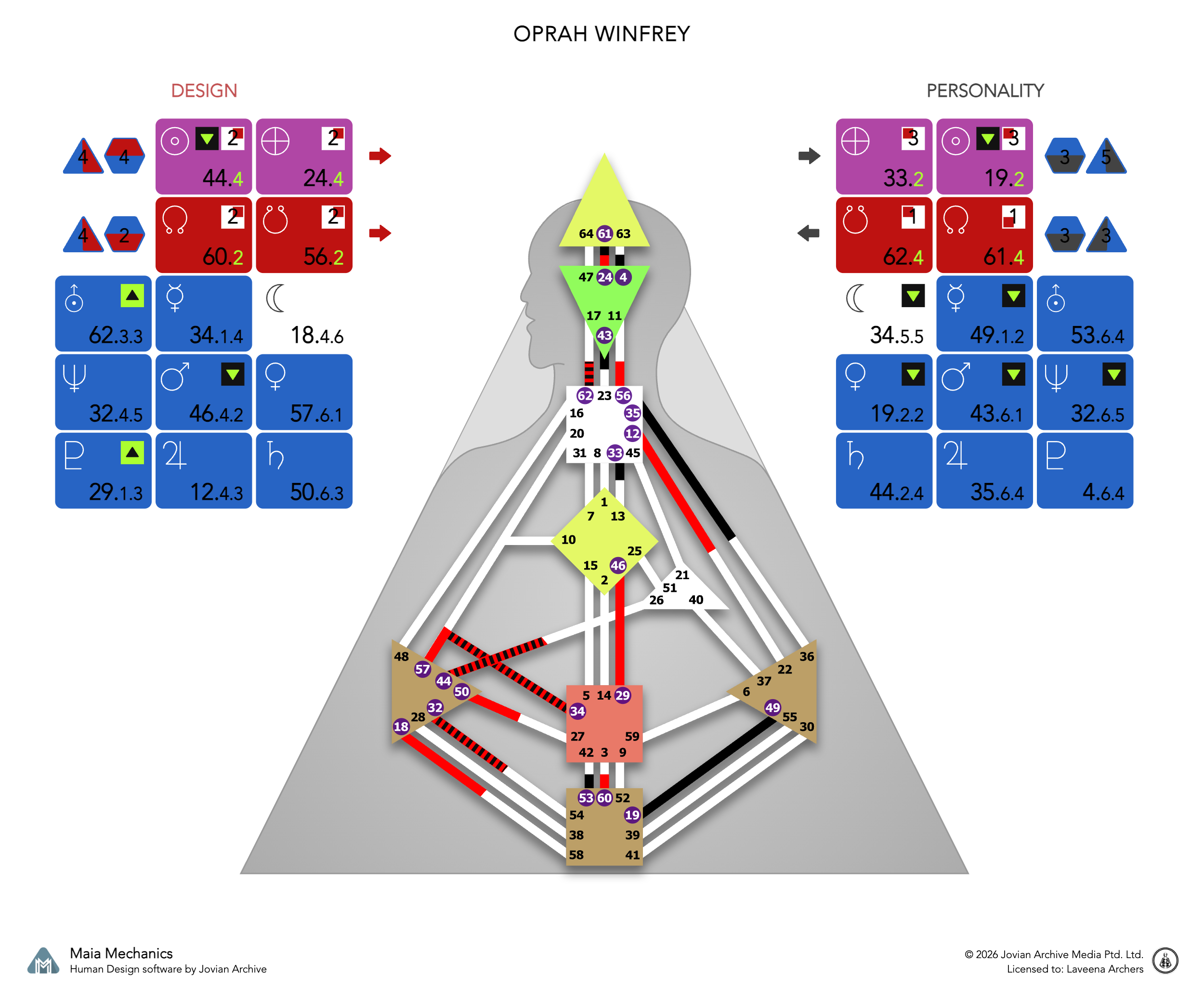
Chart calculated with Maia Mechanics, from an A-rated birth record
Quick look: Oprah Winfrey is a Generator with Solar Plexus Authority, which means nothing true was ever available to her in the room. Clarity for her arrives across a wave, over days or weeks, not at the moment of the offer. In 1986, at 32, she took her local Chicago show national in syndication, and instead of simply signing the licensing deal King World was offering, she formed her own production company, Harpo Productions, to own the show outright. Read against her design, it looks less like a bold, on-the-spot power move and more like a decision that had time to build, made through people she already trusted, in a design that was never built to run the whole thing alone.
The offer on the table in 1986
By early 1986, Winfrey’s local Chicago program, renamed The Oprah Winfrey Show, was already outperforming its market. King World Productions, the syndicator that had built Wheel of Fortune and Jeopardy! into national hits, wanted to take it wide. The straightforward version of that deal, the one most local hosts signed, was to license the show to a syndicator and collect a fee. What Winfrey did instead, working with her attorney and manager Jeffrey Jacobs, was negotiate to keep ownership of the show herself through a company she formed that year, Harpo Productions (Oprah spelled backward). King World distributed it into the national market starting September 8, 1986, in 138 markets. Winfrey kept the underlying asset.
That ownership structure, not just the national launch, is the part of the story worth sitting with. A local host taking her own show into syndication was unusual. A local host insisting on owning the company that owned the show, rather than being an employee or licensor of someone else’s syndication business, was rarer still, and it is the decision that put Winfrey in a different financial category than almost every other host of her era for the rest of her career.
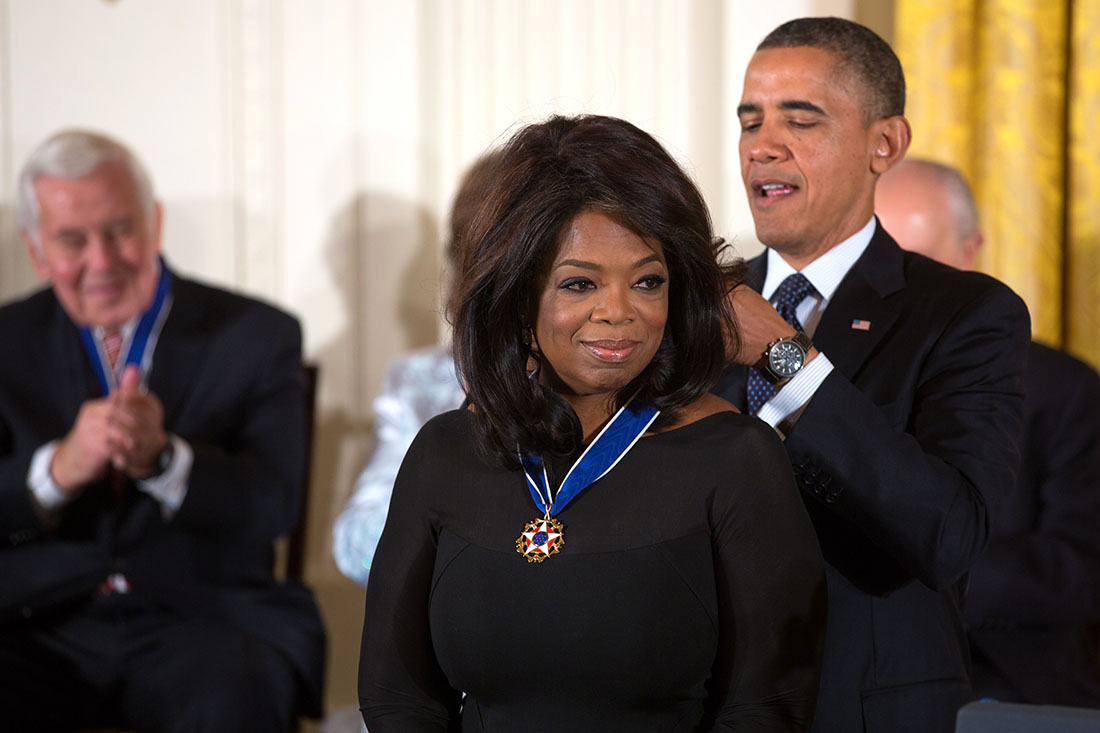 Oprah Winfrey receives the Presidential Medal of Freedom from President Barack Obama, 20 November 2013. Official White House Photo by Lawrence Jackson, public domain.
Solar Plexus Authority: a wave, not a room
Winfrey’s Authority runs through the Solar Plexus, meaning she has no reliable answer available to her in the moment. In one of my own teaching sessions on the solar plexus, I describe exactly what that mechanic asks of a person: “if you can hold steady through the wave, not make a decision when you’re really, really happy, or when you’re really, really upset… that is the most important thing you can learn as an emotional person.” The same teaching includes a personal detail about what waiting through that wave looks like in practice: “my husband says, you’re not allowed to write emails… I’m so glad I wrote tons of emails this week and I did not send all of them, thank God.” The instruction isn’t to suppress the feeling. It’s to let the wave finish its cycle before the decision goes out into the world.
Nothing about the King World offer required an answer that week. A syndication deal of that size, with legal terms, ownership structure, and a company to be formed, is not something that gets settled at the top or bottom of an emotional spike. It is exactly the kind of decision Solar Plexus Authority is built to metabolize slowly: the offer itself was real and good, and the terms that made it hers rather than someone else’s licensing product needed time and negotiation to take shape. There’s no public record of Winfrey signing anything on the spot in a single room. What’s on the record is a structured deal, built out with her own attorney over the negotiation period, that came together as ownership rather than a simple licensing fee. That’s the shape a Solar Plexus decision takes when it’s allowed to run its course: not indecision, but a correct answer that had to be built rather than declared.
A Generator’s strategy: respond to what’s already real
Winfrey is also a Generator, and a Generator’s strategy is to respond to what’s in front of it rather than originate a plan from nowhere. My own teaching on the Generator strategy puts it plainly: the sacral gives “energy available to respond,” and the work is “who are you for yourself,” not manufacturing motivation for an opportunity that isn’t there yet. Winfrey didn’t set out one day to build a syndication empire. King World came to her with a real, specific offer once her local numbers had already made the case. The response was hers; the opening was somebody else’s.
That distinction matters because it explains the order of operations. She didn’t originate the idea of taking the show national and then go pitch it around Chicago. The show was already outperforming Donahue locally, syndicators noticed, and she responded to what they brought. A Generator who initiates from a strategy document tends to run out of fuel chasing something that was never calling to them in the first place. A Generator who responds to a real, present opportunity tends to sustain the effort for the long run, and Winfrey’s show ran for twenty-five years after that 1986 launch.
Triple Split and why the deal ran through people, not a solo negotiation
Winfrey’s chart carries Triple Split Definition, meaning her defined centers form three separate areas rather than one connected shape. My own teaching on Triple Split Definition is specific about what that structure needs and, just as importantly, what it does not need: “these three different areas, they’re not interested in being whole… the way a triple split finds wholeness is simply through the mundane movement of its life… they need the exposure to the public aura.” The same teaching contrasts this directly with the more familiar single-bridge pattern of a basic split, where one particular partner completes the picture: a Triple Split “does not like being locked into a relationship that locks them into what is an artificial wholeness.” What a Triple Split runs on, instead, is movement through many connections, not dependence on one fixed structural partner.
That’s close to how the 1986 deal got built. Winfrey didn’t complete this structure alone, and she also didn’t complete it through a single all-purpose partner the way a basic split might lean on one spouse or one co-founder for everything. She worked with Jeffrey Jacobs as her attorney and negotiator on the deal terms, King World as the distribution partner that got the show into 138 markets, and (a few years earlier) Quincy Jones, who had cast her in The Color Purple and helped put her in front of a national audience before any of this was possible. None of those people functioned as a single bridging partner running her whole business. Each supplied a distinct piece, structured through Winfrey’s own company rather than folded into any one relationship. That’s the Triple Split pattern: continuity built through movement across a network of the right connections at the right moments, not through waiting on one person to complete the whole circuit.
A 2/4 Profile: opportunities that arrive through the network you already have
Winfrey’s 2/4 Profile is a Hermit paired with an Opportunist. My own teaching on the 2/4 is direct about how business reaches a person with this profile: “you’ve got to develop a solid network of people who know you, trust you, like you, so that you can service them in support of empowerment or sharing of yourself with them in order to gain your rewards in this life.” The same teaching describes the mechanic behind why the opportunities show up unbidden: “no other profile gets more attention from your network… because you are unaware of your talents and gifts,” and names the discipline required once they do: “you don’t have to leave the sanctity of your own private space without absolute clarity that whatever the call is is truly your destiny.”
Both halves of that profile show up in the record. The second-line Hermit side is why Winfrey built a local Chicago show for years before any of this was on the table, doing the work in relative privacy before anyone outside the market was watching closely. The fourth-line Opportunist side is why the opening itself, when it came, arrived through people who already knew her rather than a cold pitch she went out and made. Quincy Jones saw her on local television and brought her into The Color Purple. King World came to her because her numbers had made her visible inside the industry’s own network. Jacobs, already her attorney, became the person who structured the deal that let her keep ownership. None of that is Winfrey cold-calling syndicators with a business plan. It’s a network of people who already knew her work bringing the call to her door, and her own authority deciding, over time, which of those calls was hers to answer.
Three returns mapped against her own record
Certain planets return to the exact degree they held at a person’s birth on a fixed, calculable schedule, and three of those returns carry particular weight: the Saturn Return, the Uranus Opposition, and the Chiron Return, each marking a structural turn in a life. Overlay the transit chart for that date on the natal chart underneath it, and in Winfrey’s case, all three line up with something dated and documented in the public record, close enough to trace through individually rather than leave as theory.
Saturn Return: November 15, 1983
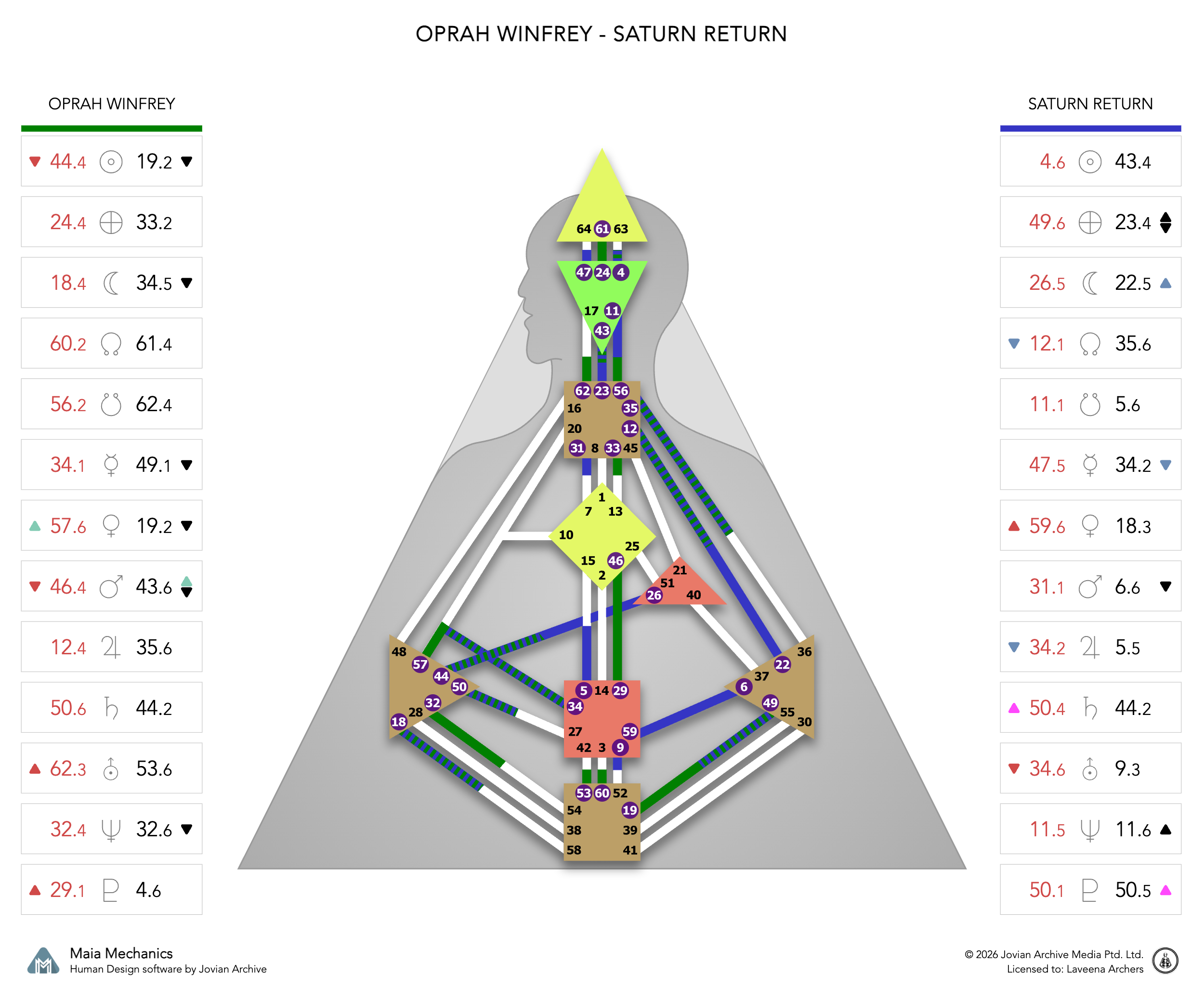 Oprah Winfrey’s Saturn Return transit chart, age 29, via Maia Mechanics.
Winfrey’s Saturn Return fell on November 15, 1983, in the exact stretch when her move from Baltimore to Chicago was closing. Dennis Swanson, the new general manager at WLS-TV, had brought her in for an audition over Labor Day weekend that August, and by December 1983 she had left her co-anchor job at Baltimore’s WJZ-TV for good, heading to Chicago to take over the low-rated local show that would become AM Chicago, with her on-air debut set for January 2, 1984. A Saturn Return is a structural accounting, the point where whatever’s been built gets tested against reality and either holds or doesn’t. Winfrey’s fell squarely inside the months where a decade of local news anchoring in Nashville and Baltimore was being tested against a new, much bigger city and a format, daytime talk, she hadn’t yet proven she could carry.
Uranus Opposition: February 16, 1993
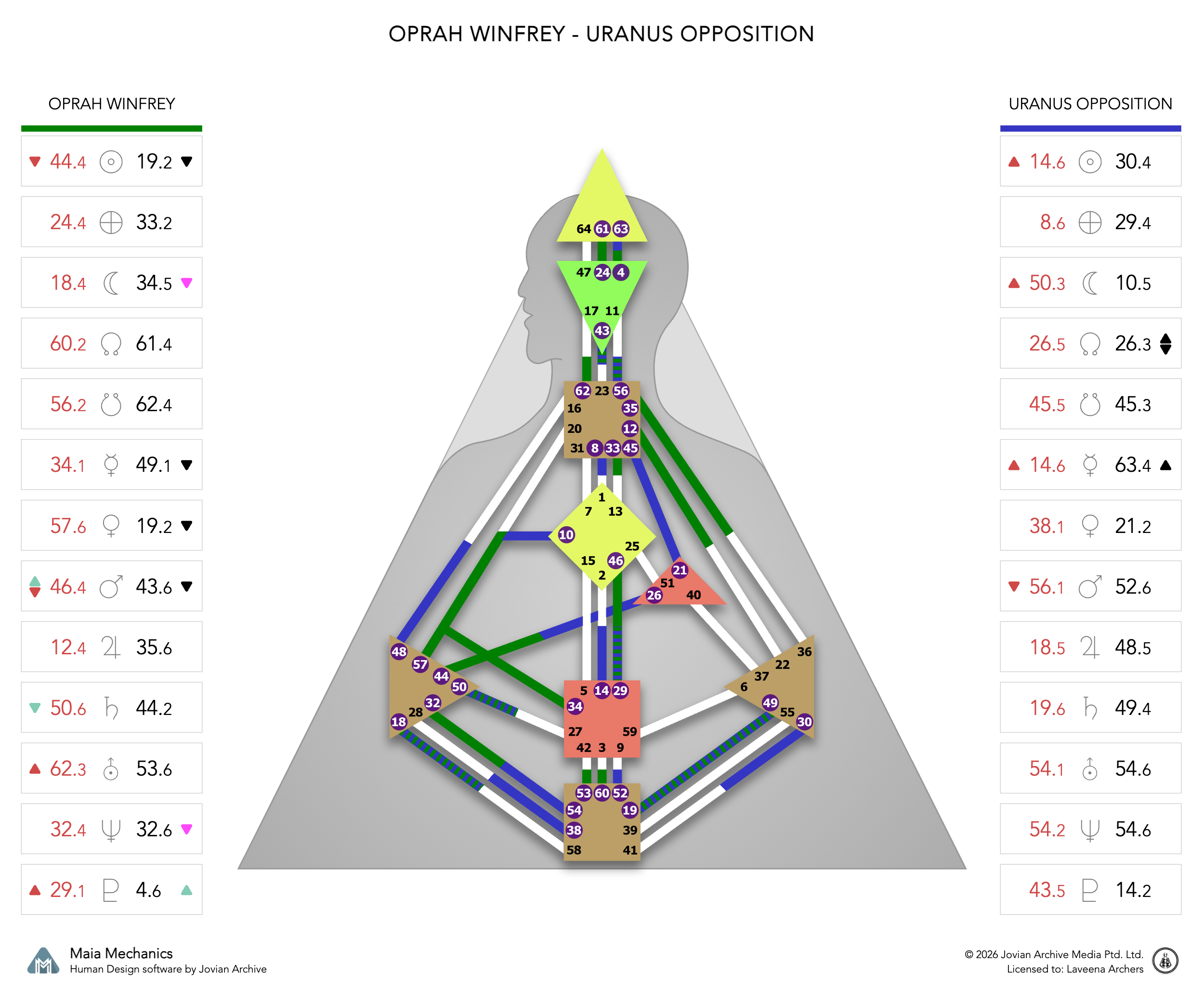 Oprah Winfrey’s Uranus Opposition transit chart, age 39, via Maia Mechanics.
Winfrey’s Uranus Opposition fell on February 16, 1993, six days after she conducted a live prime-time interview with Michael Jackson at Neverland Ranch, broadcast on ABC on February 10, 1993, to a worldwide audience estimated at 90 million people, one of the most-watched television events in history. A Uranus Opposition is a break from an established pattern, the point where the built structure gets pushed toward something it wasn’t previously built to hold. Winfrey’s show had been a successful syndicated daytime program for years by 1993; the Jackson interview pushed her into a different category of cultural reach entirely, a single broadcast watched by a share of the planet, not just her regular audience.
Chiron Return: February 27, 2004
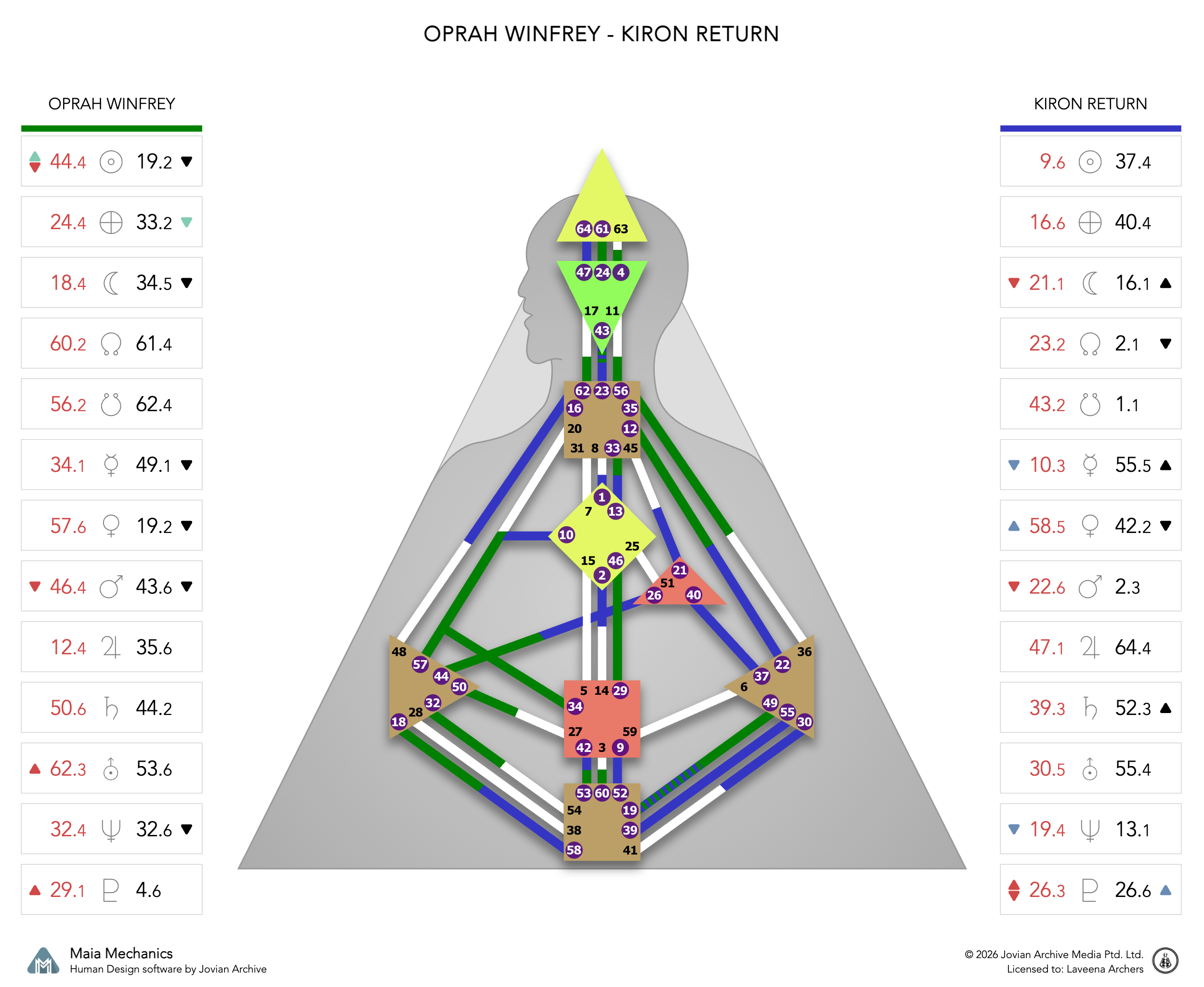 Oprah Winfrey’s Chiron Return transit chart, age 50, via Maia Mechanics.
Winfrey’s Chiron Return fell on February 27, 2004, four weeks after she turned 50 on January 29, 2004, and roughly three weeks after highlights from her 50th birthday luncheon, held January 30 in Los Angeles, aired on her show on February 6. Chiron’s mythology is the wound turned into medicine, and a Chiron Return is where the full arc of a life to that point becomes something to be metabolized rather than simply lived through. Winfrey marking 50 with a milestone birthday celebration that she then chose to air publicly, on the same show built from her own life story, sits close enough to the exact date her chart returns to its own Chiron placement to set the two side by side.
The setting the business actually ran in
Group size is its own mechanic in Human Design for Business, separate from any individual’s chart: Solo, Partnership, a Penta of three to five with its own leadership seats, and an OC16 of ten to sixteen and beyond, where a larger structure I teach as the Wa starts conditioning everyone inside it. None of that requires anyone else’s chart to notice. It’s a question of how many people the business actually ran on, and when.
Harpo Productions started at the top as a Partnership in the plainest sense: Winfrey as chairman, her agent Jeffrey Jacobs as president and chief operating officer, two people holding the company that owned the show. That structure never scaled the way the show itself did. A daily national program needs a production crew from its first broadcast, so Harpo was never functionally a two-person operation on the ground even in 1986, but the ownership and leadership stayed narrow while the staff under it grew for years. By 2002, Harpo employed roughly 70 people, well past OC16 range and solidly into Wa territory, running a production company, a magazine, and a film and television arm from a two-person governing structure that hadn’t changed since the beginning.
The limits of this reading
None of this claims Human Design explains why The Oprah Winfrey Show succeeded, or that her chart made the outcome inevitable. Plenty of Solar Plexus Generators let a good opportunity pass because they never let the wave finish, and plenty of 2/4 Profiles never get the call that Winfrey got. What the chart lays out is a mechanic: let the wave complete before answering, respond to what’s in front of you instead of manufacturing a plan, expect the pieces to arrive through several distinct relationships rather than one, and expect the opportunity itself to come through people who already know your work. The 1986 Harpo Productions decision traces that mechanic closely enough to set out directly, rather than folding it into a generic story about ambition or timing.
Where the actual profit was: her open centers
Triple Split is about how Winfrey’s defined centers group into three separate areas. It’s a different question from which centers carry no definition at all, and hers is an unusually concentrated chart on that front: seven of nine centers are defined, leaving only two open, Throat and Heart. My own model of profit centers holds that a person’s real edge tends to sit in the open centers rather than the defined ones, because an open center has no fixed way of running. It takes in whatever the moment brings and, over enough exposure, turns that into a read a defined center in the same spot never has reason to develop. With only two open, Winfrey’s version of that pattern is narrower than most of the other figures covered on this site, and sharper for it.
Throat. An open Throat carries no fixed voice, only whatever register the moment actually needs. On November 12, 1991, Winfrey testified before the Senate Judiciary Committee in support of the National Child Protection Act, disclosing her own childhood abuse on the record: “I am speaking out on behalf of the children who wish to be heard, but whose cries, wishes and hopes often, I believe, fall upon deaf or inattentive ears.” That is not the talk-show voice built to hold a studio audience for an hour. It’s a witness register, deployed once, for a setting a fixed Throat would have had to work much harder to enter. The bill passed and was signed into law in December 1993, informally known afterward as the Oprah Bill.
Heart. An open Heart has no standing need to hold the highest title available to it. In a 60 Minutes Overtime interview that aired February 15, 2018, weeks after a Golden Globes speech had triggered serious “Oprah for president” polling and pressure, Winfrey told CBS’s Ann Silvio she wouldn’t run: “I am actually humbled by the fact that people think that I could be a leader of the free world, but it’s just not in my spirit.” A defined Heart, offered that much momentum toward the most competitive job on earth, tends to take the shot. An open one can look straight at it and mean the refusal.
Two open centers, and both of them run against the instinct a person in her position would be expected to have: speak when it’s safer to stay in character, decline the biggest title on offer. That’s the pattern worth naming, even in a chart with this little open ground to work with.
Related
Curious what your own chart looks like? Get your own natal chart, Saturn Return, Uranus Opposition, and Chiron Return, rendered the same way, plus the full keynote PDF, for $37.
- Leadership Is Alignment to Your Own Authority — what it looks like to run decisions through real Authority instead of a boardroom’s preferred process
- Partnership: Why Two-Person Businesses Work or Fail — the mechanics behind choosing structural partners well
- Jessica Alba: The Founder Who Never Took the CEO Seat — another founder’s design read against her company’s documented history
Chart calculated with Maia Mechanics software. Birth data (29 January 1954, 4:30 AM, Kosciusko, Mississippi) and an “A” reliability rating, from memory or autobiography, are recorded on Astro-Databank via Astrotheme, contributed by Lois Rodden. The 1986 formation of Harpo Productions and national syndication through King World are part of the widely documented public record of Winfrey’s early career; the precise negotiation timeline between Winfrey, Jeffrey Jacobs, and King World is presented here in general terms rather than as a settled quote-level history. Harpo’s 2002 headcount is drawn from contemporary business press covering the company.
Dr. LaVeena B. Archers has spent more than thirty years as an entrepreneur and teaches the career and business application of the Human Design System. She helps business owners and entrepreneurs market themselves in a way that fits their design, lead their teams to greater efficiency and profitability, and find the work their chart was actually built for.