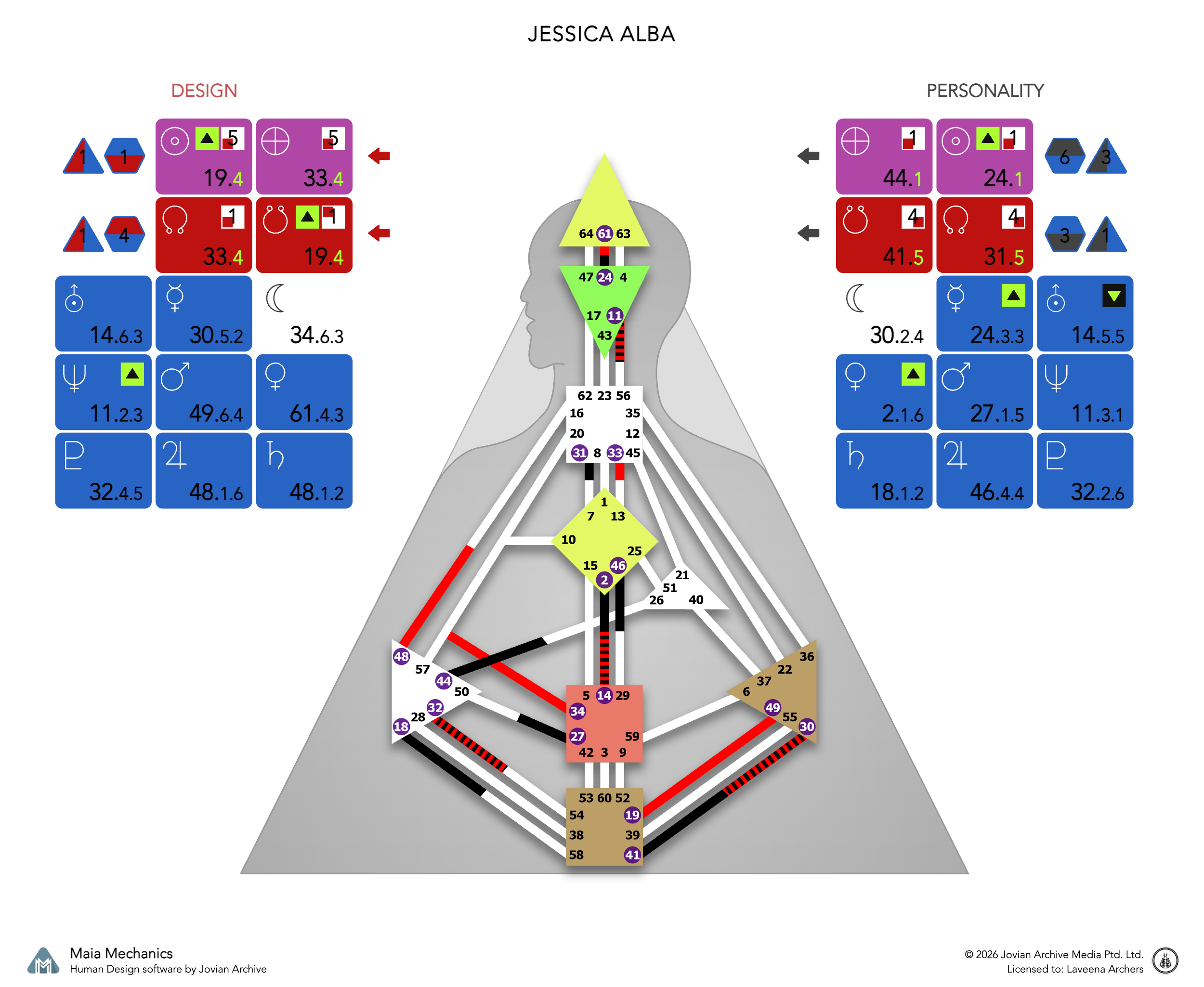
Chart calculated with Maia Mechanics, from AA-rated birth data
Short answer: Jessica Alba is designed to respond rather than to initiate, to reach certainty over time rather than in the room, and to convert what she has into output through other people rather than through her own voice. The documented history of The Honest Company follows that shape almost exactly. The business began as a reaction to something that happened to her, took four years to reach the market, and she never put herself in the chief executive’s chair.
If you are building something and keep being told to move faster, be more decisive, and back yourself as CEO, this is a useful counter-example. The structure she built matches the way her design is put together, and it worked.
 Jessica Alba on stage at TechCrunch Disrupt San Francisco, 10 September 2012, eight months after The Honest Company launched, for the “Founder’s Stories” session with co-founder Brian Lee. Photo by TechCrunch, CC BY 2.0.
Where this chart comes from
Most public-figure charts are built on a guess. Where no birth time is on record a noon default gets used, and everything depending on the minute is then presented as fact.
Alba’s is a genuine exception. Astro-Databank records her birth as 28 April 1981 at 1:51pm in Pomona, California, taken from the birth certificate and rated AA, its highest category of confidence.
The bodygraph here was calculated from those details using the Swiss Ephemeris rather than copied from a chart website. The positions reproduce the independently published ones (Sun at 8°28’ Taurus, Moon at 26°00’ Aquarius), and running the same calculation against a noon default returns a 1/3 profile rather than a 1/4, which shows how much of the usual celebrity chart is an artefact of the missing time.
What that produces: a Generator with a 1/4 profile, Emotional Authority, a Triple Split definition, and the Right Angle Cross of the Four Ways (24/44 | 19/33). Six of the nine centers are defined (Head, Ajna, G, Sacral, Solar Plexus and Root) through four channels: 61-24 Awareness, 2-14 The Beat, 49-19 Synthesis and 30-41 Recognition.
The business began as a response, not a plan
Alba is a Generator, and a Generator’s strategy is to respond. The Sacral is a motor center, built to sustain effort over years, but it does not switch itself on by decision. It answers something. The practical consequence in business is that a Generator who initiates from a strategy document tends to run out of fuel, while a Generator who responds to something real tends not to.
The origin of The Honest Company is unusually literal about this. In 2008, while pregnant with her first daughter, Alba used a laundry detergent marketed for babies and reacted badly to it. That reaction, a physical event rather than a market insight, is what she has consistently described as the beginning. She spent the following years researching what was in ordinary household products and campaigning on chemical reform.
Notice what is absent: no gap analysis, no category she had decided to enter. Something happened to her and she answered it. For a Generator that is not a charming origin story but the mechanically correct way for work to start, and it is why the energy held for the next decade and a half.
Four years of “no” is what emotional authority looks like from outside
Alba has Emotional Authority, which means there is no reliable truth available to her in the moment. Clarity arrives across time, and a decision taken in the room is taken too early. In business this reads as slowness, and gets mistaken for a lack of conviction.
Both channels running into her Solar Plexus, 49-19 and 30-41, come up from the Root, a pressure center. That is a system built to feel things under pressure and take its time resolving them, not to produce an answer on demand.
The timeline is the evidence. The reaction was in 2008. The company was incorporated in 2011 and launched in January 2012 with seventeen products. That is roughly four years between impulse and market, and Alba has spoken publicly about spending around three of them being turned down by people who did not understand what she was describing.
The sharpest detail sits inside that gap. Brian Lee, who had co-founded LegalZoom and was introduced to her through her husband, passed on the idea the first time she brought it to him. Roughly eighteen months later, after his own child was born and his household started asking the same questions hers had, he came back and joined as a co-founder.
She did not persuade him. He recognized it. That is the distinction most founders never get taught, and it is exactly what the Generator mechanic predicts: the response has to happen in the other person, on their timing, and the founder’s job is to remain available rather than to push harder. Four years of waiting was not four years of failing.
The founder who never took the CEO seat
Her definition is a Triple Split. The defined centers fall into three separate groups rather than one connected whole (Head with Ajna, G with Sacral, Root with Solar Plexus). Definition tells you how much of your own process you can complete with nobody else present, and three separate groups means the bridging comes from other people.
Then the fact that decides the argument: none of those three groups reaches the Throat. Her Throat is undefined, and no defined channel in the chart connects to it. The Throat is where a design becomes speech and action. Hers takes its character from whoever she is with rather than running on a fixed current of its own. Mechanically, this is a design that converts into output through other people. That is not a deficiency to correct. It is a staffing specification.
The public record shows exactly that structure. Alba did not appoint herself chief executive of the company she founded. Brian Lee ran it as CEO from launch until March 2017; Nick Vlahos took over from there, and Carla Vernón from late 2022. Alba held the Chief Creative Officer role from incorporation until she stepped down in April 2024. The company went public on NASDAQ on 5 May 2021 under the ticker HNST, raising just over $412 million: a founder-originated business taken to market with the founder deliberately not in the operating seat.
She has been direct about the reasoning, describing at Stanford Graduate School of Business how much of building the company came down to being clear about what she knew and what she did not, and surrounding herself with people who covered both. Read mechanically, that is a split definition and an open Throat being staffed rather than overridden, and the company is what got built on the arrangement.
This is where most founder advice gets it backwards. “Own your business” is usually delivered as an instruction to hold the top job. For a design like this, holding the top job would have been the error.
Three cycles, two already lived through
Transiting planets return to the exact degrees of a person’s own natal chart on a fixed, calculable schedule. Three of those returns mark the major structural turns of a life: the Saturn Return, the Uranus Opposition, and the Chiron Return. Alba has lived through the first two. The third is still ahead of her.
Saturn Return: December 20, 2009
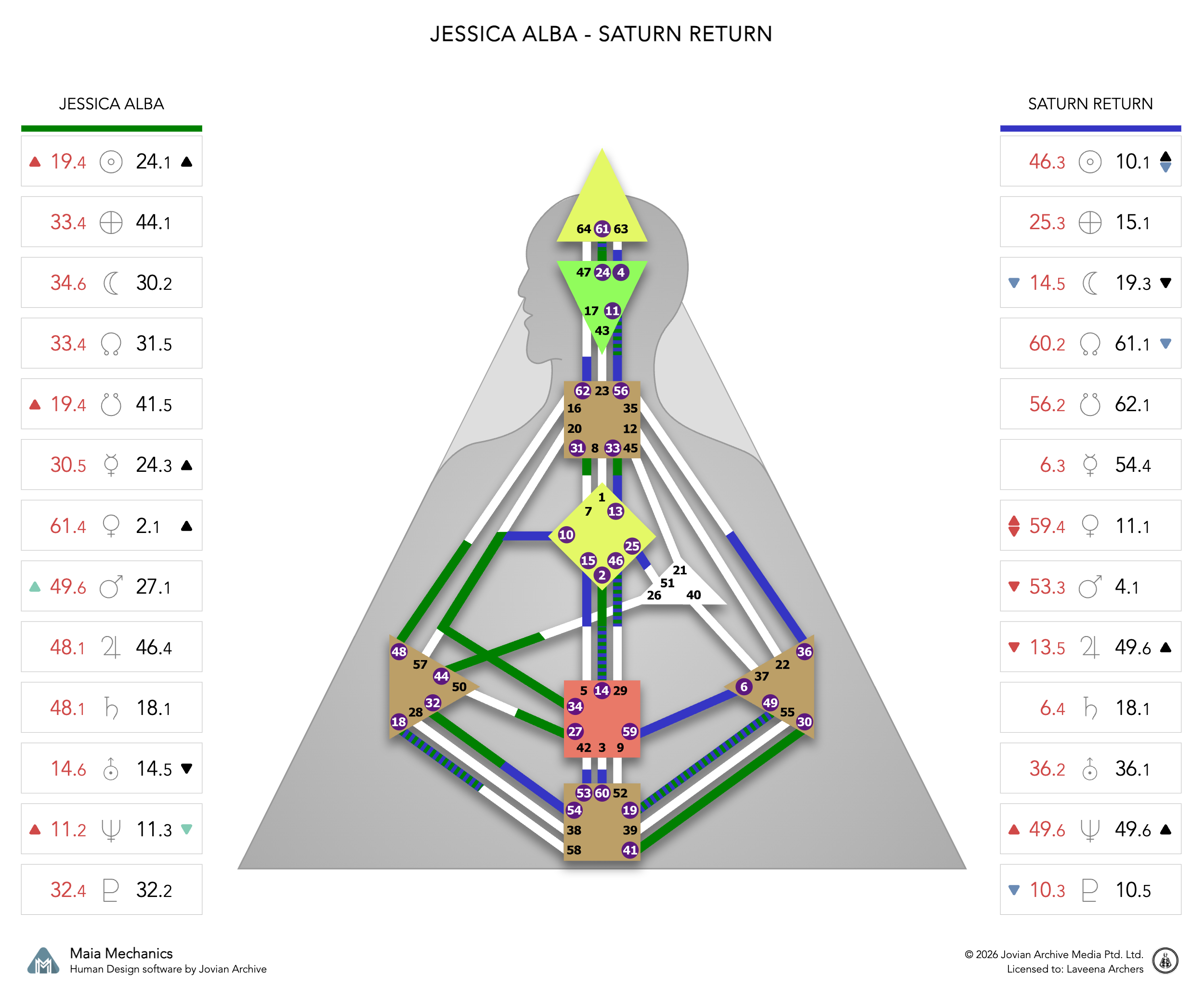 Jessica Alba’s Saturn Return transit chart, age 28, via Maia Mechanics.
Alba’s Saturn Return fell in December 2009, squarely inside the multi-year stretch this article already tracks: the 2008 reaction that started everything, and the years of being turned down before Brian Lee came back and said yes. A Saturn Return is a structural accounting, the point where what’s been building gets tested against reality. Hers landed in the middle of that waiting, before the company had a name, a co-founder locked in, or a product on a shelf, which is exactly where a 1/4 Profile’s structural test is supposed to happen: quietly, before the public record has anything to show for it.
Uranus Opposition: June 15, 2025
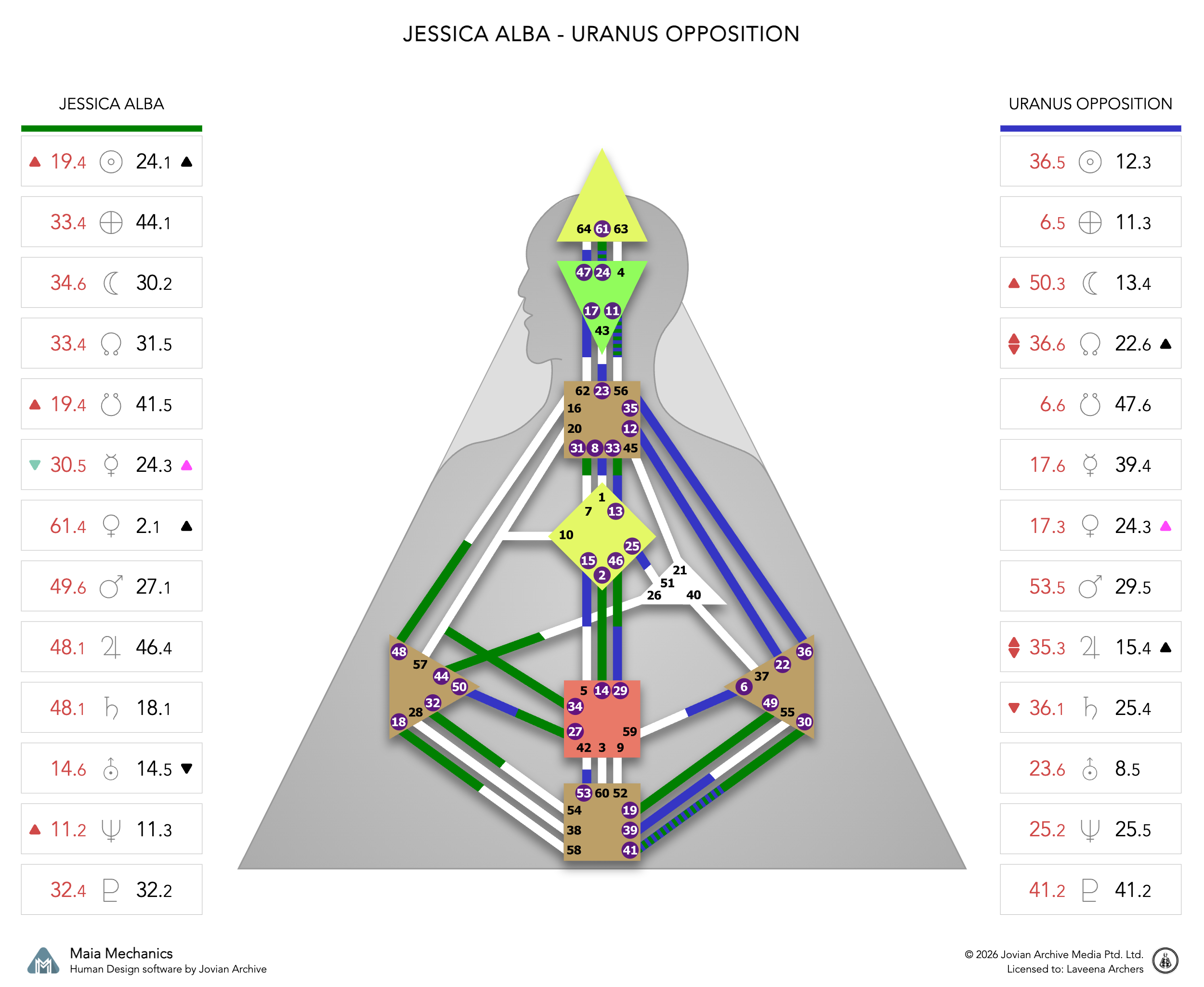 Jessica Alba’s Uranus Opposition transit chart, age 44, via Maia Mechanics.
Alba’s Uranus Opposition fell in June 2025, a little over a year after she stepped down from the Chief Creative Officer role she’d held since incorporation. A Uranus Opposition breaks an established pattern, the point where a built structure gets pushed toward something it wasn’t previously built to hold. By this transit, she was already living the second half of the structural read this article makes: not in the operating seat, staffing the gap through other people, present as founder and board director rather than as an executive with a title to defend.
Chiron Return: still ahead, May 18, 2031
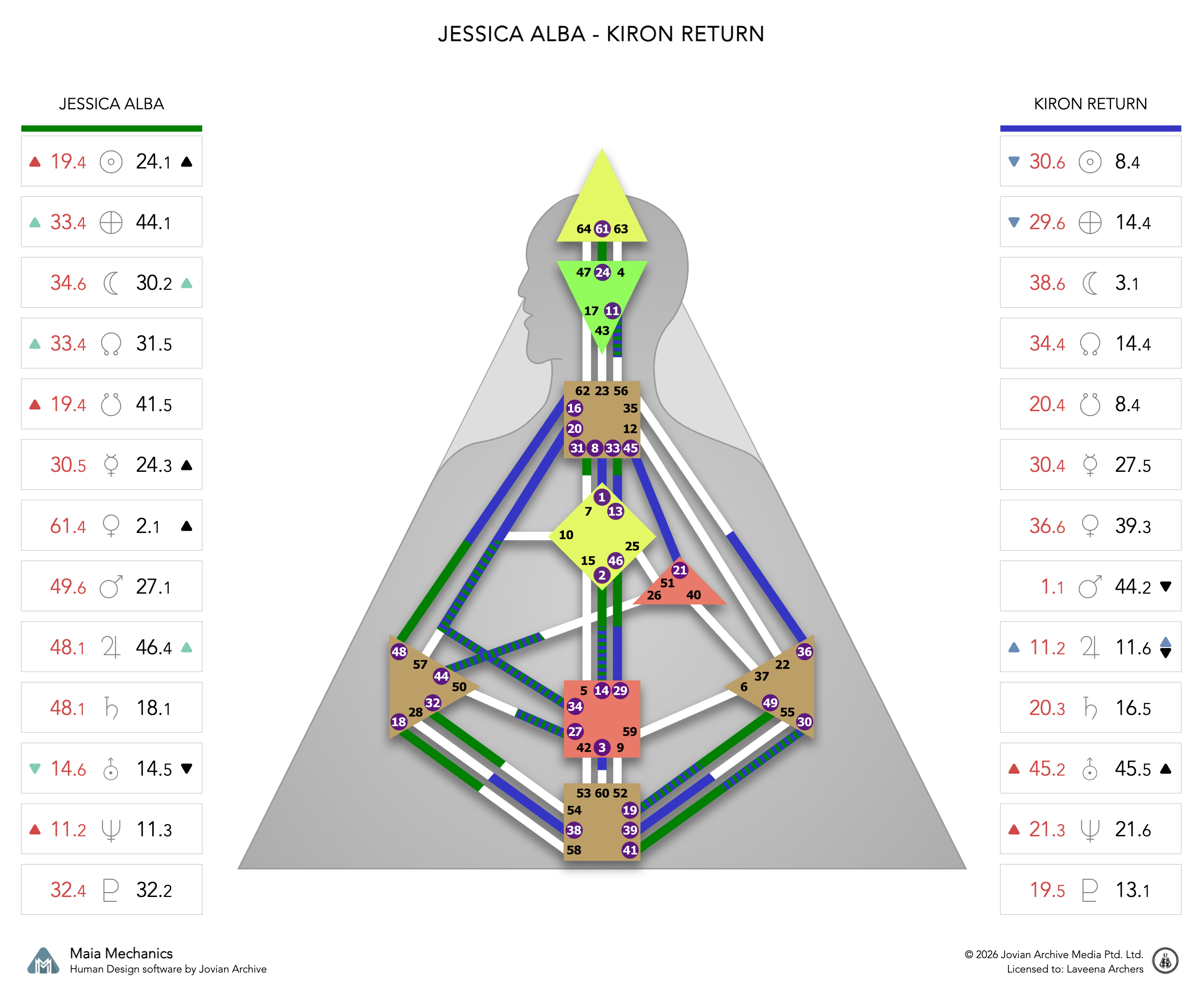 Jessica Alba’s Chiron Return transit chart, age 50, calculated in advance via Maia Mechanics.
Alba’s Chiron Return doesn’t fall until 2031, when she’ll be fifty. Unlike the two transits above, this one hasn’t happened yet, so there’s no dated event to read it against. It’s included here for the same reason the chart itself is: not as a prediction of what will happen, but as the next structural marker on a design that has, so far, tracked its two prior ones closely enough to be worth taking seriously.
The setting the business actually ran in
Group size is its own mechanic in Human Design for Business, separate from any individual’s chart: Solo, Partnership, a Penta of three to five with its own leadership seats, and an OC16 of ten to sixteen and beyond, where a larger structure I teach as the Wa starts conditioning everyone inside it. None of that requires anyone else’s chart to notice. It’s a question of how many people the business actually ran on, and when.
The Honest Company is a genuine exception to the pattern that shows up in most founder stories, including several others on this site: it wasn’t a Partnership that grew into a Penta. It started as one. The founding group was four people, not the two this article has focused on: Alba and Brian Lee alongside Christopher Gavigan and Sean Kane, all four attached at incorporation in 2011. A Penta from day one, structurally, rather than a two-person deal that widened later. What it became afterward is the more familiar arc: by the May 2021 IPO, the company employed 187 people, well past OC16 range and solidly into Wa scale, run by a chief executive brought in from outside the founding group, with Alba still holding the Chief Creative Officer role she wouldn’t step down from for another three years.
What to do on Monday
- Check the origin of your current venture. Did you respond to something real, or decide to enter a market? If it was a decision, look for what was sitting underneath it that you were responding to.
- If your Authority is emotional, put a fixed delay on every material commitment (pricing, hiring, partnership) and notice how often the answer changes overnight.
- Stop treating a slow yes as a failed pitch. Note who comes back on their own, and how long it took.
- Look at your definition before your org chart. Where your process needs another person to complete, hire for that gap rather than trying to close it through discipline.
- Ask honestly whether you should hold the chief executive role at all, or whether you are the founder of something somebody else should run.
Where the actual profit was: her open centers
The open Throat above explains why Alba didn’t run The Honest Company. It doesn’t cover the other two centers with no definition at all, and those are worth their own look. Three of Alba’s nine centers are open: Throat, Heart, and Spleen. My own model of profit centers holds that the real commercial edge tends to sit in the open centers rather than the defined ones, because an open center has no fixed way of running. It takes in whatever the moment brings, cycles through every version of that pressure over time, and eventually turns the exposure into a read on the terrain a defined center in the same spot never develops, because a defined center already answers the same way every time. Alba’s three open centers, read against her own record, add a layer underneath the staffing story already told above.
Throat. An open Throat has no fixed voice, only whatever register the room actually calls for. Alba has run through several in public that share no single throughline: the founder-pitch register she used at TechCrunch Disrupt in September 2012, eight months after launch, sitting beside Brian Lee to tell the origin story to a tech audience; a policy register two and a half years later, spending two days on Capitol Hill in June 2015 lobbying more than half a dozen senators, Harry Reid and Barbara Boxer among them, for reform of the Toxic Substances Control Act; and the actress press-tour voice that predates both. None of the three is the “real” one a fixed Throat would default to. Each is borrowed for the setting it’s actually needed in.
Heart. An open Heart has no standing need to hold a title or defend a competitive position, which is a different read than simply being modest. Alba announced on April 9, 2024 that she was stepping down as Chief Creative Officer, the operating title she’d held since founding the company in 2011, immediately after Honest posted record quarterly sales and profit. She gave up the role at its commercial peak rather than at a low point that would have made the decision easy, staying on only as a board member. A defined Heart holds on tighter when the win is fresh. An open one doesn’t need to.
Spleen. An open Spleen has no fixed instinct of its own, only an unusually sharp, real-time sense of what reads as safe, and that sense can be wrong the same way it can be right. The company’s early promise was ingredient transparency: products marketed as free of sodium lauryl sulfate. A Wall Street Journal investigation published March 15, 2016 found the detergent instead used sodium coco sulfate, which its own testing showed reliably contains SLS. Alba called the report “reckless” at the time; a class action followed, and Honest settled in June 2017 for $1.55 million, agreeing to reformulate free of both compounds. An open Spleen isn’t a guarantee of being right. It’s a read that has to keep being checked against the world instead of trusted on reflex, and this is the documented case where the checking happened after the fact instead of before it.
Three open centers, three different pressures, and none of them is the staffing story the rest of this piece already tells. That’s the layer underneath the layer: even the places Alba has no fixed answer of her own carry a real, and occasionally costly, kind of information.
Related
- Leadership Is Alignment to Your Own Authority: what authority does under real pressure
- Partnership: Why Two-Person Businesses Work or Fail: the mechanics of bringing in a co-founder
- How to Work Best as a Classic Builder: responding as a working strategy
Dr. LaVeena B. Archers has spent more than thirty years as an entrepreneur and teaches the career and business application of the Human Design System. She helps business owners and entrepreneurs market themselves in a way that fits their design, lead their teams to greater efficiency and profitability, and find the work their chart was actually built for.