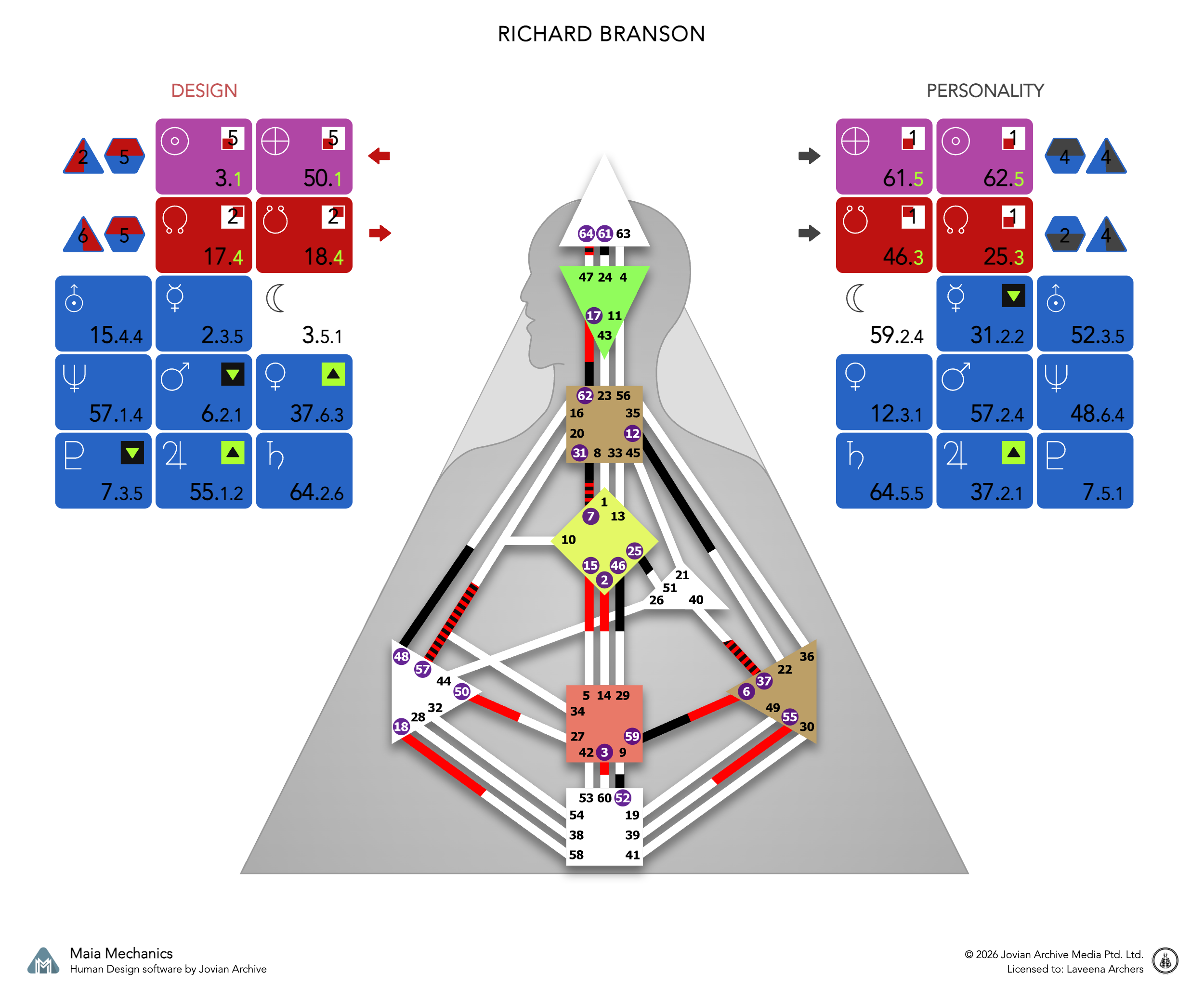
Chart calculated with Maia Mechanics, from an A-rated birth record
Quick look: Richard Branson is a Generator with defined Solar Plexus (Emotional) Authority, which means there was never a version of his life where a major decision arrived as instant certainty. Clarity, for him, is something that has to be ridden out over time, through a wave of highs and lows, until the charge drains off and what’s left is calm rather than excitement or dread. In 1992, Branson sold Virgin Records, the company he’d built from a mail-order record business into one of the biggest independent labels in the world, to Thorn EMI. He has spoken about that sale for decades, and he has been unusually candid that it hurt, that he questioned it, and that he cried over it. Read against his design, that isn’t sentimentality. It’s what a Solar Plexus decision under real financial pressure looks like from the outside.
The shape of the 1992 sale
By the early 1990s, Virgin Atlantic, the airline Branson had founded in 1984, needed capital, and needed it during a period when the airline industry was under serious financial strain. Virgin Group’s asset that could most readily supply that capital was Virgin Music Group, the record label built on the success of Mike Oldfield, the Sex Pistols, and later acts across the roster. Branson sold Virgin Records to Thorn EMI in 1992 for a sum reported at the time in the hundreds of millions of pounds, using the proceeds to shore up Virgin Atlantic rather than to expand the music business further. The company he built from nothing was the thing he gave up in order to keep the newer, riskier company alive.
This wasn’t a distress sale forced overnight. Branson has described the lead-up as a period he agonized over, weighing the airline’s survival against the label he’d spent two decades building. He has said publicly, more than once, that he cried when the deal was signed, and that friends and colleagues who knew him well understood how much the label meant to him beyond its balance sheet value.
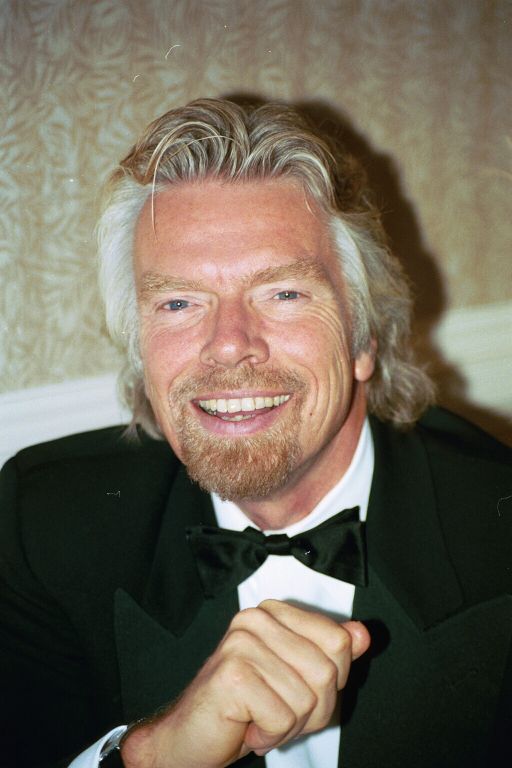 Richard Branson at the White House Correspondents’ Dinner, 2000, during the years he was building Virgin Atlantic into a global airline off the back of the label he’d just sold. Photo by John Mathew Smith / www.celebrity-photos.com, Wikimedia Commons, CC BY-SA 2.0.
Why a Solar Plexus decision doesn’t arrive in the room
A Generator’s strategy is to respond to what’s in front of it, not to originate from a plan, and my own teaching on the type is direct about where that response comes from: a Sacral yes or no, a body-level “uh-huh” or “uh-uh” that fires the instant something real shows up. But Branson doesn’t have that signal available on its own. His Authority runs through the Solar Plexus, and my teaching on emotional authority describes exactly what that changes: “there is no absolute truth in the now for you… wait for zero emotional turbulence on decisions before you move forward on anything.” The gut still responds. It just isn’t the final word. The final word only shows up once the emotional wave has actually moved.
I’ve taught Branson’s chart specifically on this point, describing him as “a Pure Emotional Generator with the 59-6 Source Wave, which is stable and stalls.” That’s a wave that doesn’t spike and crash quickly; it holds a mood for a while before shifting. Against a business decision that took real deliberation, months of weighing an airline’s cash needs against a company he loved, that’s the shape you’d expect: not a sudden reversal, but a slow, held pressure that eventually resolves.
Riding the wave rather than short-circuiting it
The lake metaphor I use to teach this authority is worth sitting with here. “Imagine you are a body of water, a tranquil lake… now imagine someone is backing up a huge dump truck to roll a boulder toward you. Boom! The boulder crashes into the lake, throwing out huge waves… Large decisions can take far more time to get clear on.” Selling the company that built his reputation to solve a cash crisis in a different company is a boulder, not a pebble. My teaching on what not to do with a decision like that is equally direct: “You never ever ever make a choice when you’re dysregulated… hi is worse than low because when you’re high, happy happy everything’s great, you’re gonna make a yes choice that you’re gonna regret later.” And the practical instruction that follows: “sleep on it, at least sleep on it, because you wake up in a totally different mood than you were when you were down.”
Nothing in the public record suggests Branson signed the EMI deal on impulse, in a single sitting, at a moment of financial panic. The accounts describe deliberation stretched over time, an emotional weight he’s talked about since, and a decision that, once made, he stood behind even while grieving it. That’s not indecision. Read through Solar Plexus Authority, tears at the signing and clarity about the necessity of the deal are not contradictory. They’re both what’s supposed to be true when the wave has been ridden out rather than short-circuited.
The Split and the deal he needed a bridge to close
Branson’s chart carries Split Definition, meaning the centers he has defined don’t all connect into one continuous shape; they form separate islands that need a bridge, a transiting gate or another person’s chart, to link up. My teaching on split definition names the two failure modes directly: with a narrow, concentrated split, “your mind blames yourself,” and with a broad split, “you’re going to be so bitter about others… you blame them,” when the more accurate read is “it’s simply a mechanical truth that some people are not aligned to interact with,” and the real work is “unattached observation of the openness leads to wisdom.”
The EMI sale wasn’t a transaction Branson executed alone from a single unified will. It required a counterparty willing to pay for something Branson needed to sell for reasons that had nothing to do with the music business itself, and it required Branson’s own team and advisors to hold the airline together while the label transition happened. None of that is a claim that any specific gate in Branson’s chart bridges to Thorn EMI’s leadership; that comparison would need both charts calculated side by side, which is outside the scope of what’s established here. What’s fair to say structurally is that a Split-definition Generator’s system isn’t built to run a decision like this in isolation. The bridge, in this case a buyer capitalized enough to make the deal real, was not optional. It was the mechanism that let the gap close and the whole operation keep functioning.
The 5/1 Profile and the fixer who gets blamed when the fix doesn’t land
Branson’s 5/1 Profile is where his public reputation and this specific decision meet most directly. My teaching on the 5/1 describes a first line underneath that “demands the basis of all things are understood, researched, investigative,” a private person who needs “a solid foundation” before doing anything visible, paired with a fifth line that carries what I call “the initial positive projection field”: the world decides, often before it knows you personally, that you are “the savior, the saint, the general, the rescuer riding in on the white horse,” here to deliver “practical solutions… particularly in times of crisis.” I’m explicit about the cost side of that arrangement too: “if you cannot fulfill on the expectations placed on you… your reputation can be incredibly demolished,” what I call, bluntly, being “burnt at the stake.”
Branson’s public identity fits that pattern almost exactly. He built Virgin Atlantic and positioned it publicly as the underdog challenger to British Airways, the “practical solution” for a flying public that felt gouged by an incumbent monopoly, a role that reads directly as the 5/1’s crisis-fixer projection. My teaching names the trap inside that role too: “don’t make your clients your friends,” because the fifth line’s currency is impact on strangers, not intimacy, and closeness dilutes the very projection field that makes the rescue possible. Selling the label he’d personally built and loved, in order to keep that larger public-facing rescue mission (the airline, the challenger brand) alive, is a decision that only makes sense if you take the fifth line’s mandate seriously: the visible, universalized fight matters more than the private attachment underneath it, however much that private attachment costs to give up.
The first-line foundation matters here too. Branson didn’t walk into the EMI negotiation without two decades of hands-on knowledge of the music business, exactly the kind of researched, lived-in expertise my teaching says a 5/1 needs before its public fix can work at all: “life rewards the prepared… if your details were faulty, then you will not likely be called upon again.” He knew precisely what he was giving up because he’d built it from the inside out, which is part of why the decision could be made with clarity even while it hurt.
Three returns, three dated turns in his own story
Certain planets return to the exact degree they held at someone’s birth on a fixed schedule, calculable years ahead of time, and three of those returns mark the structural turning points of a life: the Saturn Return, the Uranus Opposition, and the Chiron Return. Lay the transit chart for that date over the natal chart beneath it, and Branson’s three each land on a specific, dated moment already documented in his own history.
Saturn Return: August 30, 1979
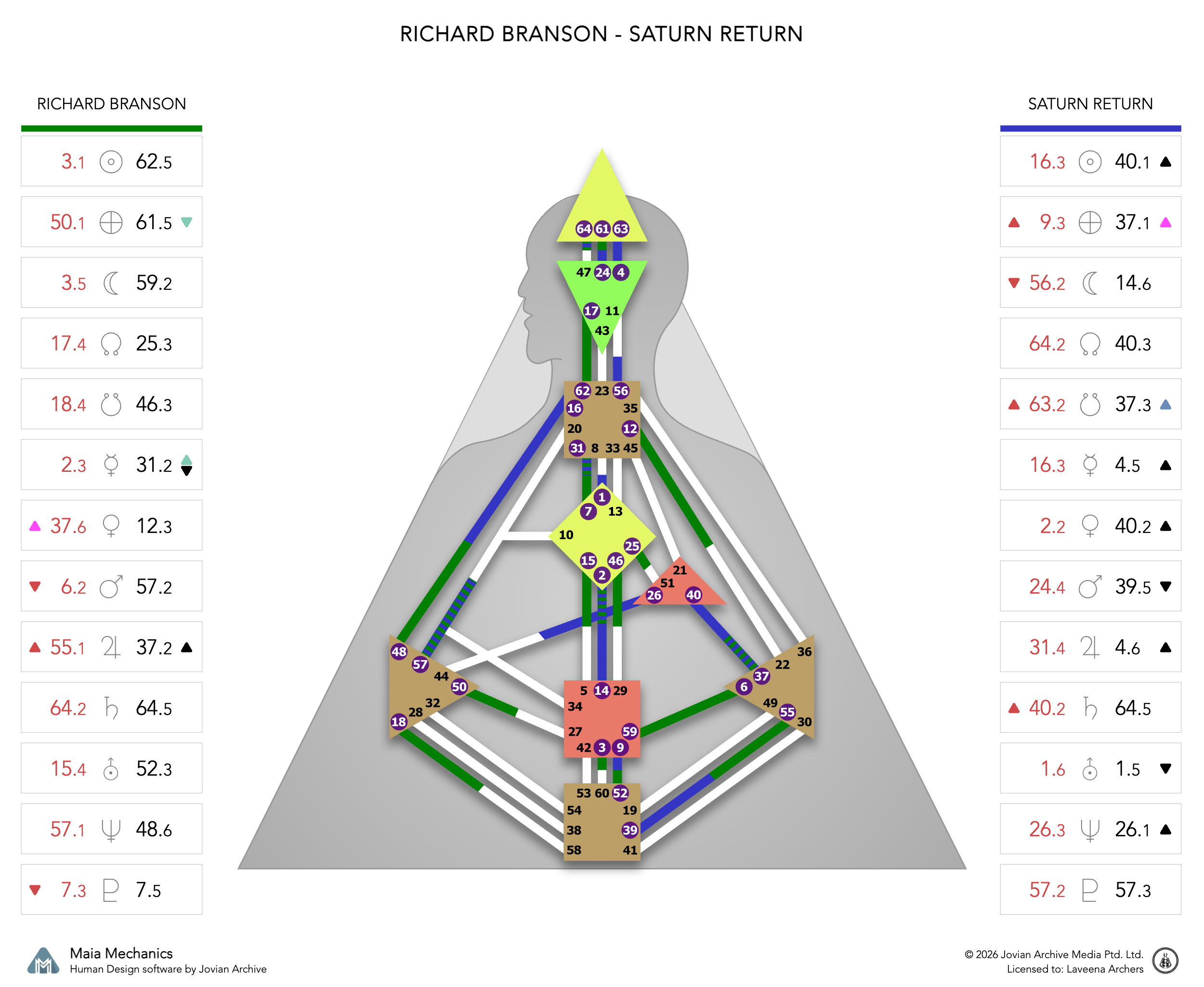 Richard Branson’s Saturn Return transit chart, age 29, via Maia Mechanics.
Branson’s Saturn Return fell on August 30, 1979, the same year the first Virgin Megastore opened at the Oxford Street and Tottenham Court Road end of London, billed at the time as Europe’s largest discount record store. A Saturn Return is a structural accounting, the point where whatever’s been built gets tested against reality and found either solid or wanting. By 1979 Virgin Records had grown from a mail-order catalogue and a single Notting Hill shop into a business with a flagship retail presence in the middle of London, the visible proof that the record label he’d started in his teens had become a real company rather than a hobby that got lucky once with Mike Oldfield.
Uranus Opposition: January 12, 1990
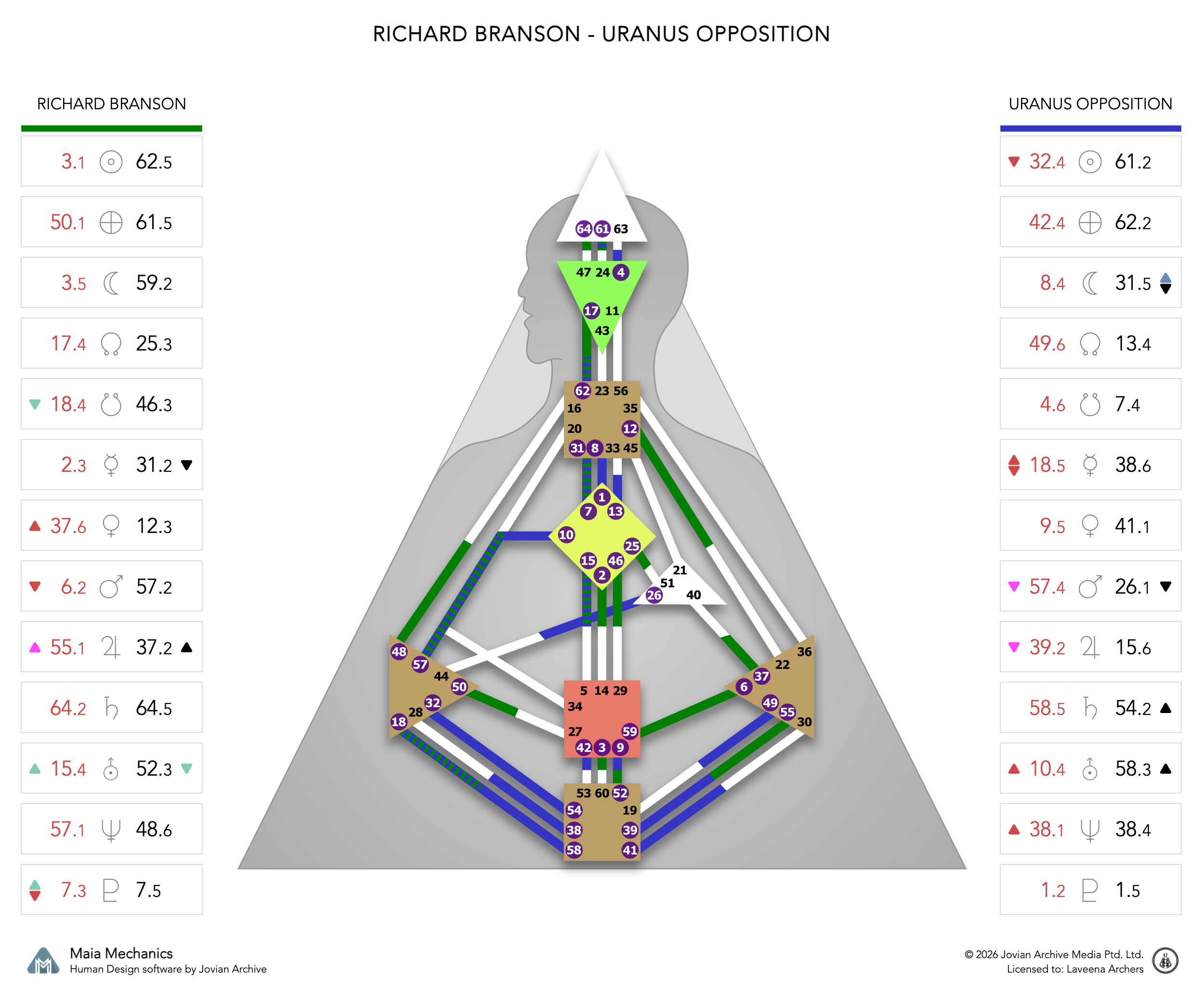 Richard Branson’s Uranus Opposition transit chart, age 39, via Maia Mechanics.
Branson’s Uranus Opposition fell on January 12, 1990, months after the Japanese conglomerate Seibu Saison acquired a 10 percent stake in Virgin Travel Group, the parent company of Virgin Atlantic, in 1989. A Uranus Opposition is a break from an established pattern, the point where the built structure gets pushed toward something it wasn’t previously built to hold. Every business Branson had run to that point, the record label, the Megastores, the airline itself, had been his alone to control. Letting an outside shareholder into the company that carried his name and his risk was a real departure from that pattern, arriving right as the transit that names exactly that kind of break was crossing his own chart.
Chiron Return: February 24, 2000
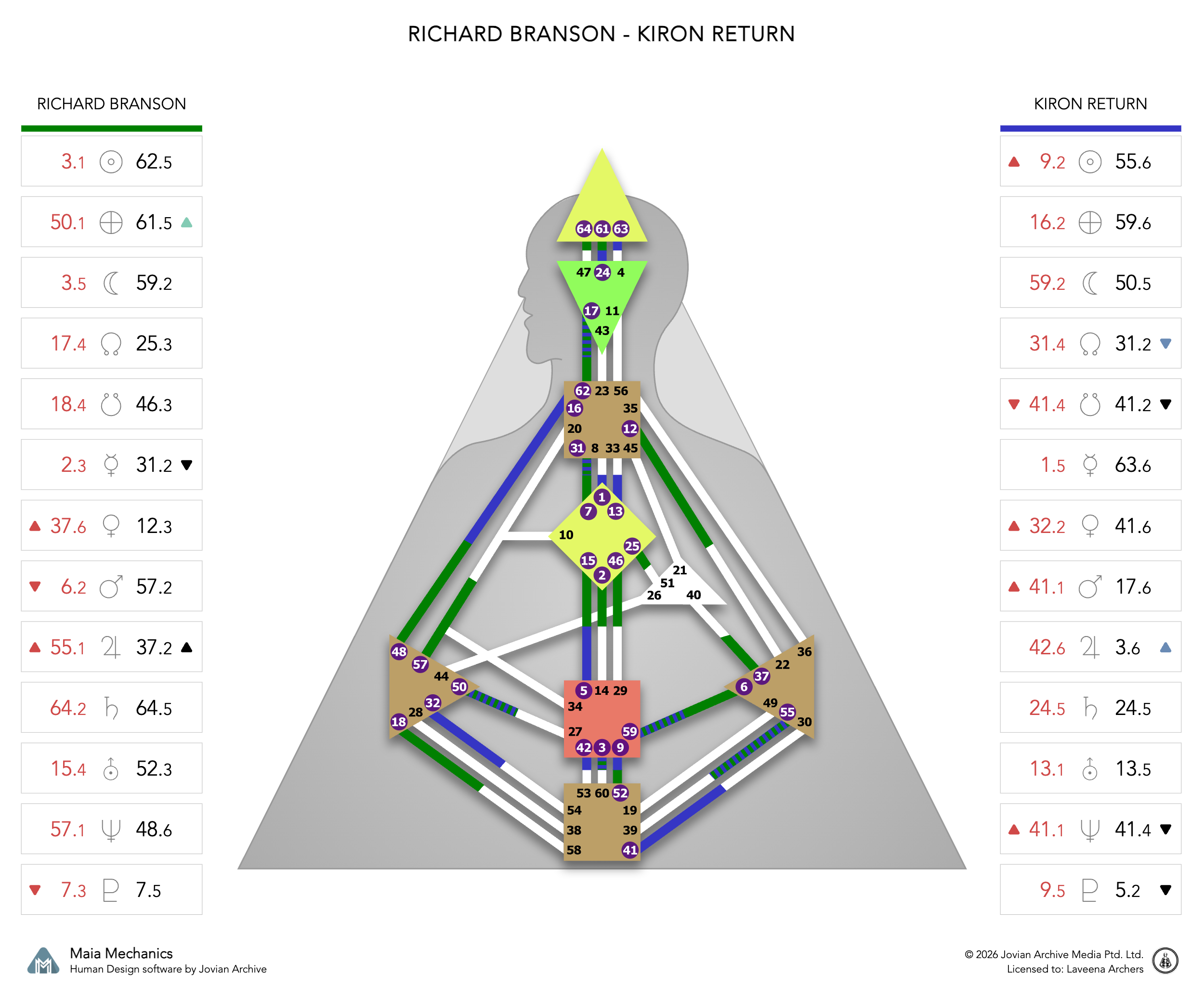 Richard Branson’s Chiron Return transit chart, age 49, via Maia Mechanics.
Branson’s Chiron Return fell on February 24, 2000, five weeks before he was knighted by the Prince of Wales at an investiture in Buckingham Palace on March 30, 2000, for services to entrepreneurship. Chiron’s mythology is the wound turned into medicine, and Branson’s public identity for two decades had been built on being the establishment’s irritant, the jeans-and-jumper upstart needling British Airways and Coca-Cola and the record majors. Being formally knighted by the institution he’d spent his career positioned against, close enough to the exact date his chart returns to its own Chiron placement to set the two side by side, reads as that same tension resolved rather than erased: still Branson, now Sir Richard.
The setting the business actually ran in
Group size is its own mechanic in Human Design for Business, separate from any individual’s chart: Solo, Partnership, a Penta of three to five with its own leadership seats, and an OC16 of ten to sixteen and beyond, where a larger structure I teach as the Wa starts conditioning everyone inside it. None of that requires anyone else’s chart to notice. It’s a question of how many people the business actually ran on, and when.
Virgin began in February 1970 as a genuine Partnership: Branson and his friend Nik Powell running a mail-order record business between the two of them, nobody else attached to the founding. What it grew into is closer to Buffett’s Berkshire than to a conventional large company, and for a similar reason. Virgin Group today operates as more than 40 separate companies, airlines, telecoms, health clubs, space flight, each run independently with its own management and, in most cases, its own other investors, all licensing the Virgin name and sharing a single brand identity rather than reporting up through one integrated head office. Branson never built one company large enough to need a Wa of its own. He built dozens of smaller ones, many of them Penta- or OC16-sized on their own terms, and federated them under a name instead of a shared org chart. The EMI sale above is a story about one of those units, the original label, being given up to keep a different one, the airline, alive. That only makes sense as a decision inside a structure built from the start to treat its parts as separable.
What this reading doesn’t claim
None of this says Human Design explains why Branson cried over a business deal, or that his chart made the EMI sale inevitable. Plenty of Solar Plexus Generators avoid decisions that require this much patience, and plenty of 5/1 Profiles never build a company the world casts as a rescuer. What the chart offers is a mechanic: no truth in the now, a wave that has to be ridden rather than shortcut, a split that needs a bridge to close, and a profile that trades private foundation for public projection and all the risk that comes with it. One 1992 sale, made slowly, made under real pressure, and mourned openly afterward, traces that mechanic closely enough to set out here rather than leave as theory.
Where the actual profit was: his open centers
Split Definition is about how Branson’s defined centers group and where a bridge is needed to connect them. That’s separate from which centers carry no definition at all, and four of his nine don’t: Head, Heart, Spleen, and Root. My own model of profit centers holds that a person’s real edge tends to live there rather than in what’s defined, because an open center has no fixed setting. It runs on whatever the moment brings, samples every version of that pressure over a lifetime, and eventually turns the exposure into a read the person with a defined center in the same spot never develops, because theirs already answers the same way every time. Branson’s four open centers, set against his own record, tell a different story than the EMI sale above.
Head. An open Head holds a question rather than closing it out once. Branson took Virgin public in 1986, then reversed course and took it private again in a 1988 management buyout after the October 1987 crash had halved the share price, saying publicly the public markets made him “lose faith” in himself and unable to make decisions at his usual speed. He stayed wary of public ownership for most Virgin businesses for decades after that, then revisited the same question in 2019 by taking Virgin Galactic public through a SPAC listing. Public versus private isn’t a position Branson settled once. It’s a question he’s answered differently at least twice, decades apart, as the pressure around it changed.
Heart. An open Heart has no standing need to defend a competitive position once it’s lost. Branson launched Virgin Cola into the American market in 1994 with a stunt built to needle Coca-Cola directly, driving a tank through a wall of Coke cans in Times Square. US market share never rose above half a percent, and Coca-Cola’s distribution pressure, what Branson later called “a very systematic kneecapping job,” pushed Virgin Drinks USA out of the market by 2001. He didn’t keep fighting a fight he’d already lost. Asked about it years later, his account was blunt: “the moment I realize it’s not going to succeed, the next day I would have forgotten about it.”
Spleen. An open Spleen carries no fixed instinct of its own, only an unusually sharp, real-time read on danger that can shift fast when the situation does. In 1991, attempting the first hot-air balloon crossing of the Pacific with Per Lindstrand, Branson’s balloon lost two-thirds of its fuel barely a seventh of the way into a seven-thousand-mile route, forcing a diversion off-course into the Arctic to survive on what remained. Thirty years later, during his own July 11, 2021 Virgin Galactic spaceflight, pilots saw a cockpit warning mid-ascent that under standard protocol should have triggered an abort. The flight continued and landed safely, though the deviation later drew FAA scrutiny. An open Spleen doesn’t remove the risk. It’s a read that has to keep recalibrating against what’s actually happening, in real time, with no fixed baseline to fall back on.
Root. An open Root has no fixed relationship to pressure, which means it can also correctly judge that a crisis calls for a bigger, faster response than the people around it assumed. On April 20, 2020, with Virgin Atlantic grounded by the pandemic, Branson wrote an open letter to staff announcing he would put up Necker Island, his private Caribbean island, along with other personal assets, as collateral to help secure a UK government loan, explicitly to save jobs rather than let the airline default to cuts under the same pressure everyone else in the industry was treating as unavoidable.
Four open centers, four different responses, and not one of them is the Solar Plexus wave the EMI sale is built around above. That’s the pattern underneath the pattern: the places Branson has no fixed position of his own are where the real read keeps showing up.
Related
Curious what your own chart looks like? Get your own natal chart, Saturn Return, Uranus Opposition, and Chiron Return, rendered the same way, plus the full keynote PDF, for $37.
- Leadership Is Alignment to Your Own Authority — what it looks like to run decisions through real Authority instead of a boardroom’s preferred pace
- Bill Gates: The Decision He Didn’t Have to Sell — another founder’s design read against a defining early deal
- Jessica Alba: The Founder Who Never Took the CEO Seat — a Split-definition founder built to staff the gaps rather than close them alone
Chart calculated with Maia Mechanics software. Birth data (18 July 1950, 7:00 AM, Blackheath, London) and an “A” reliability rating, from memory or autobiography, contributor Frank C. Clifford, are recorded on Astro-Databank via Astrotheme. The 1992 sale of Virgin Records to Thorn EMI is part of the widely documented public record of Virgin’s history; the exact dollar figure of the sale and the precise emotional timeline are Branson’s own account, told in interviews and his autobiography, and are presented here in general terms rather than as settled quote-level history. Virgin’s 1970 founding and the current scale of Virgin Group’s portfolio are likewise drawn from the public record.
Dr. LaVeena B. Archers has spent more than thirty years as an entrepreneur and teaches the career and business application of the Human Design System. She helps business owners and entrepreneurs market themselves in a way that fits their design, lead their teams to greater efficiency and profitability, and find the work their chart was actually built for.