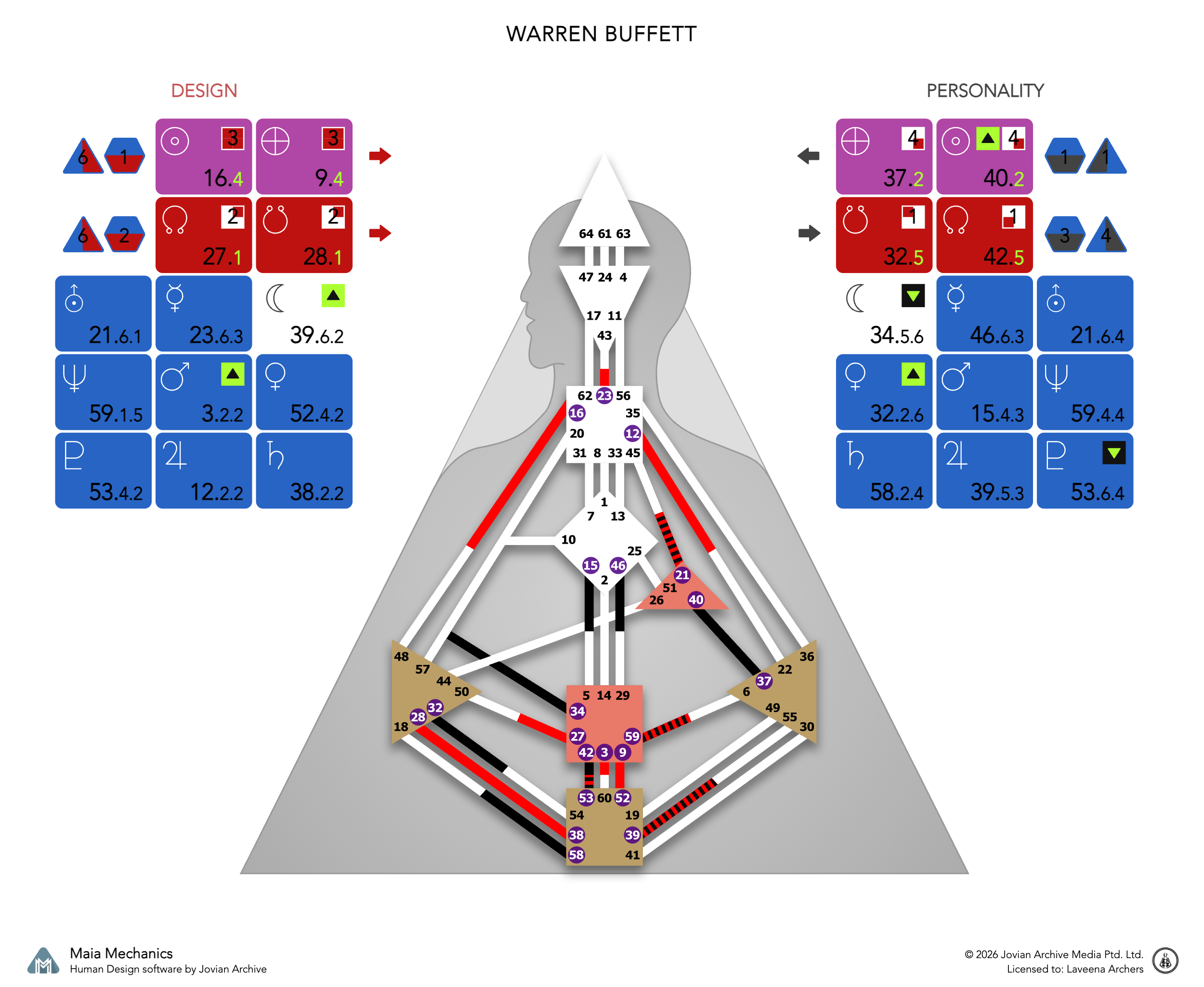
Chart calculated with Maia Mechanics, from an A-rated birth record
Quick look: Warren Buffett is a Generator with Solar Plexus (Emotional) Authority, which means there is no truth for him in the moment, only clarity that arrives across a wave of time. Most of his biography is a study in extraordinary patience: years of research before large commitments, decades of the same handful of relationships doing the heavy lifting. But there is one well-documented exception, and it is instructive precisely because it breaks the pattern. In the spring of 1965, over an eighth of a point on a stock tender, Buffett bought his way into control of a failing New England textile mill called Berkshire Hathaway. He has since called it one of the worst decisions of his career. Read against his design, it looks less like a strategic misstep and more like exactly what happens to Solar Plexus Authority when a decision gets made from the spike of the wave instead of after it passes.
The deal that was already a deal
By the early 1960s, Buffett’s investment partnership had been quietly accumulating shares of Berkshire Hathaway, a struggling textile manufacturer, as a classic Benjamin Graham value play: a company trading for less than its working capital was worth, regardless of how unglamorous the underlying business was. Berkshire’s president, Seabury Stanton, had been closing unprofitable mills and using the proceeds to buy back stock, and in 1964 he approached Buffett about tendering the partnership’s roughly seven percent stake.
The two men settled on a price of $11.50 a share in conversation. Then the written tender offer arrived at $11.375, an eighth of a point lower, worth something on the order of a few thousand dollars less to Buffett’s position. Buffett has said the discrepancy annoyed him. Rather than tender at the reduced price, he did the opposite: he started buying more Berkshire stock in the open market, and by the spring of 1965 he had accumulated enough to take control of the company and remove Stanton.
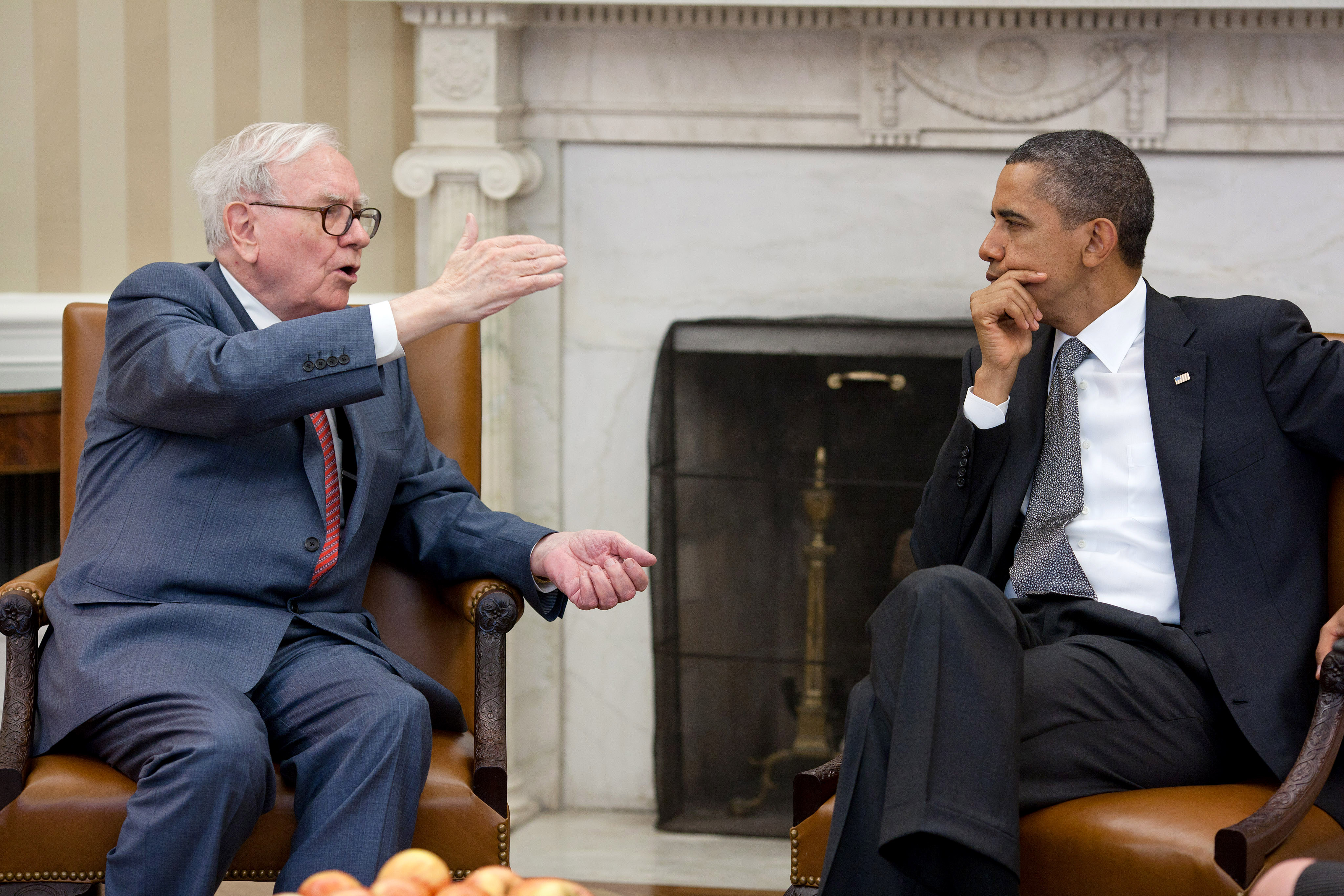 Warren Buffett in the Oval Office, 18 July 2011, the year he received the Presidential Medal of Freedom. Official White House photo by Pete Souza, public domain.
What decided from the spike looks like
I teach Solar Plexus Authority specifically around what the two extremes of the wave do to a decision. “When you’re high happy happy everything’s great, you’re gonna make a yes choice that you’re going to regret later, because you didn’t see all the downs.” The instruction that follows is equally direct: “wait for calm confidence clarity, not excitement… don’t make a choice when you’re dysregulated.” Elsewhere I frame the same authority through the image of water: “when you’re feeling good, everything looks better. When you’re feeling bad, everything looks worse. You can only reach a sense of clarity over time as the waters, your emotional waves, keep on moving.” The rule I give for both ends of that wave is the same: sleep on it, let the pressure subside, and only choose from the middle, once you’ve already been up and down on the thing in question.
The Berkshire tender is a clean violation of that rule, and Buffett has effectively confirmed it himself. He was not high with excitement over the deal; he was annoyed, insulted, provoked by what he read as Stanton chiseling him for an amount that, by his own later account, was trivial against the size of his position. That is a spike, just the irritated end of it rather than the euphoric one, and I treat both ends the same way: neither is where the correct decision lives. Instead of letting the irritation pass and asking, days or weeks later, whether owning a controlling stake in a contracting textile mill served him at all, Buffett acted directly out of the provocation. He bought control on the strength of the feeling, not after it.
The outcome matches what the mechanic predicts. Buffett has been unusually candid that the purchase was a mistake, describing it decades later as a “monumentally stupid decision,” and that the New England textile business he took control of was already heading into terminal decline. He would go on to build one of the most successful holding companies in history using the Berkshire name and its cash flows, but the textile operation itself was not the vehicle for that; it was wound down years later. The company’s later greatness came from what Buffett built on top of the shell, not from the decision that put him in the shell in the first place.
*Buffett telling the Berkshire story himself, at a 2001 University of Georgia talk.*What Buffett looks like when he isn’t rushed
The reason this episode is worth naming is that it is the exception, not the rule, and the contrast is instructive. Buffett’s more characteristic decisions, the ones that built his reputation, look nothing like the Berkshire takeover. His investigation of American Express in 1963 and 1964, during the “salad oil scandal” that had driven the company’s stock down on fears of a massive commodities fraud, involved months of Buffett personally checking whether ordinary customers were still using their American Express cards and travelers cheques before he committed a large share of his partnership’s capital to the stock. That is a Generator’s Solar Plexus process working the way I teach it: waiting out the wave, gathering more information across time, and only moving once the nervousness has settled on its own rather than been argued down by the mind. Buffett’s entire investment method, holding positions for years, reading annual reports for months before acting, declining far more opportunities than he accepts, is patience institutionalized. The Berkshire takeover stands out precisely because it is the one well-known instance where the record shows him doing the opposite of what his own authority requires, and even Buffett himself has said as much.
The foundation and the network: Graham and Munger
Buffett’s chart carries Split Definition, meaning the centers that are consistently defined in him do not all connect into one continuous shape. They form separate islands that need a bridge, either a transiting gate or another person’s chart, to run as a whole. My teaching on split definition describes exactly what a bridge supplies: “the ideal partnership for the right partner to guide their energy,” closing what would otherwise be “two islands of definition.” Where that bridge is present, the system runs; where it is absent, I’m blunt about the trap, that the mind either blames itself for what feels missing or, across a wider gap, becomes “so bitter about others… you blame them,” when the more accurate read is “a mechanical truth that some people are not aligned to interact with.” None of this claims any specific gate in Buffett’s chart is bridged by any specific person’s chart; that comparison would require both charts calculated side by side, which is outside what’s established here. What is well documented is that Buffett’s investing life was never a solitary operation, and two relationships in particular carried structural weight across decades.
The first was Benjamin Graham, under whom Buffett studied at Columbia and later worked directly at Graham-Newman in New York, absorbing the value-investing discipline that became the foundation of everything Buffett did afterward, including the reasoning that first pointed him at Berkshire’s stock. The second was Charlie Munger, whom Buffett met in 1959 at a dinner in Omaha arranged by mutual friends who had been trying to introduce the two men for two years. The friendship became a decades-long working partnership that pushed Buffett’s own investing philosophy well past what Graham had taught him, toward paying up for quality businesses rather than only hunting for statistically cheap ones. Both relationships arrived through a small, close, personal network rather than a market search: Graham through formal study Buffett actively sought out, Munger through a dinner table connection two family friends had been engineering on purpose.
*Buffett on the Munger partnership, in his own words.*A 2/4 Profile: build the foundation privately, then wait for the call
Buffett’s 2/4 Profile is what I call the Hermit-Opportunist combination. The first line of it needs real preparation before stepping out: “for you as a second line, education is essential, as in preparedness… so that when you do get called out, you don’t collapse and become ineffective.” The fourth line half is about a fixed, personal network rather than public visibility: “your skill here is about investment in people… you’ve got to develop a solid network of people who know you, trust you, like you,” and crucially, the opportunities that matter for a 2/4 arrive through that network rather than through initiating out into the world: “no other profile gets more attention from your network… because they come to you more than any other profile.”
Buffett’s biography tracks both halves closely enough to be worth naming. The Hermit half shows up as the years of quiet, private study under Graham before he ever ran significant capital of his own, the kind of foundational preparation the profile requires before a call can be answered well. The Opportunist half shows up as the fact that Buffett’s two most consequential relationships, the mentor who gave him a method and the partner who spent decades pushing that method further, both arrived through direct, personal introduction rather than a public search process. Graham was a professor Buffett sought out; Munger was a dinner-table connection two friends spent two years engineering. Neither showed up as a cold deal or a public announcement. That is close to the shape the 2/4 predicts: build genuine expertise in private first, and let the calls that matter come through the small circle of people who actually know you.
Four returns, checked against the record
A natal chart is only the starting point. Certain planets return to the exact degree they held at birth on a schedule that’s fixed and calculable decades out, and these returns matter more than the rest: the Saturn Return, the Uranus Opposition, the Chiron Return, and, for a long enough life, a second Saturn Return roughly thirty years after the first. Each one is a structural turn. Layer the transit chart for that date over the natal chart underneath, and Buffett’s line up against something specific and dated in the public record.
Saturn Return: March 1, 1959
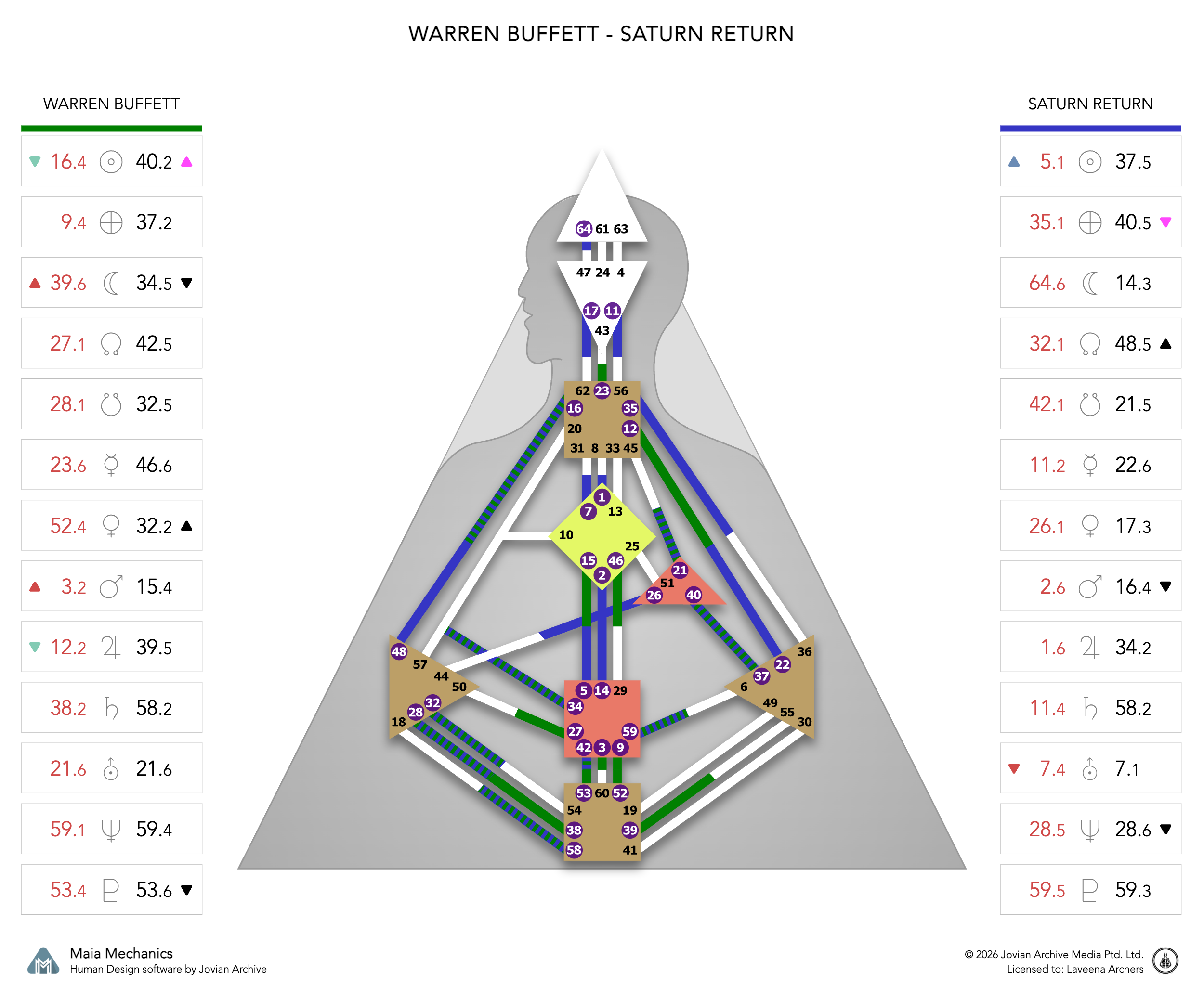 Warren Buffett’s Saturn Return transit chart, age 28, via Maia Mechanics.
Buffett’s Saturn Return fell on March 1, 1959, the same year a mutual introduction in Omaha put him across a dinner table from Charlie Munger for the first time. A Saturn Return is a structural accounting, the point where whatever’s been built gets tested against reality and either holds or doesn’t. Buffett’s investment partnership, formed in 1956, was three years into proving itself when Saturn returned to its natal degree, and within that same year the relationship arrived that would end up supplying what Buffett’s own Split Definition chart runs on structurally: a bridge. Munger became the partner who pushed Buffett’s method past what Ben Graham alone had taught him, and that shift, from statistically cheap assets toward paying for quality, started with a dinner that happened to land inside the calendar year of Buffett’s own structural reckoning.
Uranus Opposition: October 20, 1971
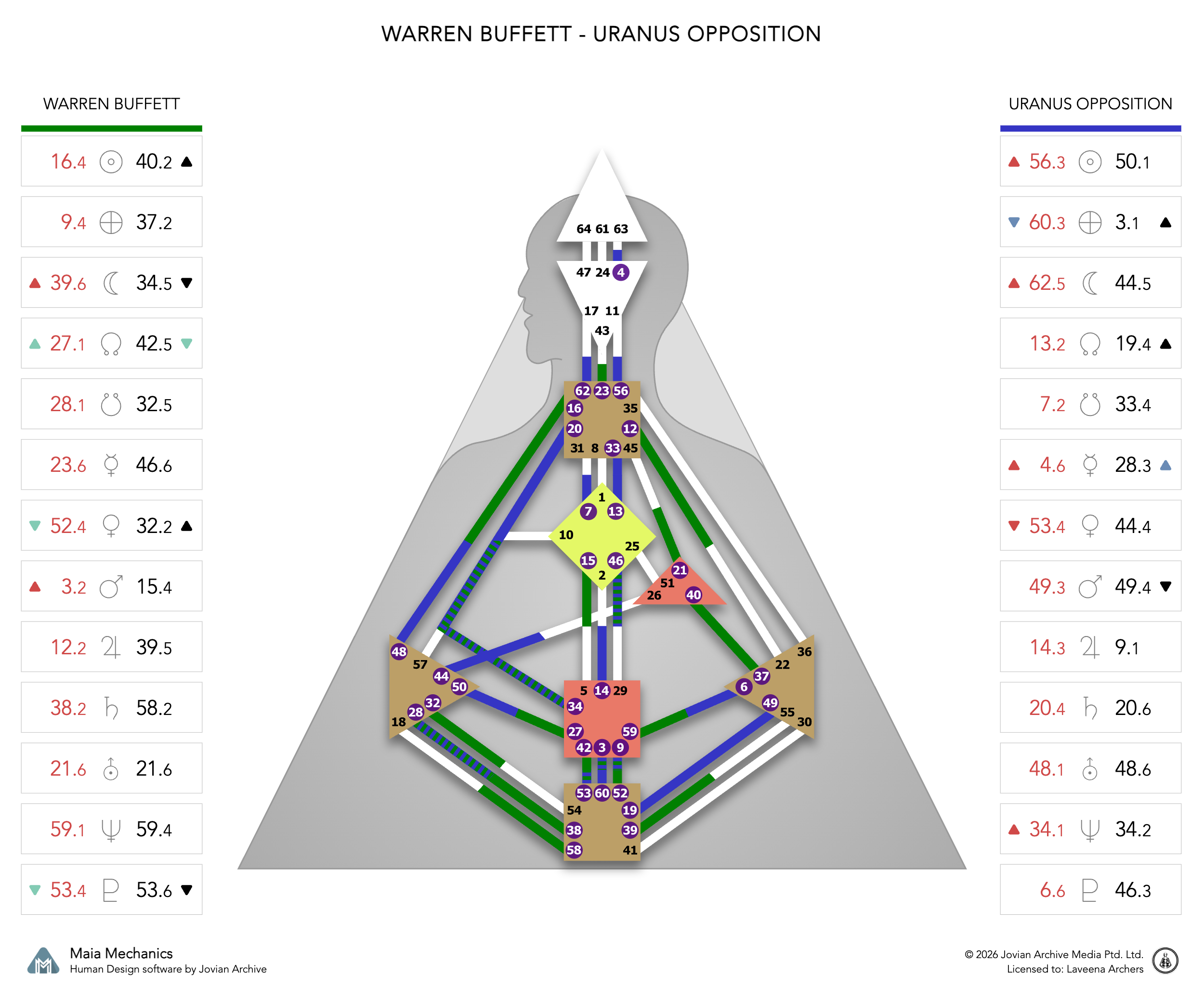 Warren Buffett’s Uranus Opposition transit chart, age 41, via Maia Mechanics.
Buffett’s Uranus Opposition fell on October 20, 1971, squarely inside the negotiation that closed that winter: Buffett and Munger’s purchase of See’s Candies, agreed in the late months of 1971 and completed in January 1972 for $25 million. A Uranus Opposition is a break from an established pattern, the point where the built structure gets pushed toward something it wasn’t previously built to hold. Everything about See’s ran against the Graham-style discipline that had built Buffett’s reputation: instead of a statistically cheap asset trading below its liquidation value, See’s was a well-run, premium candy business priced above its book value, exactly the kind of purchase Graham’s rules would have rejected. Munger argued for it anyway, and Buffett, negotiating right through the weeks his own chart opposed its natal placement, held at his own number and bought his first real lesson in paying up for a wonderful business rather than hunting for a wonderful price.
Chiron Return: May 21, 1981
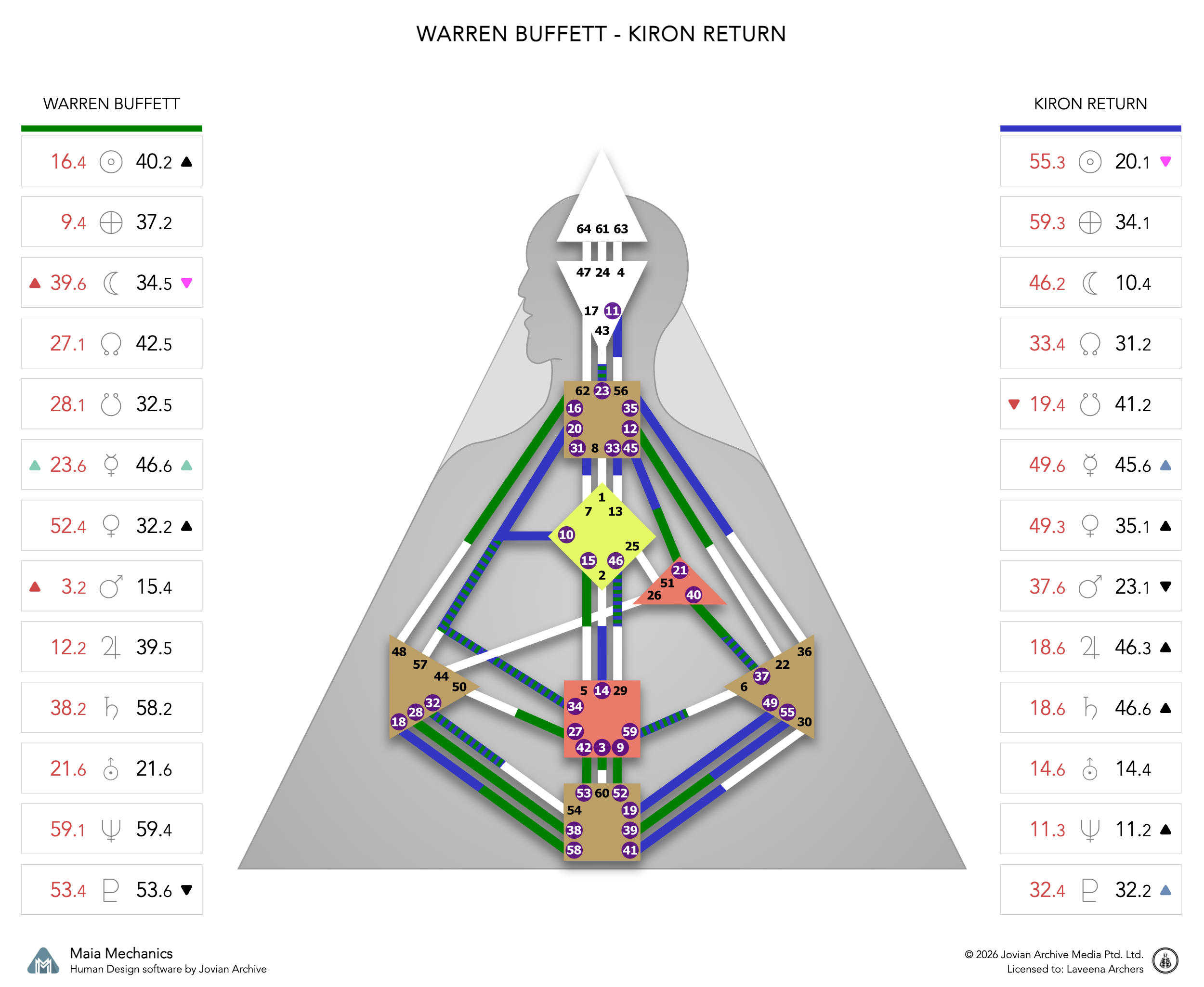 Warren Buffett’s Chiron Return transit chart, age 50, via Maia Mechanics.
Buffett’s Chiron Return fell on May 21, 1981, the same year Berkshire replaced what Buffett called “ordinary corporate practice” in charitable giving with something built to fix exactly what bothered him about it. That fall, after Berkshire received a favorable tax ruling from the Treasury Department on September 30, Buffett wrote to shareholders on October 14 laying out a new shareholder-designated contributions program, an idea Munger had conceived, that let individual shareholders name the charities Berkshire’s corporate dollars would go to. Buffett’s own stated complaint about standard practice was pointed: gifts, he wrote, tend to get made “based more on who does the asking and how corporate peers are responding than on an objective evaluation of the donee’s activities.” Chiron’s mythology is the wound turned into medicine, and a program built, in the same year as Buffett’s own Chiron Return, specifically to correct a practice he considered dishonest is as direct a version of that mechanic as a corporate record offers. The program launched to what Berkshire’s own materials called “extraordinary enthusiasm,” with more than 95 percent of eligible shares participating in its first year.
Second Saturn Return: 1988
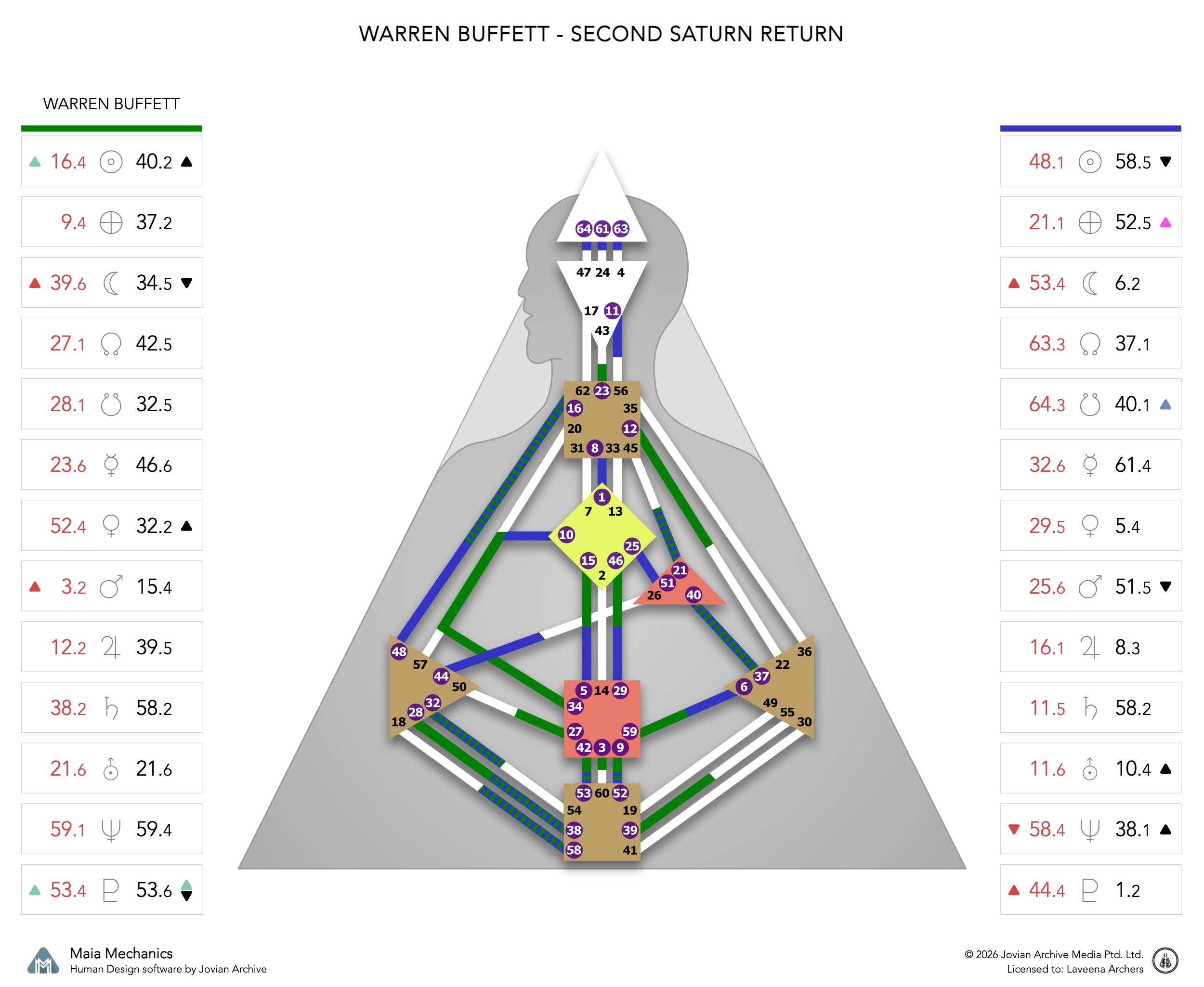 Warren Buffett’s second Saturn Return transit chart, age 57, via Maia Mechanics.
Saturn’s orbit is roughly twenty-nine and a half years, so it comes back around to its natal degree twice in a life this long: once near 29, and again near 58, a second structural accounting rather than a first one. Buffett’s fell in 1988, at 57, the same year he did something he’d spent decades declining to do. Every purchase covered so far in this piece, Berkshire itself, American Express, See’s Candies, ran on the same Graham-rooted logic: buy assets for meaningfully less than they were worth, on the numbers. In the summer of 1988, Buffett had Berkshire start buying shares of The Coca-Cola Company, a business trading at what value investors of the old school would have called a rich multiple, on the strength of a brand and a moat rather than a statistical discount. By the time the buying was done the following year, Berkshire had put over a billion dollars into a single consumer stock, the largest position it had ever taken. A first Saturn Return tests whether a structure holds. A second one, arriving this late, tests whether the builder can still change the structure’s own rules when the evidence calls for it. Buffett had spent a first Saturn Return proving the Graham method could work at scale, with Munger’s help. He spent the second one proving he wasn’t permanently bound to it.
The setting the business actually ran in
Group size is its own mechanic in Human Design for Business, separate from any individual’s chart: Solo, Partnership, a Penta of three to five with its own leadership seats, and an OC16 of ten to sixteen and beyond, where a larger structure I teach as the Wa starts conditioning everyone inside it. None of that requires anyone else’s chart to notice. It’s just a question of how many people the business actually ran on, and when.
Buffett Associates, Ltd., formed on May 1, 1956, had eight people attached to it from the start: Buffett as general partner and seven limited partners, family and close friends who supplied the capital. By headcount alone that’s already inside OC16 range, but not in the way the term usually implies. The seven partners were investors, not operators; Buffett ran the actual analysis and decision-making alone, which means the group’s real working size, the people doing the day-to-day thinking, was one.
What Berkshire became is the more interesting structural fact, and it runs against the instinct almost every large company follows. Berkshire’s own workforce now runs past 380,000 people across its subsidiaries, and the corporate headquarters that sits above all of it in Omaha employs fewer than 30. Buffett never built the giant centralized Wa a company that size would normally require. He kept the center at something close to Penta scale and let every subsidiary, See’s, Geico, the railroads, run as its own independent unit answering to its own management, not folded into one integrated head office. The eighth of a point that started this piece was a decision made almost entirely alone. The company built on top of it is, by design, thousands of small operating units that were never centralized into one at all.
Where this reading stops
None of this says Human Design explains why Buffett became one of the most successful investors in history, or that his chart made the Berkshire decision inevitable. Plenty of Emotional Generators make plenty of decisions from the middle of the wave and never build anything close to what he built. What the chart offers is a mechanic: Solar Plexus Authority has no truth in the now, only clarity after the wave passes. An unusually well-documented case of following that discipline (American Express) and an unusually well-documented case of breaking it (Berkshire Hathaway) both sit inside one investor’s public record, close enough to the predicted shape to lay out side by side rather than fold into a generic story about genius.
Where the actual profit was: his open centers
Split Definition, covered above, is about which of Buffett’s defined centers connect to each other. It isn’t the same question as which centers are open at all, and that second question gets skipped far more often than it should. Four of Buffett’s nine centers carry no definition: Head, Ajna, Throat, and G. My own model of profit centers argues the real commercial edge tends to sit there, not in the defined centers everyone points to, because an open center has no fixed way of running. It takes in whatever the moment hands it, cycles through every version of that pressure over a lifetime, and eventually turns the exposure into a kind of pattern recognition a person with a defined center in the same spot never needs to develop, because theirs already has one setting. Read Buffett’s record against those four centers instead of just his Sacral, and a second pattern shows up underneath the wave he’s famous for waiting out.
Head. An open Head takes in a mental question without ever settling it once and being done. Buffett first raised the question of who succeeds him as CEO in his 2006 shareholder letter, then kept re-answering it in public for the better part of two decades, naming Greg Abel in 2021 and still returning to the question in his final letter as chairman on November 10, 2025, writing that he couldn’t think of anyone he’d pick over Abel. Nineteen years is a long time to keep the same question open in public rather than closing it with one clean, early answer.
Ajna. An open Ajna has no fixed way of reasoning something through, which is a liability until it becomes the reason a person can reclassify something that technically breaks their own rule. Buffett spent decades stating plainly that he didn’t buy technology stocks, and sat out the entire 1990s boom on that basis. Starting in early 2016, Berkshire began buying Apple anyway, and by the following year held more than six billion dollars of it. Asked about the apparent contradiction on CNBC’s Squawk Box on February 27, 2017, he didn’t defend the old rule or quietly abandon it. He reframed the company: “Apple strikes me as having quite a sticky product,” a consumer-products read, not a technology one, and the rule stayed intact because the category underneath it had moved.
Throat. An open Throat has no fixed voice and no standing need to be seen, only whatever the moment actually calls for. Berkshire’s annual shareholder meeting opens every year with a comedy film the company produces itself and keeps out of general circulation. In 2013, that film cast Buffett and Munger in a “Breaking Bad” parody with Bryan Cranston and Aaron Paul, playing a rival candy man contesting the two chemists’ peanut-brittle operation, a nod to Berkshire’s own ownership of See’s. It’s a register Buffett never uses in a shareholder letter or a CNBC interview, deployed exactly once a year for an audience that already knows the real him, then put away again.
G Center. An open G Center has no fixed identity of its own, and Buffett’s most famous one wasn’t self-applied. “Oracle of Omaha” traces to financial journalism, not to Buffett; Fortune’s Allan Sloan has said he likely coined it in a June 1985 Forbes piece, calling the phrase an unconscious, alliterative habit of his own writing rather than a title Buffett cultivated. A name a reporter reaches for without thinking, and a public identity spends the next four decades wearing, is what an open G Center does with whatever gets projected onto it.
Four open centers, four different products, and not one of them is the Sacral yes-or-no everyone reaches for first. That’s the pattern under the pattern: the places Buffett had no fixed position of his own are where the actual edge kept showing up.
Related
Curious what your own chart looks like? Get your own natal chart, Saturn Return, Uranus Opposition, and Chiron Return, rendered the same way, plus the full keynote PDF, for $37.
- Leadership Is Alignment to Your Own Authority — what it looks like to run decisions through real Authority instead of a boardroom’s preferred process
- Partnership: Why Two-Person Businesses Work or Fail — the mechanics behind choosing a structural partner well
- Dolly Parton, Human Design, and the Business Built on a Single No — another Generator’s design read against a specific, dated decision
Chart calculated with Maia Mechanics software. Birth data (30 August 1930, 3:00 PM, Omaha, Nebraska) and an “A” reliability rating, from memory or autobiography, are recorded on Astro-Databank via Astrotheme, contributed by Paul Hewitt. The Berkshire Hathaway tender-offer episode, the American Express investigation, the Graham and Munger relationships, and the 1988 Coca-Cola purchase are part of the widely documented public record of Buffett’s career; exact dollar figures and the precise private wording exchanged with Seabury Stanton vary slightly by account and are presented here in general terms rather than as settled quote-level history. The 1956 partnership’s structure and Berkshire’s famously small corporate headquarters staff are likewise part of the public record, drawn from Buffett’s own partnership letters and contemporary business press.
Dr. LaVeena B. Archers has spent more than thirty years as an entrepreneur and teaches the career and business application of the Human Design System. She helps business owners and entrepreneurs market themselves in a way that fits their design, lead their teams to greater efficiency and profitability, and find the work their chart was actually built for.